

A marketplace is not just a filter. It is a separate Amazon account, reporting in its own currency, with its own listings, its own competitors and its own search behaviour — and TrackIQ keeps them separate for good reason.
Prefer to watch? Ninety-nine seconds on why there is no combined total, and which figures survive a border.
Marketplace sits below brand
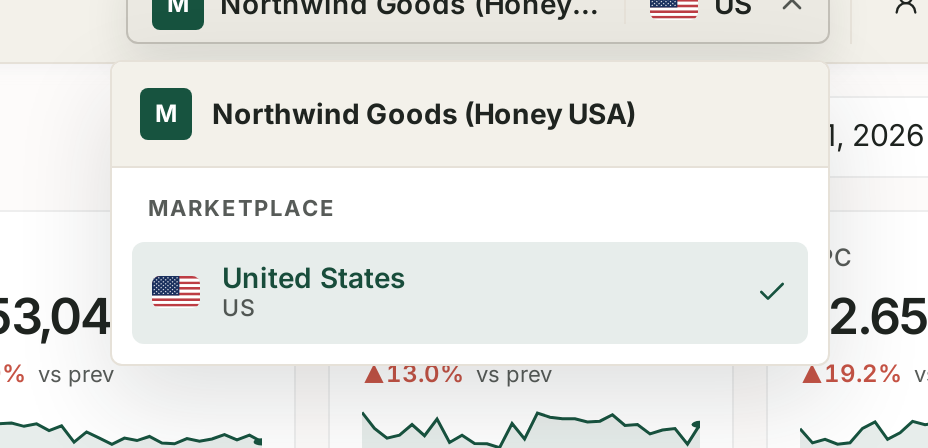
The top-bar picker has the brand at the top and a MARKETPLACE section beneath it, each entry showing the country name, its two-letter code, and a checkmark on the active one.
So the hierarchy is:
Workspace → Brand → Marketplace → the data you are looking at.
A brand's marketplace list is its own, which is why the list changes when you switch brand. See Switching Brands and Choosing a Marketplace.
Each marketplace carries its own currency
This is the fact that matters most for reporting.
Every marketplace connection records a currency alongside its country and account type — a US connection reports in USD, a Mexican one in MXN, a UK one in GBP, and so on. Amazon reports each marketplace in local currency, and TrackIQ reports what Amazon reports.
Three consequences:
The currency symbol on screen follows the marketplace, not a workspace preference.
Figures from two marketplaces are in different units. A spend of 20,000 means something very different in two currencies.
There is no conversion and no combined total. TrackIQ does not present a cross-marketplace sum, because summing unconverted currencies would be wrong and converting them needs a rate and a date that are your decision, not the tool's.
Never add across marketplaces
The single most damaging habit available on this screen.
Adding USD to MXN produces a number that is not money. It looks like a total and means nothing.
Averaging ACoS across marketplaces is equally wrong. A ratio of two currencies is dimensionless, so ACoS is comparable — but an unweighted average of two ACoS figures is not a portfolio ACoS. Weight by spend, in a common currency, or do not do it.
If you need a group figure, convert each marketplace at a stated rate and date, do the arithmetic outside TrackIQ, and say what rate you used. That is a finance exercise, not a reporting one.
What is comparable across marketplaces
Ratios and rates travel; absolute money does not.
| Comparable | Not comparable |
|---|---|
| ACoS, TACoS, ROAS | spend, sales, CPC |
| CTR, conversion rate | AOV |
| impression / click / cart / purchase share | search volume |
| rank and visibility | units, if pack sizes differ |
Even the comparable ones deserve caution. A 30% ACoS in a mature marketplace and a 30% ACoS in one you launched last quarter are the same number describing different situations.
Each marketplace is a separate connection
A common misunderstanding when a marketplace does not appear.
Authorising your US seller account does not grant Canada or Mexico. Each is its own authorisation, even within the same Amazon regional group.
Each marketplace also has its own Ads, DSP and AMC grants, so a marketplace can be present with SP data and missing its advertising data entirely. Check the source chips on the account card in Connections. See Managing Your Connected Accounts.
Account type comes with the connection too
Each marketplace connection also records whether it is a Seller, Vendor or KDP account, and that changes what is reported — sellers identify products by SKU, vendors by ASIN.
So one brand can hold both a Seller and a Vendor connection for the same country, and they will not look alike. See Seller vs Vendor Accounts: What Changes in TrackIQ.
Working across marketplaces sensibly
Do the work marketplace by marketplace. Rules, budgets, keywords and rank projects all belong to one.
Compare on rates, report in local currency, and state the marketplace next to every figure.
Expect different search behaviour. The same product sells on different queries in different countries, so SQP and Rank Tracker findings do not transfer. Re-run the analysis rather than assuming.
Watch inventory separately. Stock is held per marketplace, and a healthy US position tells you nothing about the UK.
Related
- Switching Brands and Choosing a Marketplace — the control.
- Managing Multiple Brands — the level above.
- Seller vs Vendor Accounts: What Changes in TrackIQ — the other axis of a connection.
- Why Don't My Numbers Match Seller Central? — when a single marketplace disagrees.
- Narrowing Fifteen Ideas to Seven — checking demand across marketplaces before committing.