

Before you build a single campaign, decide what you are willing to spend per day on this product. Everything downstream depends on it — how many campaigns you run, how many keywords you can afford to target, and how fast you can buy the data that tells you what is working.
A bigger starting budget is genuinely better, because it buys data faster and gives you room to push the campaigns that matter and starve the ones that do not.
But there is one hard constraint: your inventory.
Prefer to watch? One hundred and fifty-two seconds on working out whether inventory constrains you, converting cover into a daily budget, and tapering in the right order.
First, is inventory a constraint?
Compare units on hand against your current daily sales.
10 units a day and 500 in stock — that is 50 days of cover. Inventory is a constraint.
10 units a day and 5,000 in stock — 500 days. It is not.
And factor in lead time. Manufacturing domestically with under 30 days of lead time is a different problem from 90 days of ocean freight from Asia — see Inventory Forecasting and Purchase Orders.
This single question decides which of the two paths below you are on.
Path A: inventory is not a constraint
Pick a daily budget per product that you are comfortable with. $100/day or more is the recommendation.
Hold it flat for 30 days. Changing the budget weekly makes the result unreadable.
Then one of two things has happened:
Sales went up. Good — now adjust the budget per product based on what each one returned.
Sales stayed flat. That is a conversion problem, not a budget problem. More spend on a listing that does not convert buys more of the same result. Look at price first — see Pricing and Gross Margin.
Path B: inventory is a constraint
Here you deliberately do not sell as many units as you can.
1,000 units with a 90-day manufacturing lead time means pushing for 30 sales a day empties you in a month — and then you are out of stock, which costs rank, costs the momentum you just paid for, and takes months to recover. See Going Out of Stock.
So work backwards from cover, not forwards from ambition.
The calculation
Maximum sustainable daily sales = units on hand ÷ days of cover you need.
1,000 units ÷ 90 days = 11 units a day.
Then convert that into a budget. The daily spend you can afford is the gap between your gross margin before PPC and your target margin, applied across those units:
Daily PPC budget = max daily sales × price × (gross margin before PPC − target margin)
Your gross margin before PPC comes from your pricing table — see Where Your Margin Actually Goes.
If that number comes out below $100/day, use $100 anyway as a minimum for the next 30 days, or until you hit your maximum sustainable daily sales. Below that, campaigns take too long to accumulate readable data.
Then taper, in the right order
Watch the 4–7 day average, not a single day.
1,500 units, 90-day lead time, calculator says 17 units a day is your ceiling.
Start at $100/day.
When the 7-day average reaches 15–20 units, start easing off.
And do it in this order:
1. If you cut price for the launch, raise it back first — roughly $1 a week.
2. Then reduce the PPC budget.
Price first, because a price rise improves margin on every unit while a budget cut only reduces spend. Doing it the other way round leaves you selling at a launch price you no longer need.
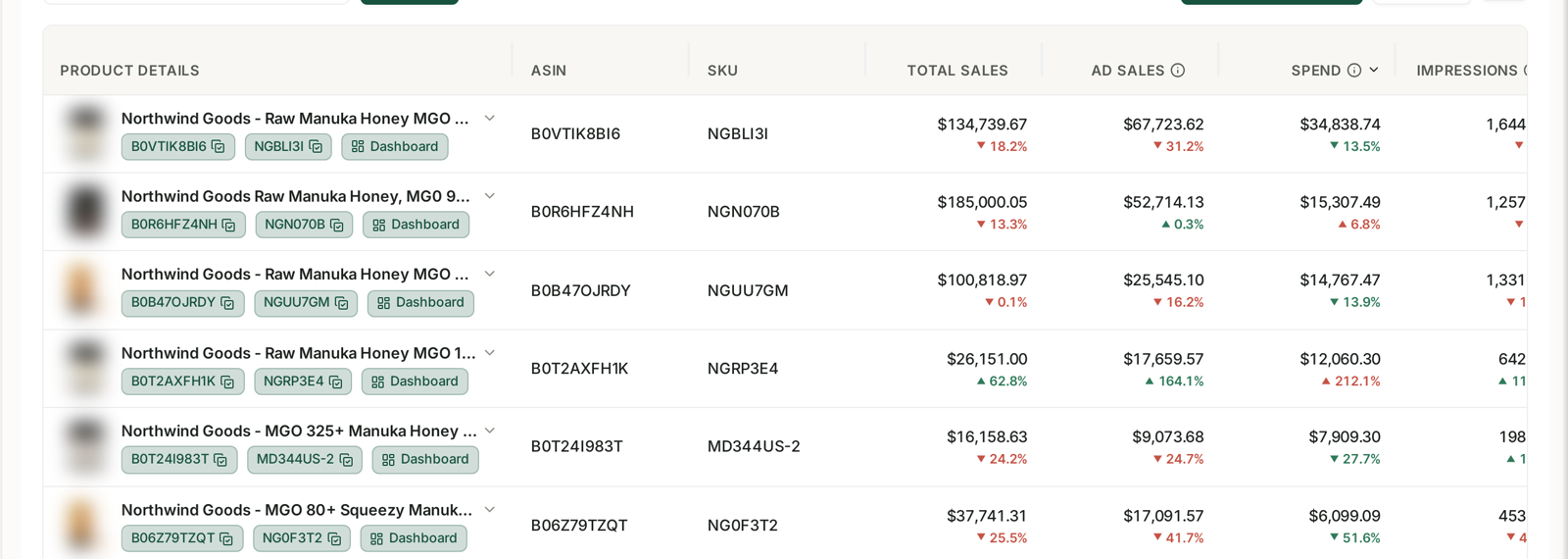
Tracking daily run-rate against remaining cover per product is the check that tells you when to taper — see Monitoring Inventory Against Sales. Doing it by exporting inventory and sales reports and reconciling them by hand is how the taper gets missed until you are already out of stock.
The point you are steering toward
When sales stabilise at your sustainable ceiling and the budget is coming down, that is the moment the product starts making real money.
It is also the moment to place the next inventory order — because the constraint that shaped this entire plan is the thing you are now in a position to remove.
Common mistakes
Deciding the budget after building the campaigns, so the structure does not fit the money.
Ignoring inventory, and buying sales you cannot supply.
Starting too small. A thin budget spreads across campaigns so slowly that nothing produces readable data.
Changing the budget weekly in the first 30 days, and never learning what it did.
Treating flat sales as a budget problem when it is a conversion problem.
Cutting spend before raising price on a product you discounted for launch.
Waiting until stock is nearly gone to place the reorder.
Related
- Preparing a Launch — what this budget funds.
- Setting Target TACOS per Product — the efficiency target the budget runs against.
- Monitoring Inventory Against Sales — the signal that tells you to taper.