

A token is the standard unit AI systems use to measure text — roughly a word or a fragment of one. Every AI product in existence counts them internally, which is why the word turns up in pricing conversations.
Here is the part that matters to you: TrackIQ does not cap your token usage, on any plan. There is no monthly allowance, no meter running against you, and nothing to top up.
Prefer to watch? Sixty-nine seconds on why there is no allowance to manage.
Why there is no limit
This is a deliberate consequence of how TrackIQ is priced.
Above your first $1.5M in trailing twelve-month average revenue, you pay a small percentage of revenue — falling as you grow, capped at 0.5%. See How Revenue-Based Pricing Works.
That component already scales with the size of your business, and a larger business naturally asks more questions. So the pricing already accounts for heavier usage, which removes the need to meter it separately.
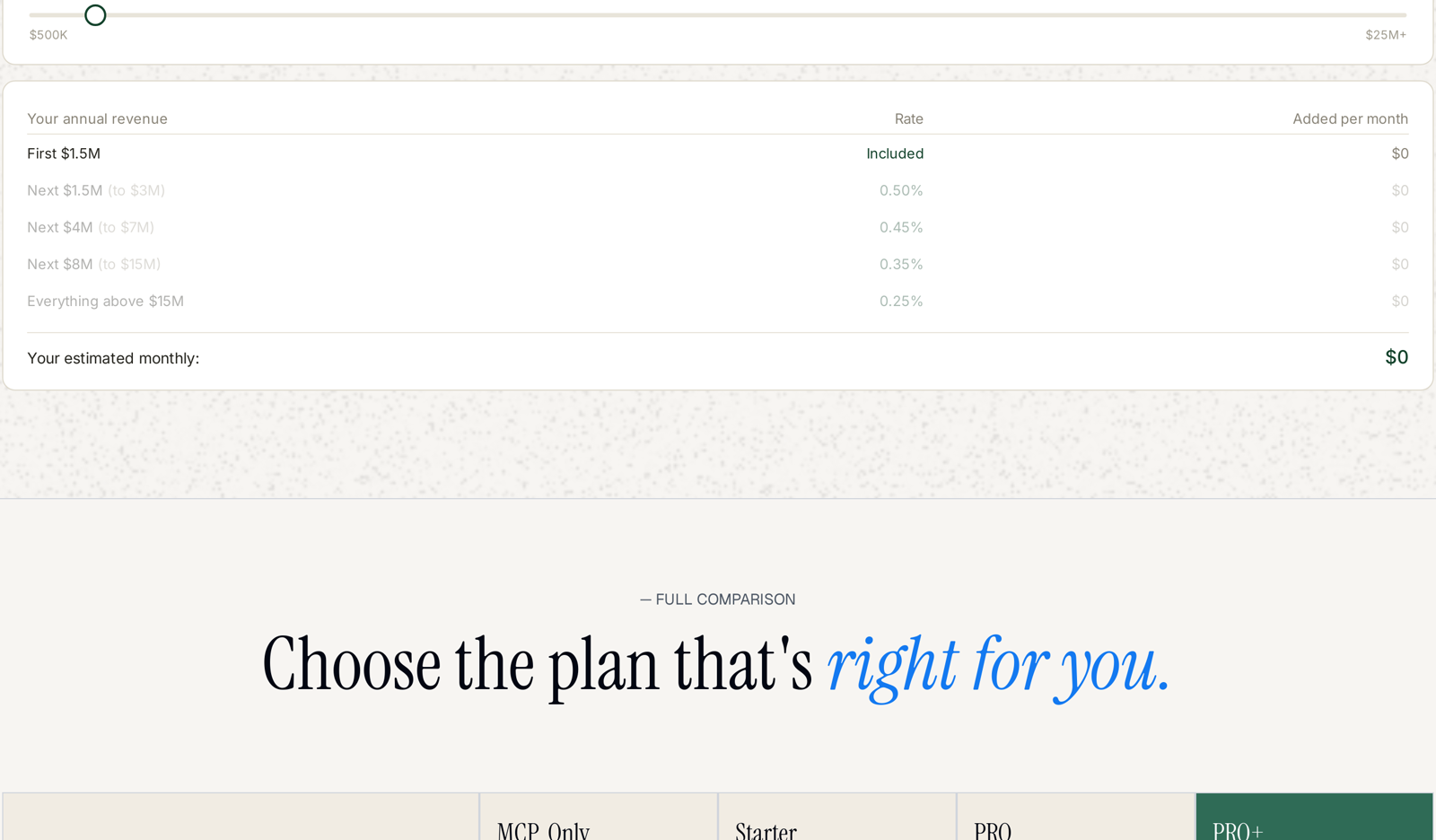
Usage-based AI pricing exists to stop heavy users costing more than they pay. Revenue-based pricing solves the same problem from the other end — and it has the considerable advantage of being predictable, because your bill does not change based on how curious your team was this month.
What this means in practice
Ask Aria as much as you like. There is no budget to preserve and no reason to ration questions across a team.
Roll it out to everyone. A colleague who asks a lot of questions is not costing you anything extra. Ask a follow-up rather than trying to get it right first time.
Let the automation run. AI Insights, generated report sections and Role-based AI Agents all work continuously without drawing down anything.
Use MCP freely. An assistant querying through MCP all day is not metered either. See What Is MCP, and Why It Matters.
The practical upshot is that usage is never the reason to hold back. If a question is worth asking, ask it.
So what should you optimise for?
Not cost — quality. The advice that used to be framed as “spend fewer tokens” is still good advice, for an entirely different reason: specific questions get better answers.
Name the period and the brand. Ambiguity produces a summary where you wanted a number.
Ask one thing at a time. Three questions bundled together get you a description of all three rather than an answer to any.
Say what you would do with it. “Which campaigns should I cut budget on?” returns a ranked list with reasons. “How is my advertising?” returns prose.
Pin what you re-read. A question you ask every Monday belongs in a Studio or a scheduled Business Report — not because repeating it costs anything, but because a pinned view is there when you open it and consistent week to week.
Monitor with alerts and rules, not questions. Alerts run whether you ask or not, and Rule-Based Optimization acts the moment a threshold is crossed rather than the next time somebody remembers to check. That is a better outcome, not a cheaper one.
What does differ by plan
Not usage — features. Aria is on Starter and above; Role-based AI Agents are PRO+ only; Search Query Performance, DSP and AMC start at PRO.
So the question is never “can I afford to ask?” but “is the data I want to ask about included on my plan?”
See What's Included in Each Plan.
Related
- Are There Token Limits or Usage Caps? — the short version of this article.
- How Revenue-Based Pricing Works — what you actually pay for.
- What Aria Can and Cannot Answer — the real boundary, which is scope rather than volume.