

Optimising a badly structured account is like tuning an engine with a part missing. You can spend months adjusting bids on campaigns that were never going to give you a clean answer, because the structure itself makes the data unreadable.
So before any of the optimisation routines, there is a foundation pass: work out what campaigns you have, what you are missing, and whether the ones you have can be read at all.
Prefer to watch? One hundred seconds on the structural rule that makes every downstream report trustworthy, the campaigns you are probably missing, and the launch check almost nobody does.
The structural rules
Two rules, and the first is not negotiable.
One parent ASIN per campaign. This is the rule that matters. A campaign advertising several parent ASINs produces numbers that cannot be attributed to any one product, so you can never tell which product the spend was working for. Every report downstream inherits that ambiguity.
One child ASIN per campaign, where practical. Recommended rather than required. Variations often differ enough in price and conversion that averaging them hides the truth.
Group every campaign for a parent ASIN under one portfolio. This is what makes product-level budget management possible at all.
If your account breaks the first rule, fix that before anything else. Nothing downstream is trustworthy until you do.
Get the listing SEO-ready first
Advertising and organic search are not separate systems, and a campaign pointed at a listing that does not mention the keyword will underperform for reasons no bid can fix.
Before launching campaigns, for each product:
Identify the top 3–5 keywords by search volume and relevance, and get them into the title.
Identify the top 10–15 keywords, and make sure each appears at least once in the title, bullets or description.
Put everything else in the back-end search terms.
One caution on titles. A title change affects organic ranking and conversion as well as advertising, and a bad one can undo months of progress. Change titles deliberately, one at a time, with a before-and-after to measure against.
The campaigns every product should have
Once the structure is clean, the question is what is missing.
| Campaign type | What it is for |
|---|---|
| Exact match | proven keywords, high exposure, ranking pressure |
| Broad or phrase | research and profit — finding new search terms |
| Auto | discovery of terms closely tied to the listing |
| Product targeting (PAT) | competitor ASINs where you convert well |
| Single-keyword exact | your biggest keyword, isolated for maximum control |
| Easy wins | simple campaigns that reliably turn a profit |
The single-keyword campaign is the one people skip. Isolating your largest keyword into its own campaign gives you budget and bid control over the term that matters most, instead of letting it compete for budget with thirty others.
On product targeting, aim at two kinds of ASIN: the best-sellers in your niche, and weaker competitors — higher priced, fewer reviews, poorer listings — where you compare well.
Naming, so the account reads itself
In six months the campaign name is the only context you have. A consistent pattern makes the account sortable and filterable.
Product — Ad type — Targeting — Match type — Placement note
For example: Product X — SP — KWs — Exact — TOS Only
For single-keyword campaigns, include the keyword itself: Product X — SP — 1KW — "keyword" — Exact — TOS
Note anything unusual in the name — exact-only, Top of Search only, dynamic bidding. Those are exactly the details you will want to filter on later, and exactly the ones you will not remember.
Budgets
Budget depends on the product's stage and its current TACoS, so there is no single right answer. But there is a workable default split:
| Campaign group | Share of PPC budget |
|---|---|
| Manual Sponsored Products | 70–80% |
| Product targeting | 10–20% |
| Auto | under 10% |
Start each campaign at a level that can actually produce data. A campaign on a trivial budget will take months to tell you anything, and you will make decisions on eight clicks.
Launching without losing control
Launch 1–3 campaigns a week if you want to keep spend under control, or all at once if you are comfortable with the step up.
Then check daily that they spend. New campaigns very often do not, because the opening bid is below the going rate. This is the single most common reason a launch appears to do nothing.
If yesterday's spend was under 30% of budget, raise all target bids by 10% — and raise placement bids too if you have set any. Repeat daily until it spends.
Do your top 3–5 products first. Get the structure right where the money is, then apply the same pattern outward.
One check worth doing immediately
Look at what share of spend is going to your own brand name. If branded terms are taking more than about 5% of total spend, add your brand as a negative phrase in the broad, phrase and auto campaigns.
Branded search converts extremely well, which makes those campaigns look excellent while they buy sales you would very likely have had anyway. See Brand Keywords: Proving Upper-Funnel Spend Works for the fuller argument about when branded spend does earn its place.
And look at which match type is working. If broad is consistently outperforming phrase in your account, launch more broad. The account tells you its own preference if you ask.
Then start optimising
With the structure clean and the missing campaigns live, the routines have something readable to work on. See The Nine-Report PPC Routine.
Related
- Create a Sponsored Products Campaign — building each one, step by step.
- Score Your PPC Performance — scoring the account before you rebuild it.
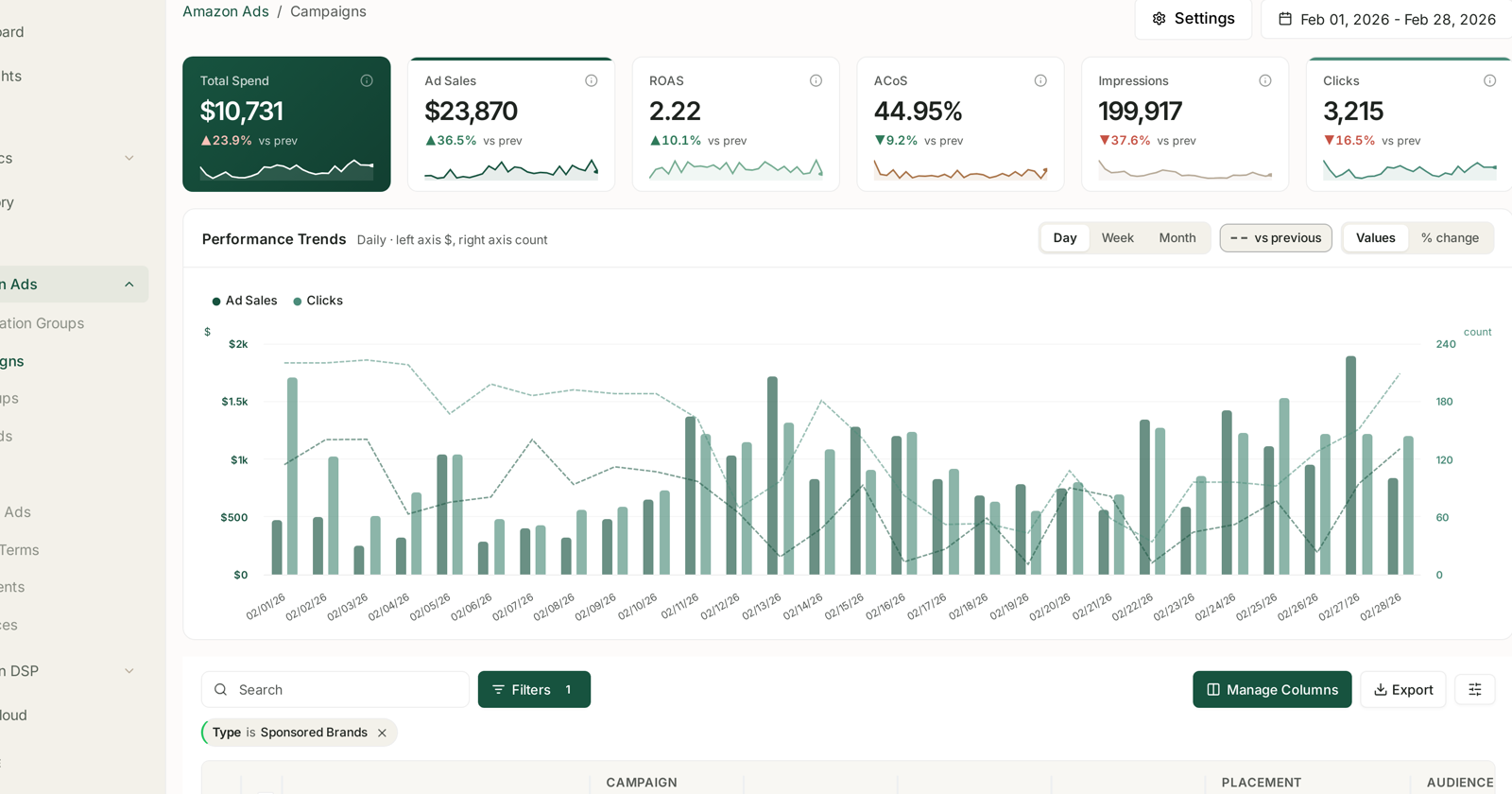
- Campaigns: Budgets, Placement and Audience Adjustments — the screen where structure becomes visible.
- Easy-Win Campaigns — the low-bid structures worth adding to a complete account.
- How Much to Spend on Branded Keywords — isolating branded terms, and why it matters.
- Designing the Offer — what happens before a new product needs campaigns.