

The campaigns are live. From here the launch is a loop between two numbers: is my conversion rate still good, and can I buy more velocity?
Each stage has a data point that must be met before you move to the next. That gating is what stops a launch becoming an expensive guess.
Prefer to watch? One hundred and thirty seconds on the three daily stabilisation checks, the impression-share ladder with its conversion gates, and how to withdraw spend without losing the position.
How velocity is measured
You cannot see your share of a keyword's sales directly. Top of Search Impression Share is the usable proxy.
It reports what percentage of the available Top of Search impressions for that keyword you captured. Since impressions are proportional to the keyword's total traffic, a rising share means a rising share of the sales — which is precisely the signal Amazon ranks on.
Stage 1: stabilise (first 1–2 weeks)
Before pushing anything, get the campaign behaving. Three daily checks.
Force the spend to Top of Search
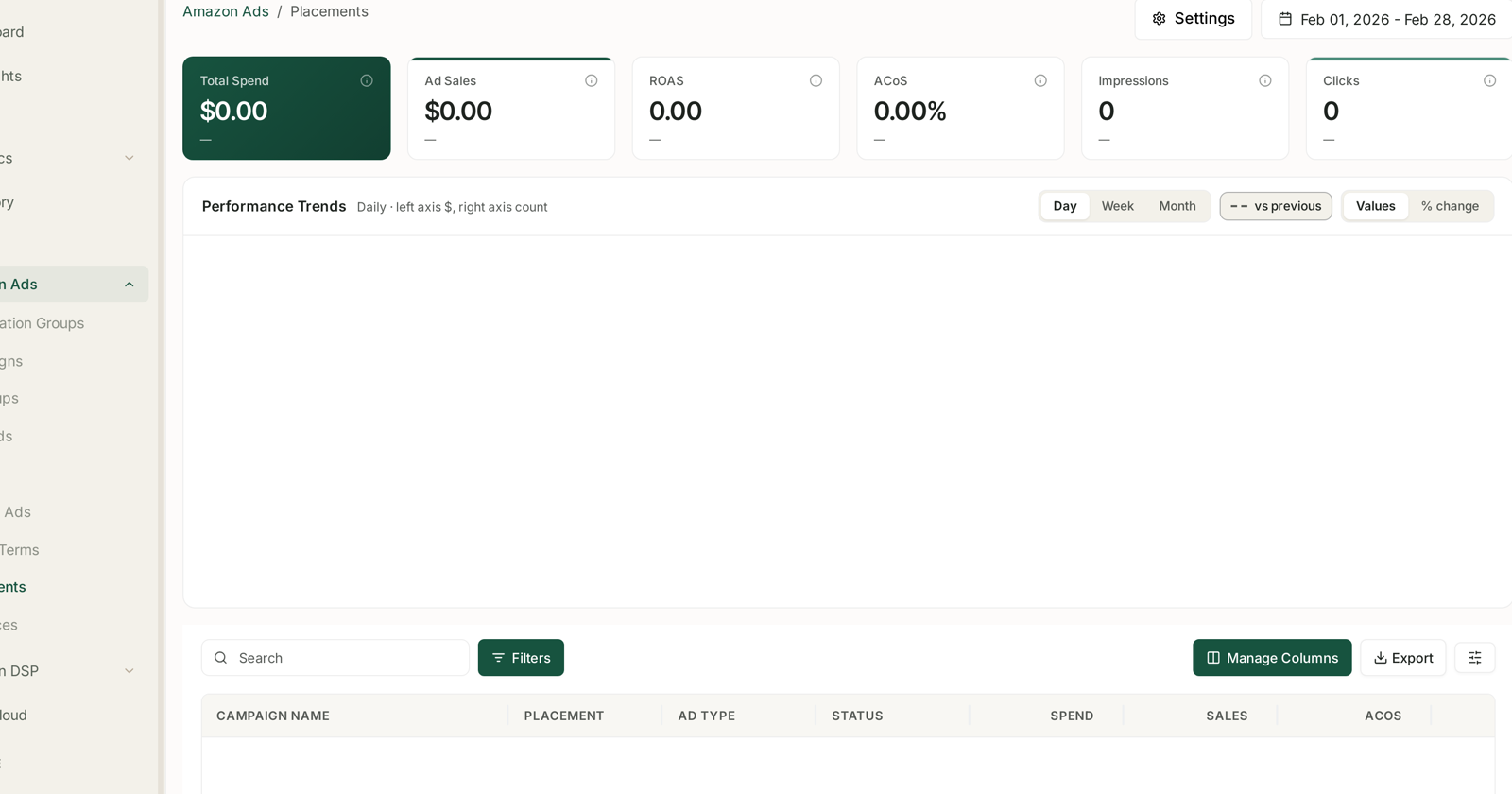
Check Placements daily. If more than 20% of spend is going to Rest of Search or Product Pages:
Lower the keyword bid by 10%, and raise the Top of Search multiplier by 25%.
Repeat daily until 80%+ of spend is at Top of Search.
The exception: if conversion on the other placements is genuinely good against the keyword average, leave it. The rule exists because Top of Search usually converts best, not as an end in itself.
If the campaign holds several keywords, lower bids only on the ones with CTR under 1% — low CTR is the signature of impressions landing on product pages rather than in search. Repeat every two days until 80%+ of clicks are at Top of Search.
Make sure it spends
If the campaign is spending under 75% of its budget, raise both the Top of Search multiplier and the keyword bids by 10%. Daily, until it clears 75%.
A ranking campaign that will not spend is not a cheap launch; it is no launch.
Make sure it does not spend too fast
Check at 1–3pm. If the campaign has already exhausted its budget by then, it is dark for the rest of the day — including the evening, when conversion is often strongest.
Lower the Top of Search multiplier by 10% daily, or raise the budget, until it survives past 2pm.
Stage 2: confirm conversion rate
Gate: your CVR for the target keyword must beat the keyword average.
If it does, proceed. If it does not, stop — do not buy more traffic for a listing that is converting below par. Go back to the listing tactics, improve, and re-check.
This gate recurs at every stage. It is the discipline that separates this from simply spending money.
Stage 3: scale to 30–35% impression share
Now buy velocity. Raise budgets, Top of Search multipliers and keyword bids together to grow spend and sales.
Hold at 30–35% Top of Search impression share for 1–2 weeks.
After 7 days at that level, re-check CVR against the keyword average. Still ahead? Continue. Fallen behind? Stop climbing and fix conversion first — more volume at a weak conversion rate teaches Amazon the wrong thing about your product.
Stage 4: scale to 45–50% impression share
Keep raising budgets and bids. Hold at 45–50% for two weeks.
At this level you are taking roughly half the Top of Search impressions for the keyword and driving substantial sales. This is where organic rank should visibly move.
Re-check CVR again. Same gate, same response.
Checking whether it worked
Check organic rank every two days.
Check it from more than one location. Amazon results vary by delivery address, so a single check can mislead. Use rank tracking plus a manual look from a couple of different postcodes — a west-coast and an east-coast one, for example.
If rank has not moved after 3–4 weeks at high impression share, velocity alone is not going to do it. Add:
Coupons. Lightning Deals or Best Deals. A short-term price reduction to lift conversion and sales together.
If none of that moves it, the honest conclusion is that the listing is not yet worthy of the position, and the answer is listing work rather than more spend.
Once you reach the top 10, hold for 1–3 weeks before changing anything. Rank needs to settle before you test whether it survives without support.
Stage 5: scale back without losing the rank
After 2–6 weeks at the top, start reducing spend — gradually, because the position is only as durable as the sales that hold it.
Step the impression share down. From 50% to 30%, wait one to two weeks, then to 20%. From there, optimise the campaign toward break-even ACoS like any other.
Use deals to cover the gap. While a Best Deal runs, cut the ranking campaign's spend hard. The deal supplies the velocity; the campaign does not have to.
Cap the budget deliberately. Set it so the campaign exhausts by midday, concentrating spend in the strongest hours.
Add a secondary campaign on the same keyword, tuned to break-even ACoS, to pick up traffic once the main campaign runs dry.
The combination that works most reliably: reduce advertising spend while running a sequence of Lightning Deals and Best Deals. The deals hold velocity steady while paid support comes out, so rank has time to become self-sustaining on organic sales.
Then start the next group
Once the position holds on reduced spend, that budget is free. Move it to the next keyword group and repeat.
This is the compounding part. Each group you win reduces the advertising the previous one needs, so the same budget buys progressively more rank. Over a year, an account can convert a substantial share of its paid velocity into free organic traffic.
Common mistakes
Skipping the CVR gate because impression share is climbing nicely.
Scaling before the campaign is stable, so you cannot tell what caused what.
Reading rank from one location.
Cutting spend all at once after reaching the top, and giving the position straight back.
Judging the campaign on ACoS. It is a ranking campaign, and it is supposed to look expensive — see Profit Campaigns and Ranking Campaigns.
Related
- Preparing a Launch: CTR and CVR Tactics — the work that makes this cheaper.
- Placement Bid Optimisation — the mechanics of moving spend to Top of Search.
- Triage a Rank Drop — when rank moves for reasons that are not your launch.
- When You Are Going Out of Stock — recovering rank after a constrained period.