

You have two or three finished images. The question now is which is best — and whether any of them beats what you already have.
Two tests, in order. A cheap one that narrows the field, then a real one on Amazon that decides it.
Prefer to watch? One hundred and twenty seconds on the two tests and their order, how to read the result against a range, and the trap of judging on click-through alone.
Test 1: pick the strongest candidate
Before touching your live listing, run your new images against each other with a survey panel.
Compare the new images to each other first, not against your current one. You are ranking them — best, second, worst — so that the image you put live is your strongest candidate rather than an arbitrary one. That single step meaningfully raises the odds the live test succeeds.
Optionally, run your best new image against your top three competitors. Use Brand Analytics to find who actually receives the most clicks on your main keyword, and put your image alongside theirs.
Reading that comparison:
Placing first or second — proceed to the live test.
Placing third or fourth — go back and improve before spending live traffic on it.
This whole stage is optional and worth doing anyway. Panel results are not shopper behaviour — people asked to compare images behave differently from people shopping. But it is cheap and fast, and it stops you burning a live test on your weakest candidate.
Test 2: live on Amazon
The only test that counts.
Upload the new image, then measure against a stable baseline.
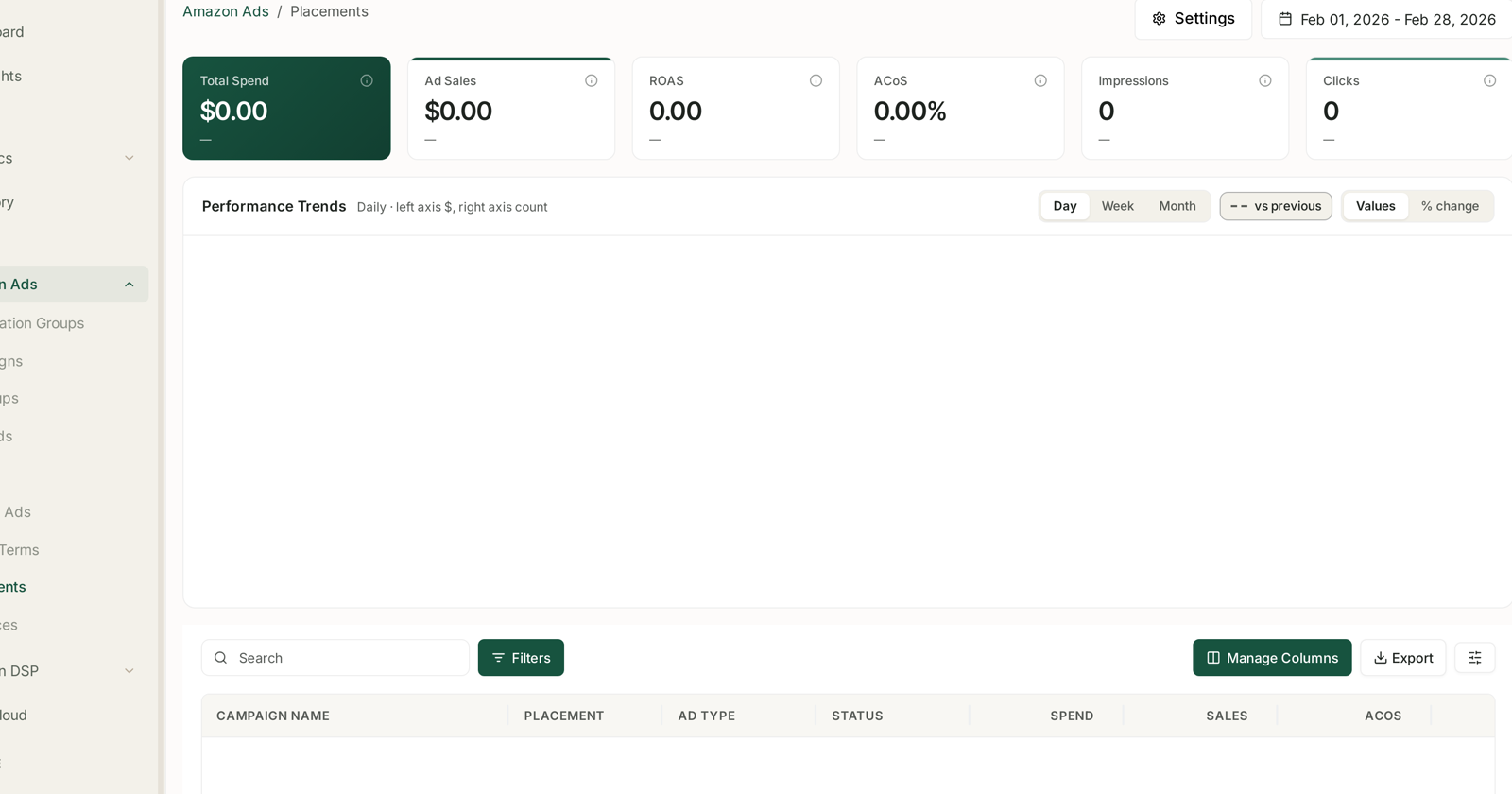
Watch Top of Search placements specifically. They are the most predictable and least noisy part of your traffic, which makes them the cleanest read on a CTR change. Pick your top three Sponsored Products campaigns by spend and track those.
Reading it, day by day then week by week
Days 1–4 — check daily, but only for disasters.
Sales falling clearly — the image is worse. Stop and switch to your second candidate. Do not wait for statistical certainty; you are losing money now.
Sales stable or rising — leave it alone and let data accumulate. Four days is not enough to confirm a win, only to catch a failure.
After one week — look properly.
CTR, week by week over the last six weeks, from the Search Catalog Performance report. You are comparing the current week against the recent range rather than against a single previous week, because weekly CTR is noisy.
CVR, from your business reports — unit session percentage.
Advertising CTR and CVR on those three campaigns, Top of Search only.
The verdict
Compare this week's CTR against the range of the previous weeks:
| Result | Reading | Action |
|---|---|---|
| Above the range | very good | keep it |
| Top of the range | good | keep it, watch another week |
| Bottom of the range | bad | consider the next image |
| Below the range | very bad | switch to the next image |
Then decide:
Bad after one week — start the test with your second image.
Middling after one week — give it one more week. Some of that is noise, and a second week usually resolves it.
Good or excellent — keep it, and decide whether to stop or chase further gains with the remaining candidates.
And check CVR alongside CTR. An image can raise clicks while lowering conversion — usually because it over-promises, and the shopper arrives to something different from what they expected. More traffic that converts worse is not a win, and CTR alone will not tell you.
A note on risky images
If your new image pushes against Amazon's image rules — heavy text, added graphics, unconventional backgrounds — there is a real risk of suppression, and getting your original back live can take time.
For those, use Amazon's own experiment tooling rather than swapping the live image. It is slower, but a suppressed main image on a high-traffic listing is a serious outage.
After a win
Do it again. The first improvement is rarely the ceiling, and you now have a process and a designer who understands your product.
Then move to your next product. Run this monthly across your catalogue, starting with the listings that get the most impressions.
And re-check your CTR against the keyword average — that comparison is what started this project, and it is how you know whether you are now ahead of your category or merely ahead of where you were. See Understanding Search Query Performance.
Common mistakes
Testing the new image against the old one on a panel rather than ranking the new ones first.
Switching after two days on normal fluctuation.
Comparing to a single previous week instead of a range.
Watching CTR and ignoring CVR.
Reading all placements together, which buries the signal in noise.
Stopping after one win.
Related
- Writing an Image Brief — producing the candidates.
- Why the Main Image Decides Your CTR — the benchmark this is measured against.
- Placements: Top of Search — why Top of Search is the cleanest read.