

DSP is the line item most often defended on faith and cut on impulse. It rarely looks good on ACoS, the case for it is always "brand building", and nobody can produce a number.
There is a number. It takes about an hour to build, and it either justifies the spend or it does not.
Time: about an hour. Do it quarterly, or before any renewal.
Prefer to watch? Eighty-one seconds on what you actually bought, and the harder comparison.
Step 0 — Ask the right question
Not "is DSP profitable?" — measured on last-click it almost never is, and that tells you nothing.
The question is: is DSP doing something the rest of the account cannot do? There are only three honest candidates:
- Bringing customers who are new to the brand.
- Creating demand that converts later somewhere cheaper.
- Re-reaching people at a cost below what Sponsored Products pays for the same outcome.
If it is doing none of the three, it is an expensive way to buy sales you already had.
Step 1 — Find out what you actually bought
Amazon DSP → Campaigns.
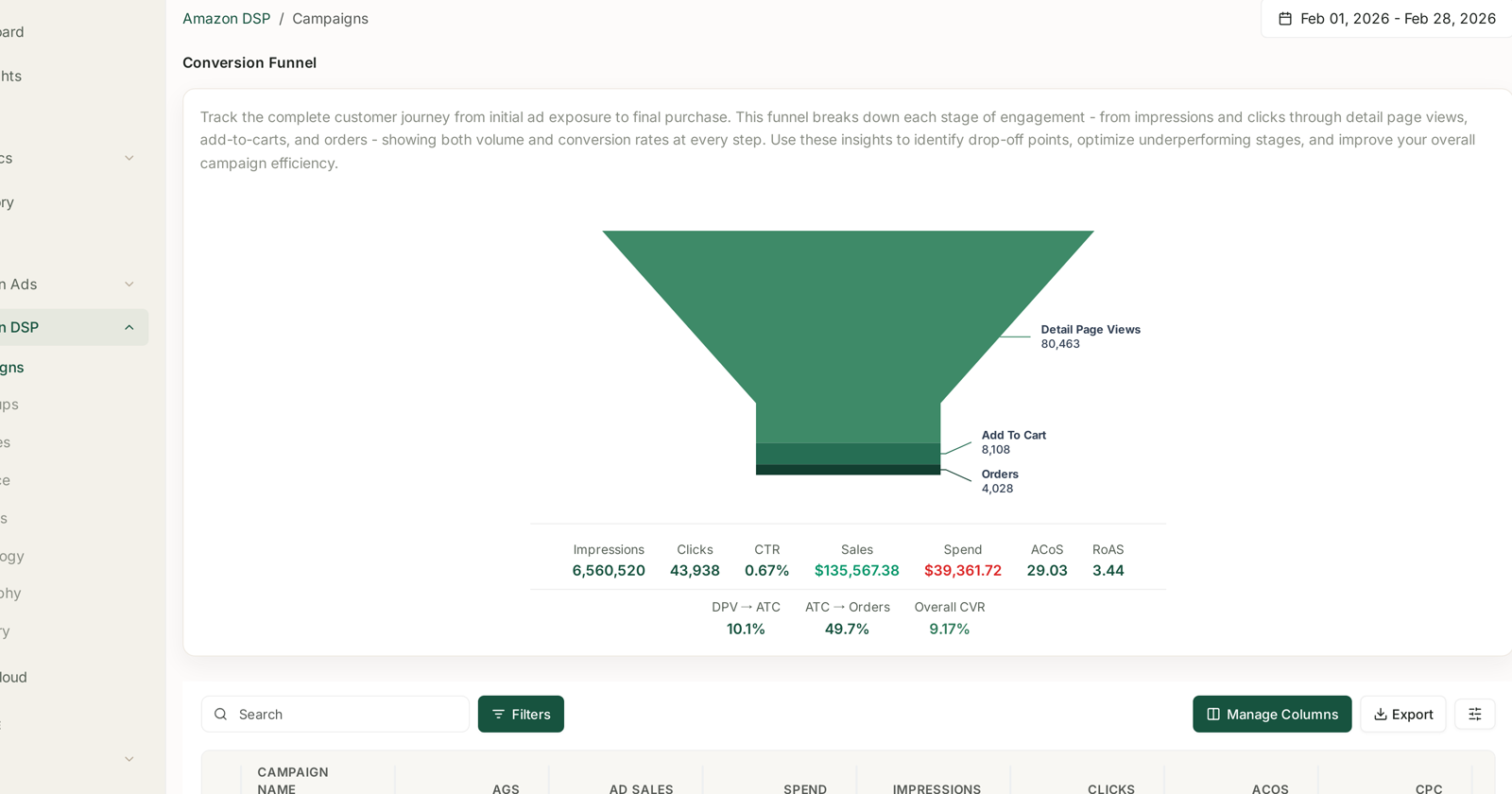
Read the campaign names and sort them into two piles: prospecting (audiences who have not met you) and remarketing / retargeting (audiences built from people who have).
This is the single most important step, and it is usually where the argument ends. A DSP buy that is 80% remarketing is not upper-funnel advertising. It is a re-engagement channel wearing upper-funnel language, and it should be judged as one.
Write down the split. Everything below depends on it.
Step 2 — Check whether it brings anyone new
AMC Cloud → NTB Purchases.
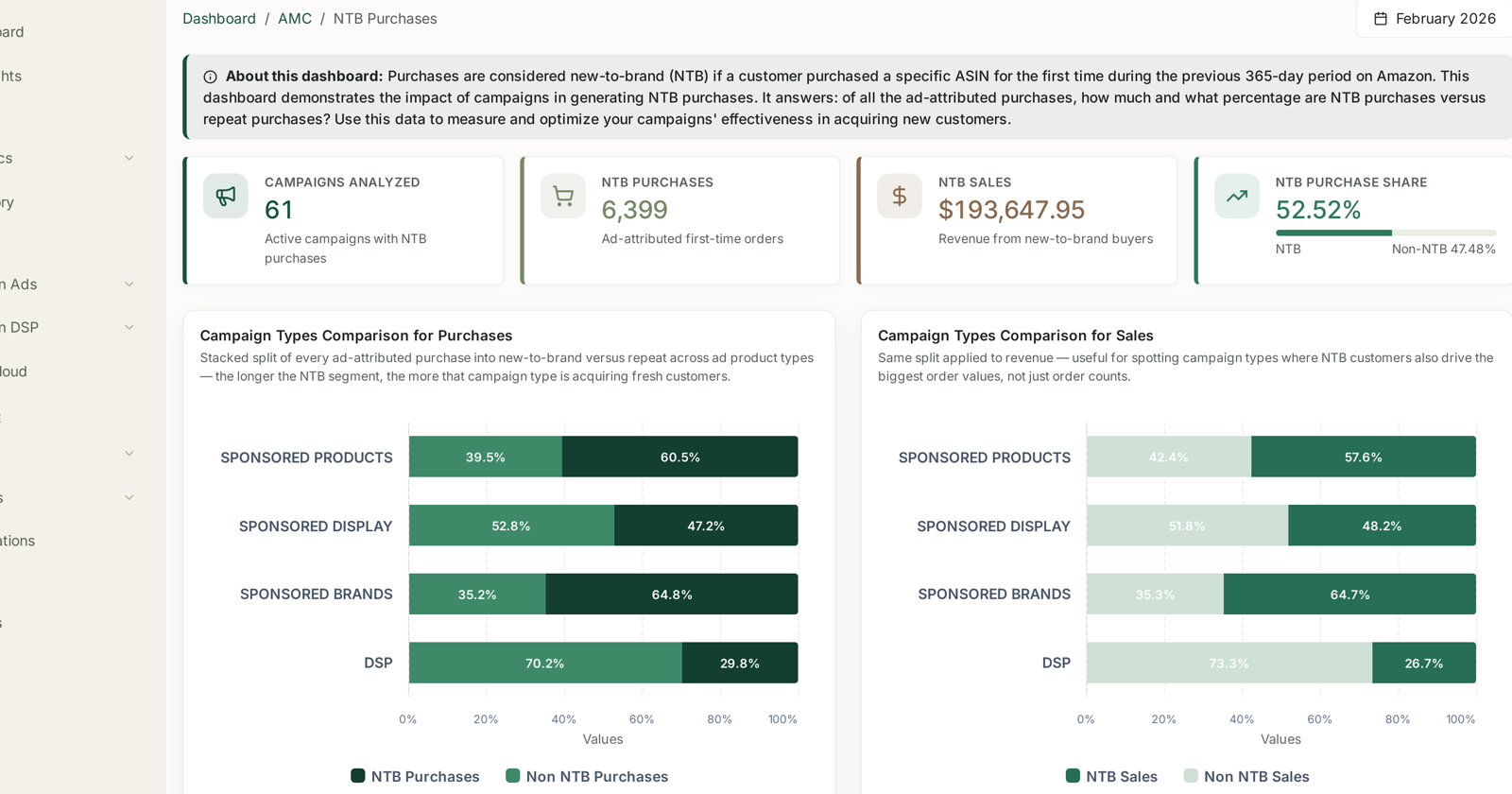
Compare DSP's new-to-brand share against your other formats.
If DSP is at the bottom, that is consistent with a remarketing-weighted buy and it is not automatically damning — but it does mean claim (1) is dead. You are not buying new customers.
If DSP is at the top, claim (1) is alive and you have your justification. Confirm it on NTB Customers, which counts people rather than orders and will tell you whether the volume is meaningful or just the rate.
The trap here is a good rate on a tiny volume. A format that is 70% new-to-brand and delivers 0.1% of your new customers is not acquiring anybody.
Step 3 — Check where it sits in the journey
AMC Cloud → Path to Purchase.
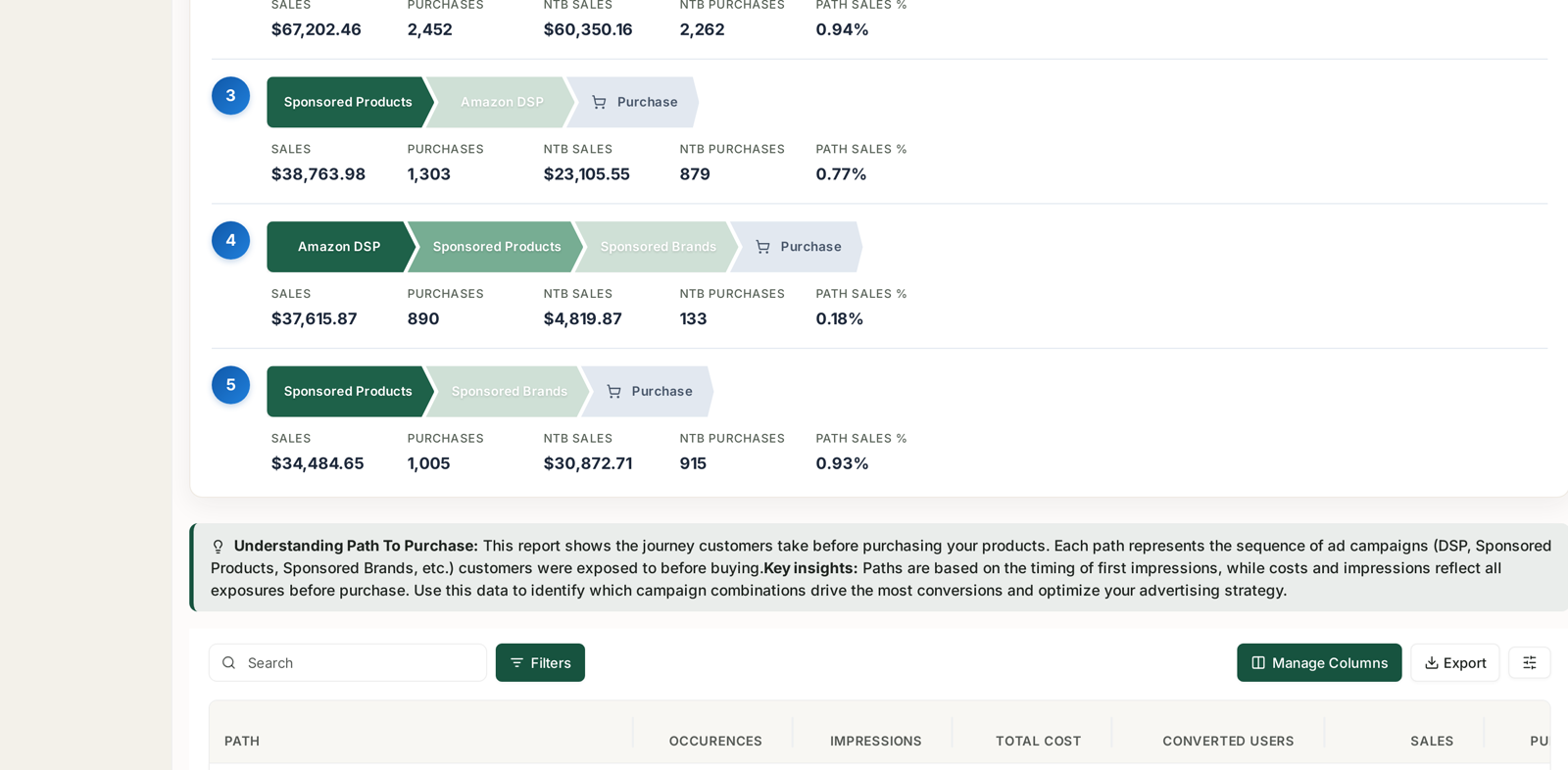
This is the step that settles it, because it shows order, not just presence.
Compare paths that begin with DSP against paths that begin with Sponsored Products, and read the NTB purchases column rather than sales:
DSP-first paths with a high NTB rate — DSP is genuinely finding new people and handing them to search. That is the upper funnel working exactly as advertised, and it is worth paying for.
DSP-first paths with a low NTB rate — DSP appears first because it re-reached somebody you already had. It is not opening the journey; it is intercepting one already in progress.
Then the harder comparison: does adding DSP to a path improve it? Compare a path with DSP against the same path without. If the single-touch Sponsored Products path produces more purchases and more new customers than the DSP-assisted one, the DSP exposure is a cost added to a sale that was already coming.
Step 4 — Check whether it created demand
AMC Cloud → Brand Keywords.
If DSP is building awareness, it should produce brand searches — people who saw the ad and later typed your name into Amazon. That is claim (2), and this is the only place it is measurable.
Look at Campaigns Driving Searches. If your DSP campaigns appear and their branded search volume moves with DSP spend, you have evidence of created demand that will convert later through cheaper channels. If DSP spend rises and branded searches do not move at all, claim (2) is dead too.
Step 5 — Price the remarketing honestly
If DSP turns out to be mostly remarketing, that is claim (3), and it is still a legitimate case — but only if the price is right.
The comparison is: what does DSP pay to re-reach a past visitor, versus what Sponsored Products pays to reach the same person again through search? If DSP is cheaper per outcome, keep it and stop calling it upper-funnel. If it is dearer, you are paying a premium for display inventory to do a job search already does.
Making the call
| What you found | Decision |
|---|---|
| High NTB, DSP-first paths acquire | Keep and fund. This is what it is for. |
| Low NTB, but branded searches track spend | Keep, smaller. It is creating demand, not customers. |
| Low NTB, no search lift, cheap remarketing | Keep as remarketing. Rename it in your own reporting. |
| Low NTB, no search lift, dear remarketing | Cut. It is buying sales you already had. |
| Prospecting exists but delivers nothing | Fix before cutting. The audiences are wrong, not the channel. |
That last row matters. If your prospecting campaigns are funded and still deliver no new customers, the problem is audience selection, and cutting the whole channel throws away the only part that could have worked.
What not to do
Do not judge it on ACoS. Prospecting always looks worse than remarketing — that is the definition of the two strategies, not a finding.
Do not cut prospecting to improve the average. It feeds the remarketing pools that look so good. Cutting it improves this month and starves next quarter.
Do not decide on one month. AMC reports monthly cohorts. Look at three.
Do not forget DSP is read-only here. TrackIQ reports it; changes happen in Amazon's DSP console.
Related
- DSP Campaigns — step 1, reading the funnel.
- NTB Purchases: New Business by Campaign — step 2.
- Path to Purchase: Which Ad Sequences Actually Convert — step 3, the decisive one.
- Brand Keywords: Proving Upper-Funnel Spend Works — step 4.