

Monitoring catches stockouts coming. Planning stops them happening.
The planning half is a monthly habit rather than a system: forecast six months out, count everything you own wherever it currently sits, and order the difference.
Done properly, stockouts stop being events.
Prefer to watch? One hundred and twenty-seven seconds on the six-month pipeline, the monthly ordering rule, and why over-ordering and under-ordering are not symmetrical mistakes.
Build a six-month sales forecast
Forecast six months ahead, per product, and update it monthly.
Do not aim for precision. Nobody can predict Amazon exactly, and a forecast that is roughly right and actually maintained beats a precise one built once and abandoned.
Where the numbers come from:
Last year's figures for the same month, which is the only thing that captures your seasonality.
Recent months against the same months last year, which tells you your growth rate.
Weight them by how you are trending. Growing strongly? Lean on recent data, because last year understates you. Flat? Lean on last year, because it captures the seasonal shape better than a short recent window.
Adjust for peaks, and be optimistic about them. Q4 numbers will look implausible next to a quiet spring. Order against them anyway — the asymmetry below explains why.
Each month, roll it forward: revise the coming months with what you now know, and add a new sixth month.
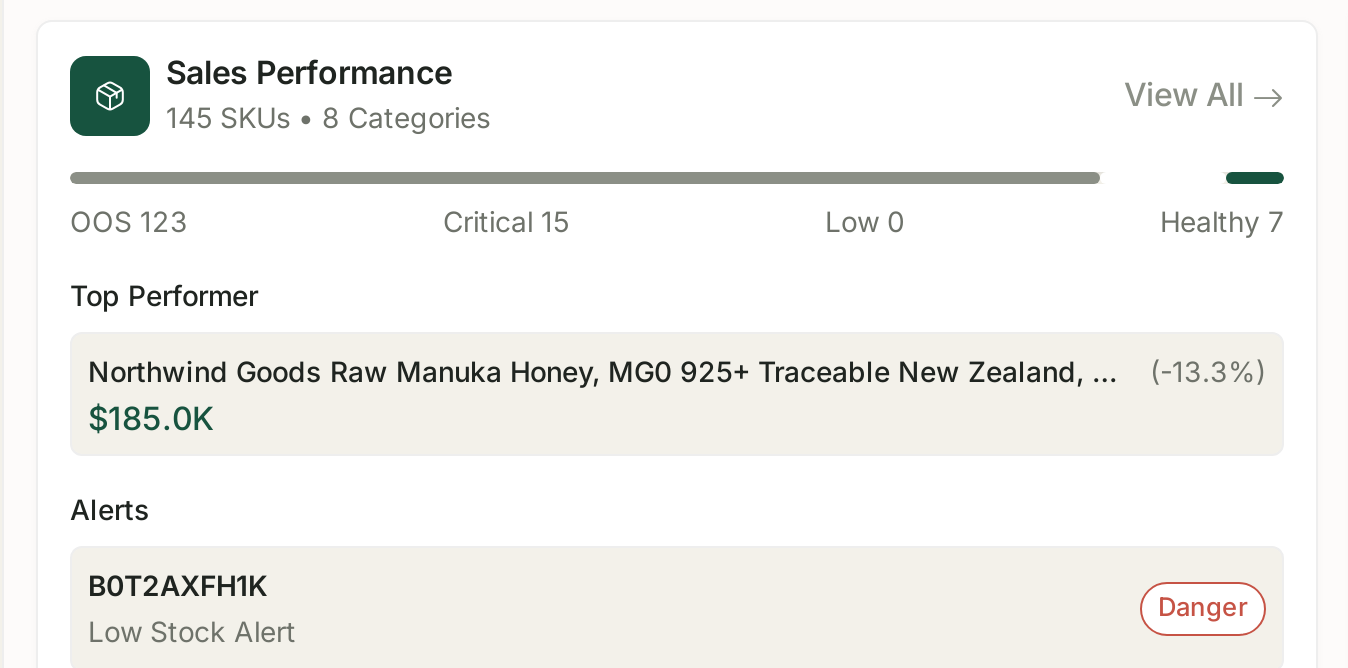
Count everything in the cycle
Your stock is not what is at Amazon. It is everything you have paid for or committed to, wherever it is:
At Amazon. In your warehouse or 3PL. In transit. In production.
A healthy pipeline, for a seller manufacturing overseas, looks roughly like:
| Stage | Cover |
|---|---|
| At Amazon | 2–3 months |
| Warehouse / 3PL | ~1 month |
| In transit | ~1 month |
| In production | 1–2 months |
That is around six months in the cycle at any time. Manufacturing domestically? Same principle, shorter numbers — scale to your actual lead time.
The monthly order rule
At the start of each month, compare units in the cycle against your six-month forecast, and order the gap.
If you are half a month short of six months' cover, place a purchase order for half a month. Not more, not less.
Ordering monthly is the point. It keeps each order small, keeps the pipeline continuously topped up, and means a demand change is absorbed within weeks rather than at the next big order.
If your supplier's minimum order quantity makes monthly impractical, tell them you intend to order every month — that regularity is often worth a lower MOQ to them. Failing that, order every two months and size accordingly.
Adjust by product tier
Not every product deserves the same cover.
Top sellers: 5–6 months. These fund the business, and a buffer here is not optional.
Everything else: 4–5 months, adjusted for cash flow. It is reasonable to run second-tier products leaner when cash is tight; it is not reasonable to do that with your best seller.
Add a buffer, and make it real
Add 0.5 to 2 months on top of your planned order.
Delays are normal rather than exceptional — production slips, freight is delayed, receiving takes longer than expected. If you planned five months, order six.
For top sellers, the buffer is non-negotiable.
And a larger buffer creates room to grow. A product that cannot go out of stock can be advertised harder, relaunched, and pushed into a deal without anyone doing anxious arithmetic first. Where a product is performing well on advertising and rank, size the buffer generously — you are buying the ability to press the advantage.
Plan Q4 in June
Start Q4 planning in June and have the orders placed by the end of July.
Include January and February in the Q4 order. Otherwise you land in Q1 having sold through everything with nothing behind it.
If you manufacture in China, order March–June stock during October and November, because Chinese New Year closes factories for weeks and the queue afterwards is long. Sellers who miss this spend Q1 out of stock.
Getting this right is one of the clearest advantages available, precisely because so many competitors leave it late.
The asymmetry that should shape every decision
If you place a £1,000,000 purchase order, you can sell at most £1,000,000 of it. You cannot sell more than you ordered.
That is the whole argument for optimism. Over-ordering costs you storage fees and tied-up cash — real, but recoverable. Under-ordering costs you the sales, the rank, the reviews and the competitor's growth at your expense — and none of that is recoverable.
The two errors are not symmetrical. Lean toward ordering more.
What to review it against
Forecasting needs actual sales history by product and month, current velocity, and stock across the pipeline.
In TrackIQ that history sits alongside current stock, so the year-on-year comparison and the current runway are the same view rather than two exports. See Understanding Business Reports for sales history and How to Monitor Your Stock Levels for the pipeline.
Common mistakes
Forecasting once and never updating it.
Counting only Amazon stock and being surprised by a gap the pipeline was supposed to cover.
No buffer, so every delay becomes a stockout.
Treating all products identically, and starving the top seller to fund the tail.
Leaving Q4 to September, and Chinese New Year to January.
Ordering pessimistically and capping your own year.
Related
- Monitoring Inventory Against Sales — the weekly half.
- Why Inventory Is the Second Pillar — what a stockout actually costs.
- Prepare for Prime Day — stock planning around an event.