

Every campaign you run is doing one of two jobs. Either it is trying to make money now, or it is trying to buy organic position for later.
They look identical in the console. They are judged by completely different numbers, and confusing them is why perfectly good campaigns get switched off.
Prefer to watch? One hundred and fourteen seconds on the two jobs a campaign can have, the KPIs that belong to each, and the two ways people confuse them.
Profit campaigns
Purpose: sell efficiently. These are the majority of your account — usually the large majority of spend — and they are supposed to be profitable on their own terms.
What lives here: auto campaigns, research campaigns, your exact-match workhorses, ASIN-targeting campaigns, and most Sponsored Brands and Sponsored Display.
The KPIs are ACoS and TACoS. ACoS tells you whether the campaign is efficient. TACoS tells you whether the account is affordable.
The goal is not the lowest possible ACoS. It is the most sales you can generate while staying inside your TACoS target. Those are different objectives, and chasing the first one shrinks the account.
An ACoS of 8% sounds excellent until you notice it was achieved by bidding so low that the campaign barely spends. A campaign that spends £4,000 at 28% may be worth far more than one that spends £300 at 12%, provided 28% still clears your margin.
What "profitable" means depends on your gross margin and your niche. A 35% ACoS is comfortable on a 60%-margin product and ruinous on a 25%-margin one. The more competitive the category, the harder profitable gets — which is a fact about the category, not a failure of the campaign.
Ranking campaigns
Purpose: move organic position on chosen keywords. These are deliberately not trying to be profitable in the short term. You are buying sales velocity on a specific search, because velocity is what moves organic rank, and organic rank keeps paying after you stop.
They have a recognisable shape:
Sponsored Products only. It is the ad type most directly tied to keyword-level rank.
Exact match only. You are ranking for a specific phrase, so you cannot afford the traffic to wander.
Top of Search placement, aggressively. That is where the velocity is.
Short-lived. A ranking campaign is a push, not a permanent fixture.
The KPIs are different, and this is the important part. You judge these on conversion rate, click-through rate, and sales velocity on the target keyword — not on ACoS. ACoS on a ranking campaign will look bad, because it is supposed to. You are paying above the efficient rate on purpose.
When it works, you stop. Once the keyword holds the organic position you wanted, you wind the campaign down and move the budget to the next keyword. Ranking campaigns that are still running six months later have usually stopped being ranking campaigns and become expensive profit campaigns nobody re-labelled.
Why mixing them up is expensive
Two failure modes, and both are common.
Judging a ranking campaign on ACoS and switching it off two weeks in. You paid the expensive part — the initial velocity — and quit before the organic position that was supposed to repay it had settled.
Letting a profit campaign quietly become a ranking campaign. Bids creep up, Top of Search multipliers get raised, ACoS drifts, and nobody has decided that is the plan. The account is now buying rank by accident, at a price nobody agreed.
The fix is naming. Put the intent in the campaign name at creation — the same discipline covered in Create a Sponsored Products Campaign. In six months the name is the only context you have, and "is this supposed to be profitable?" is the first question you will ask.
Which to do first
Get the profit campaigns efficient before you run ranking campaigns.
Ranking campaigns are expensive by design. Run them on top of an account that is already leaking money into non-converting targets and mis-set placement bids, and you will not be able to tell which cost was the investment and which was the waste.
Score the account first — Score Your PPC Performance — fix what the low scores expose, and only then start buying rank.
Reading them apart in TrackIQ
Because the two types are judged on different numbers, you want to look at different columns.
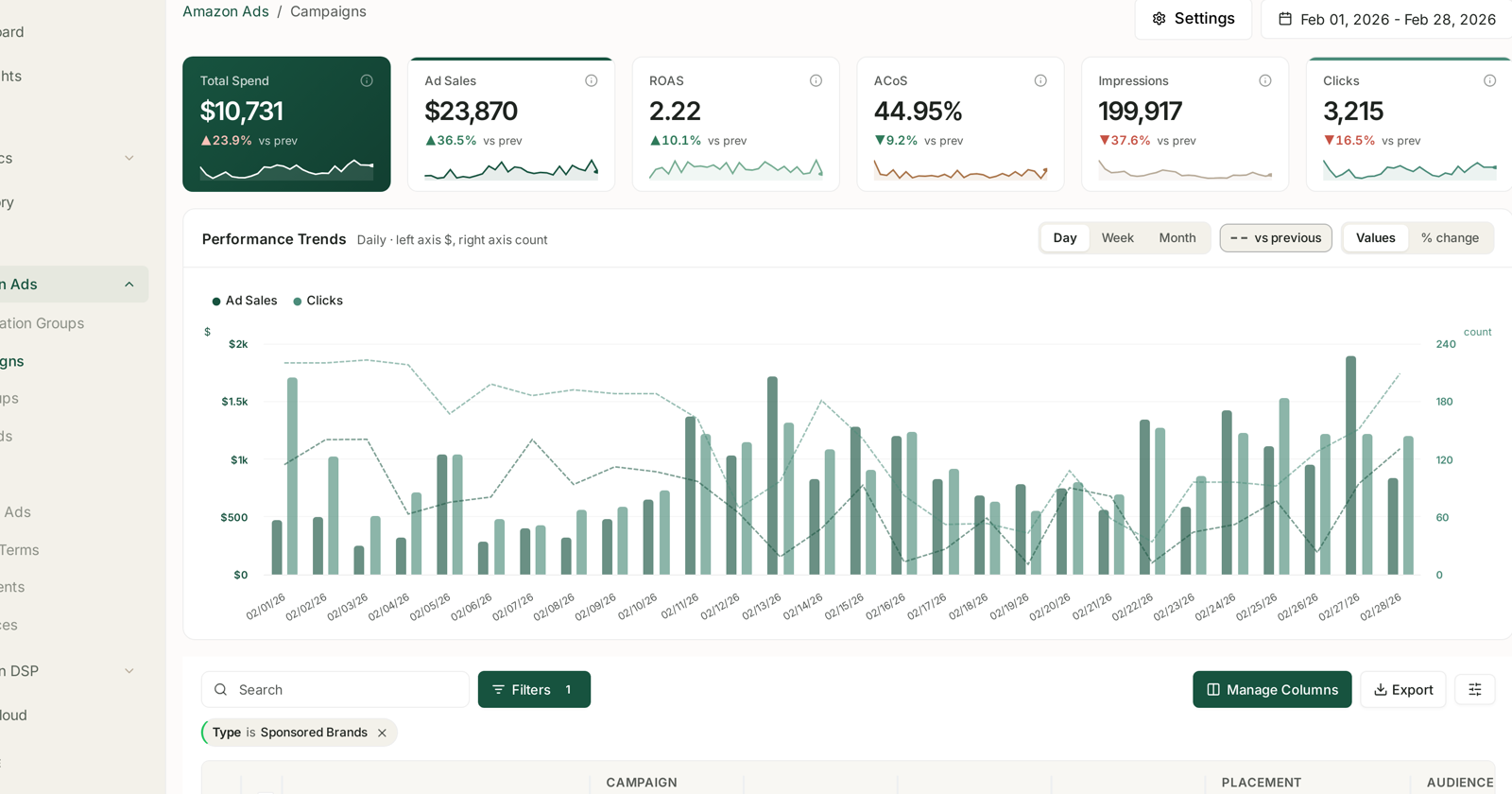
For profit campaigns, Amazon Ads → Campaigns gives spend, sales, ACoS and conversion in one table with a date range that holds. See Campaigns: Budgets, Placement and Audience Adjustments.
For ranking campaigns, the useful views are keyword-level and rank-level: Keywords and Match Types for CTR and CVR on the target phrase, and the organic rank tracking that tells you whether the position actually moved. If rank is not moving after a fortnight of real velocity, the problem is usually the listing rather than the bid.
Related
- What Amazon PPC Is Actually For — why advertising and organic rank are the same conversation.
- Amazon PPC: Core Terms and Metrics — ACoS, TACoS and attribution.
- Placements: Top of Search, Rest of Search and Product Pages — where ranking campaigns need to win.
- Bid Optimisation: Six Rules — steering a profit campaign toward its target ACoS.
- Setting Target TACoS per Product — the budget envelope profit campaigns work inside.
- What a Relaunch Is, and When to Run One — the full process a ranking campaign belongs to.
- Running a Launch: Stabilise, Scale, Scale Back — how a ranking campaign is actually driven.