

The reason a nine-report routine is workable at all is that you do not do most of it.
The system splits into two roles. One person produces the reports and executes the changes; you make the decisions. That is roughly an 80/20 split of the work, deliberately arranged so that your 20% is the part that actually moves performance.
Without that split, the routine is not efficient — at which point you would be better off optimising campaigns by hand.
Prefer to watch? One hundred and seventy-five seconds on the four-step workflow per report, why the report categories have to be complete, and the week-5 to week-25 ramp.
The structure
Nine recurring reports:
Four weekly.
Two fortnightly.
Three monthly.
Together they cover every aspect of campaign optimisation — bids and placements, cleaning up waste, adding new targets, and the periodic view of overall performance. See The Nine-Report PPC Routine and The Brand Manager's Calendar.
Run all nine on their cadence and you can be confident nothing is being missed. That completeness is the point of having a fixed set rather than doing whatever seems urgent.
The workflow, per report
1. The assistant builds the report — pulls the export, filters it, formats it.
2. You review the data and make the optimisation decisions.
3. You document each decision in the report.
4. The assistant implements them in the campaign manager.
Your entire role is step 2 and 3. Reading, deciding, and writing the decision down.
Steps 1 and 4 are the bulk of the hours and have almost no direct effect on performance. They are assembly and execution.
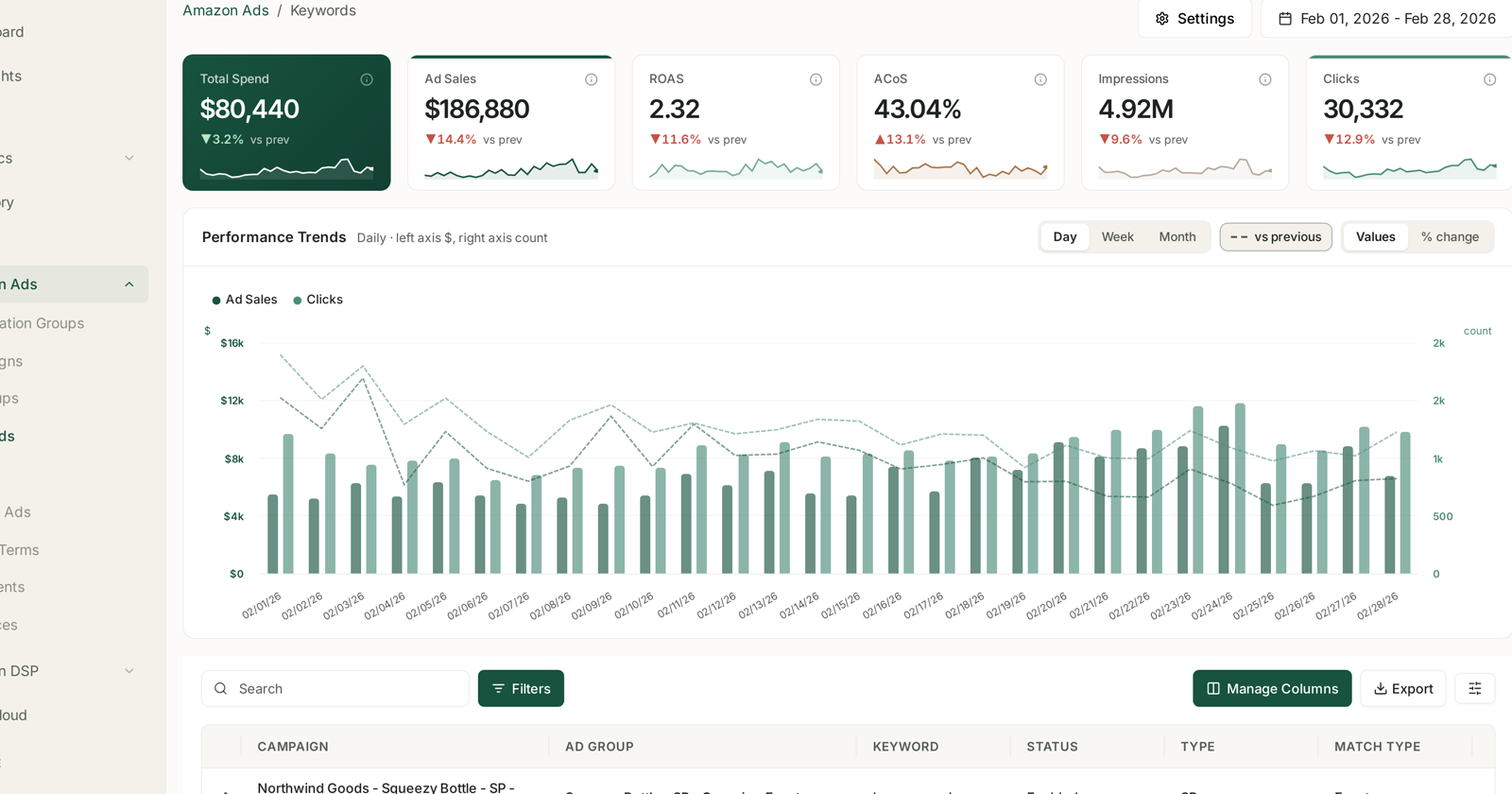
Steps 1 and 4 are exactly the parts that shrink when the data assembles itself and the changes apply through rules — see Rule-Based Optimization: Automating Bids and Budgets. The judgement in step 2 is yours either way; the question is how many hours sit either side of it.
What each report is for
They are deliberately different in purpose, which is why the set works as a whole:
Bids and placements — steering existing spend toward what performs.
Cleaning up waste — cutting targets that spend without returning, in three different windows.
Growth — harvesting new targets and adding campaigns.
Overview — the periodic 360° read on where performance actually stands.
Miss a category and you develop a systematic blind spot, which is precisely what these routines exist to prevent.
Resourcing it
The assistant is not optional in this model.
Finding and training one takes two to three weeks, so start before you need them — see Onboarding a VA.
And train on the processes themselves, not on general Amazon knowledge. What you need is someone who can reliably produce the same report the same way every week.
Expect a real learning curve
This is the part people are not warned about, and it causes more abandonment than any of the tactics.
At first it takes longer than you expect. That is normal.
By week 5 — around 25–30% faster than week 1.
By week 10 — noticeably faster, and the decisions are better.
By week 25 — seamless, and completed with minimal effort.
So judge the system at week 10, not week 2. The first few cycles are you learning what each report is telling you, and that cost is paid once.
If you abandon it in month one because it is slow, you paid the entire learning cost and collected none of the benefit.
Common mistakes
Running the system without an assistant, and spending all your time on assembly.
Doing the reports yourself "just this once", repeatedly.
Making decisions without documenting them, so nothing can be executed or reviewed later.
Dropping reports from the set because a week is busy, and creating a blind spot.
Judging the system in week two, at the peak of the learning curve.
Delegating the decisions as well as the assembly. Step 2 is the part that is actually yours.
Related
- The Nine-Report PPC Routine — the reports themselves.
- Onboarding a VA — resourcing the other 80%.
- Optimisation as a Calculated Bet — how to make the decisions in step 2.