

Every account drifts the same way. Remarketing and branded terms look efficient, so they get more money; prospecting looks expensive, so it gets less. Repeat quarterly and you end up with an advertising programme that is very good at selling to people you already have.
It looks healthy right up until growth stops, because the pool it harvests from has stopped being refilled.
Time: about two hours. Do it quarterly.
Prefer to watch? Seventy-nine seconds on measuring the drift, and judging the fix properly.
Step 1 — Measure the drift
Two numbers, taken from the same month:
NTB share of purchases — AMC Cloud → NTB Purchases.
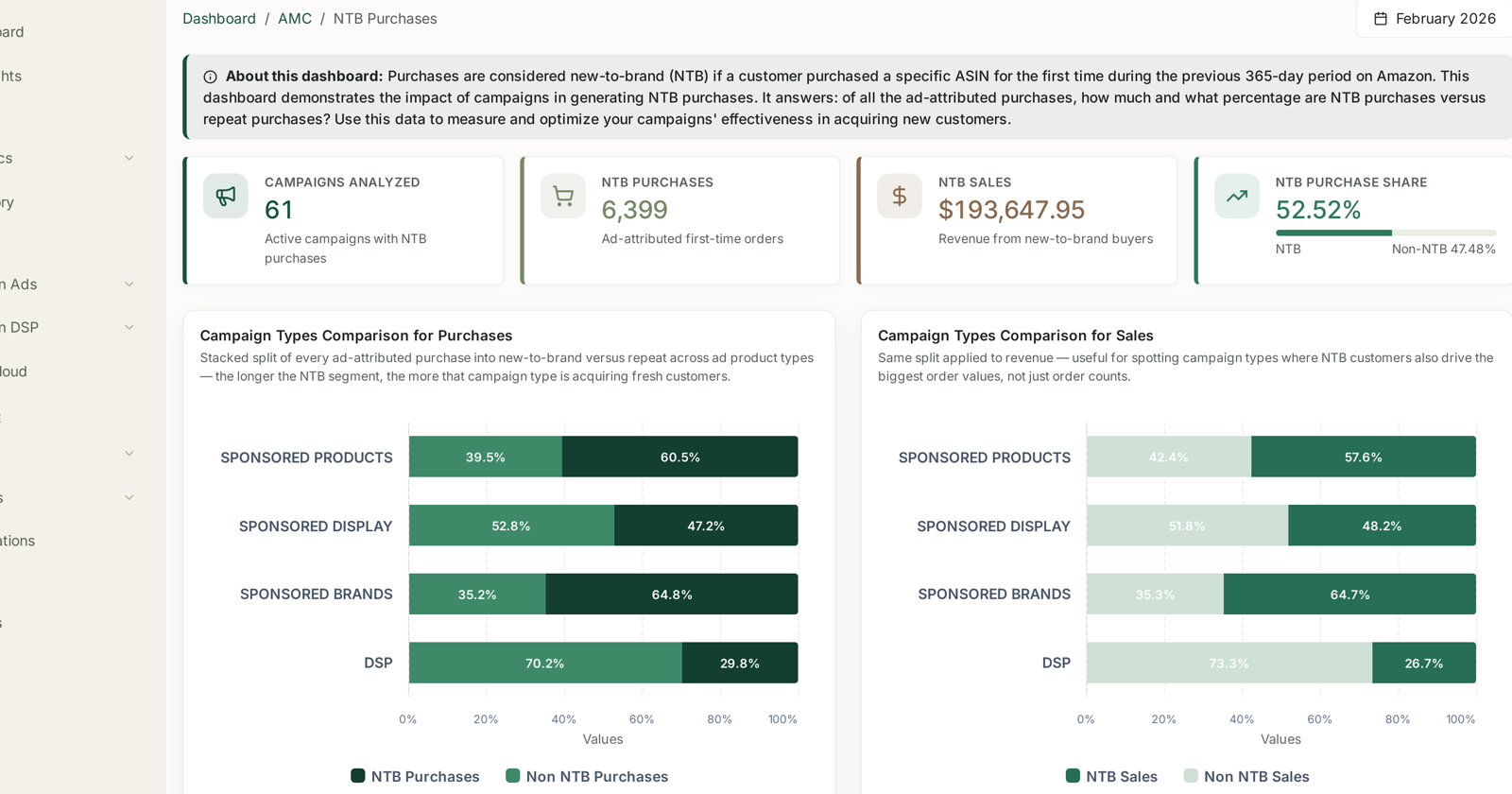
NTB users — AMC Cloud → NTB Customers, which counts people rather than orders.
Now compare against the same month last quarter, and last year if you have it. The pattern to look for:
| What you see | Reading |
|---|---|
| NTB share falling, total sales holding | the drift — you are converting advertising into a remarketing programme |
| NTB share holding, NTB users falling | the business is shrinking; the ratio is flattering it |
| Both holding | no problem to solve; stop here |
| NTB share rising | acquisition is working — check it is not just a smaller base |
Track the count, not just the share. A percentage can improve while the absolute number of new customers falls, and that is the worst outcome disguised as the best.
Step 2 — Find where the money actually is
Sort your spend into the two jobs. The split is usually not what people assume:
Harvesting — branded terms, remarketing and retargeting audiences, exact-match keywords on proven queries. These convert well because the customer had largely decided.
Acquisition — generic terms, broad and auto discovery, prospecting audiences, upper-funnel display.
Two screens do most of this:
Generic, Branded and Competitor Terms classifies your search queries into the three buckets and tells you what proportion of your search spend is chasing people who already know your name. See that article for how the classification works — and note that a single generic word in your brand list will make the split useless.
DSP Campaigns splits display into prospecting versus remarketing by campaign name. A display buy that is overwhelmingly remarketing is harvesting, whatever it is called internally.
Step 3 — Work out what the harvesting is really earning
Harvesting spend has a specific weakness: it is the spend most likely to have happened anyway.
Somebody searching your brand name was going to find you. A remarketing ad shown to a customer who already has the product in their basket is charged for a sale it did not cause.
You cannot measure this precisely without a holdout, and TrackIQ does not run holdouts. But Path to Purchase gives you the strongest available proxy: compare a single-touch path against the same path with a harvesting touch added. If the multi-touch version produces no more purchases and fewer new customers, that extra exposure is a cost, not a contribution.
See Prove your display campaigns created demand for how far this evidence can honestly be pushed.
Step 4 — Move the money, in a bounded way
Do not rebalance the whole account at once. You will not be able to attribute the result.
Take 10–15% out of harvesting, from the places most likely to be self-cannibalising: branded terms above the volume you need to defend, and remarketing audiences with the shortest lookback.
Put it into acquisition with a defined target and a defined end date. Generic terms with real search volume, or prospecting audiences you have not funded properly before.
Set the acquisition target where acquisition can actually run. Prospecting will always look worse on ACoS than harvesting — that is the definition of the two strategies, not a finding. Give it its own rule group and its own target. See Set a Target ACoS Across a Whole Portfolio.
Step 5 — Judge it on the right measure, after the right interval
The measure is NTB users, not ACoS. If you judge an acquisition shift on efficiency, you will reverse it within a month, because efficiency is exactly what you traded away on purpose.
The interval is a quarter. New customers take time to arrive and longer to repeat. A month tells you the ACoS went up, which you already knew.
At the end of the quarter:
| Result | Do |
|---|---|
| NTB users up, blended ACoS up a little | working — hold, consider another 10% |
| NTB users up, blended ACoS up sharply | working but expensive — tighten the acquisition target |
| NTB users flat, ACoS up | the acquisition spend is not reaching new people — the audiences or terms are wrong |
| NTB users down | reverse it, and look for a cause outside advertising |
The third row is the common one, and the fix is targeting rather than budget. Money moved into prospecting that reaches the same people is not acquisition; it is harvesting with a different label.
Step 6 — Protect what recruits
While you are here, make sure the products that do the acquiring are not being managed like everything else. A gateway ASIN starved of budget or allowed to stock out will undo this whole exercise. See Protect the products that bring you new customers.
What not to do
Do not cut harvesting to zero. Branded defence is cheap and losing it is expensive. This is a rebalance, not a purge.
Do not move more than 15% in one go. You will not learn anything from a change that big.
Do not do this and a bid-strategy change in the same quarter. One variable at a time.
Do not read one month. AMC reports monthly cohorts and seasonality moves NTB share hard.
Do not confuse NTB with incremental. New to brand means the customer had not bought from you in 365 days. It does not prove the ad caused it.
Related
- NTB Customers: New vs Repeat, Counted as People — the measure that matters in step 5.
- Generic, Branded and Competitor Terms — splitting search spend by job.
- Decide whether your upper-funnel DSP is worth keeping — the display half of the same question.
- Set a Target ACoS Across a Whole Portfolio — giving acquisition its own standard.
- Scaling Profit Campaigns — where the freed budget should go.