

Once you know how to move a product's organic rank, the question stops being how and becomes what to point it at, month after month.
Because organic rank is where the profit is. How many keywords you rank on, and how high, is roughly what determines how much money the business makes.
This is the long-term operating pattern that follows from that.
Prefer to watch? One hundred and sixty seconds on how many launches your revenue supports, choosing keyword groups across products rather than within them, and winning your niche in every marketplace first.
The prerequisite
This is the fourth pillar, and it only works once the first three are running.
Margins as high as they will go, with back-end costs optimised and offers that are genuinely strong — see Where Your Margin Actually Goes.
Inventory working, with no stockouts — see Monitoring Inventory Against Sales.
Advertising running on a defined system — see The Nine-Report PPC Routine.
Pushing rank on a product with thin margins, unreliable stock and chaotic campaigns just spends money faster.
Plan it monthly, as a portfolio
Each month, decide which products to push and which keyword group to push for each.
Every listing can take a relaunch phase — including the same product in other marketplaces.
How many at once
Scale it to revenue:
| Annual revenue | Concurrent launches |
|---|---|
| ~$1m | 1–2 |
| ~$10m | 5–7 |
| $20m+ | 10 or so |
Two to five keyword groups is focused enough for most operations, and cheap enough to sustain.
Going wider than your revenue supports is the common error, and it produces several half-funded pushes instead of one that works — see Focus on Two or Three Products.
Prioritise across products, not within them
Look at every keyword group across every product together.
Seven products might produce twenty keyword groups. The question is not which group is best for each product — it is which of the twenty has the best chance of success.
Start with the clear winners. Once those are handled, take more risk with the marginal ones.
That is a portfolio decision, and it will regularly mean pushing a group on your second-best product ahead of a weaker group on your best.
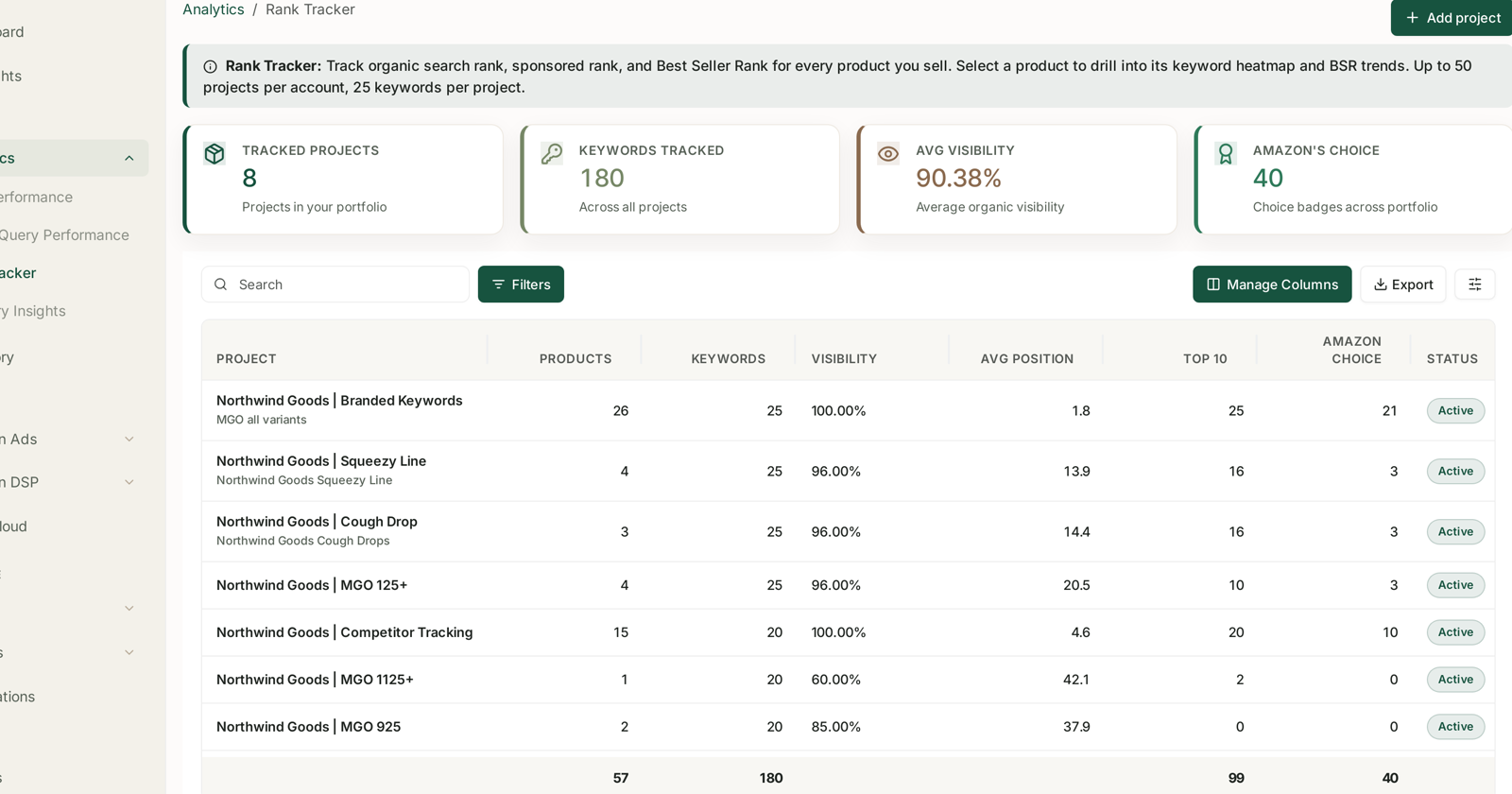
Comparing twenty keyword groups across seven products on likelihood of success requires seeing rank, conversion and keyword volume together — see Reading Organic and Sponsored Rank and Grouping and Prioritising Keywords. A monthly planning meeting that starts with building the comparison rarely gets to the decision.
Win your niche everywhere before you go broad
Two sequencing rules, and the order matters.
First, rank top-of-page for every root keyword in your niche.
Second, do it in every marketplace you sell in — Canada, UK, Germany, France, Italy, Spain.
Only then expand to broader discovery keywords.
Why the other marketplaces are underrated
Competition is materially lower, and — more importantly — the listings competing with you there are largely unattended. Nobody is running a system against you.
The scale this reaches is easy to underestimate. It is entirely achievable for the non-US marketplaces combined to approach parity with the US on profit — effectively doubling the business off the same catalogue.
Ranking in a secondary marketplace is usually far easier than the equivalent push in the US, and it is the same work you already know how to do.
Squeeze your main products before launching more
This is the most common and most expensive mistake in the whole framework.
Sellers see one or two products succeed and immediately launch five more.
Instead: maximise what already works. The bigger a product gets, the stronger its flywheel — sales, rank, reviews and profit each reinforcing the others.
Expanding the product line is still necessary, and not optional over a horizon of years. But 20% of your listings drive 80% of your profit, and at least 80% of your attention belongs there.
New products are how you grow in three years. Your existing top products are how you grow this year.
Common mistakes
Pushing rank before margins, inventory and advertising are in order.
Running more launches than your revenue can fund.
Choosing keyword groups product by product rather than across the portfolio.
Going after broad discovery keywords before owning your niche.
Ignoring secondary marketplaces, where the same work is easier and the upside is comparable.
Launching new products instead of maximising the ones already working.
Related
- What a Relaunch Is — the mechanic this plan repeats.
- Grouping and Prioritising Keywords — producing the groups you choose between.
- Focus on Two or Three Products — the same concentration principle, at product level.