

You already know which products sell. You probably do not know which ones get bought together — and that pairing is the cheapest new product you will ever launch, because it requires no new product.
The data is in AMC. The discipline is in not over-reading it.
Time: about 45 minutes. Do it quarterly.
Prefer to watch? Eighty seconds on reading the base before the ratio, and testing it cheaply.
Step 1 — Check whether you have enough data
AMC Cloud → ASIN Purchase Upsell.
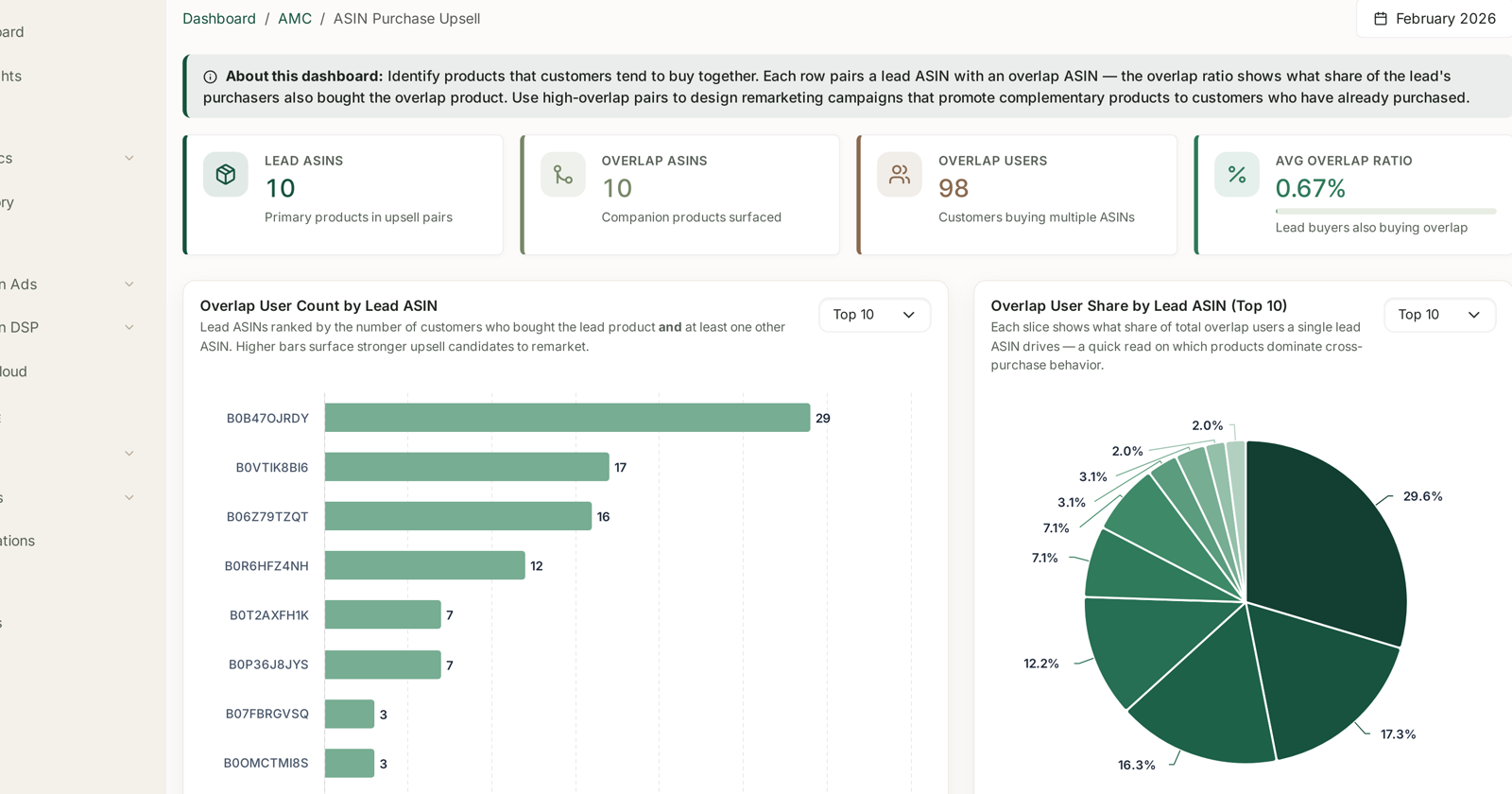
Before looking at a single pair, read the two tiles that decide whether this exercise is worth doing:
Overlap Users — how many customers bought more than one of your ASINs at all.
Avg Overlap Ratio — on average, what share of a lead product's buyers also bought the companion.
Cross-purchase is rare. An average ratio under 1% and overlap users in the low hundreds is entirely normal, and it means every pair you are about to look at rests on a handful of people. That does not make the exercise pointless — it makes it a hypothesis generator rather than a source of findings.
If overlap users is in single or low double digits, stop. There is nothing here yet. Come back after a quarter with more volume.
Step 2 — Rank by volume, not by ratio
Use Overlap User Count by Lead ASIN first. It ranks lead products by how many customers bought them and at least one other ASIN.
Then read the ratios against that. The four-way split:
| Overlap users | Ratio | Reading |
|---|---|---|
| high | high | a real pair — act on it |
| high | low | popular lead, weak companion pull |
| low | high | noise — a big percentage of very few people |
| low | low | nothing here |
The bottom-left row is the trap, because a 40% overlap ratio catches the eye and looks like a discovery. On three customers it is not.
Step 3 — Read the pairs properly
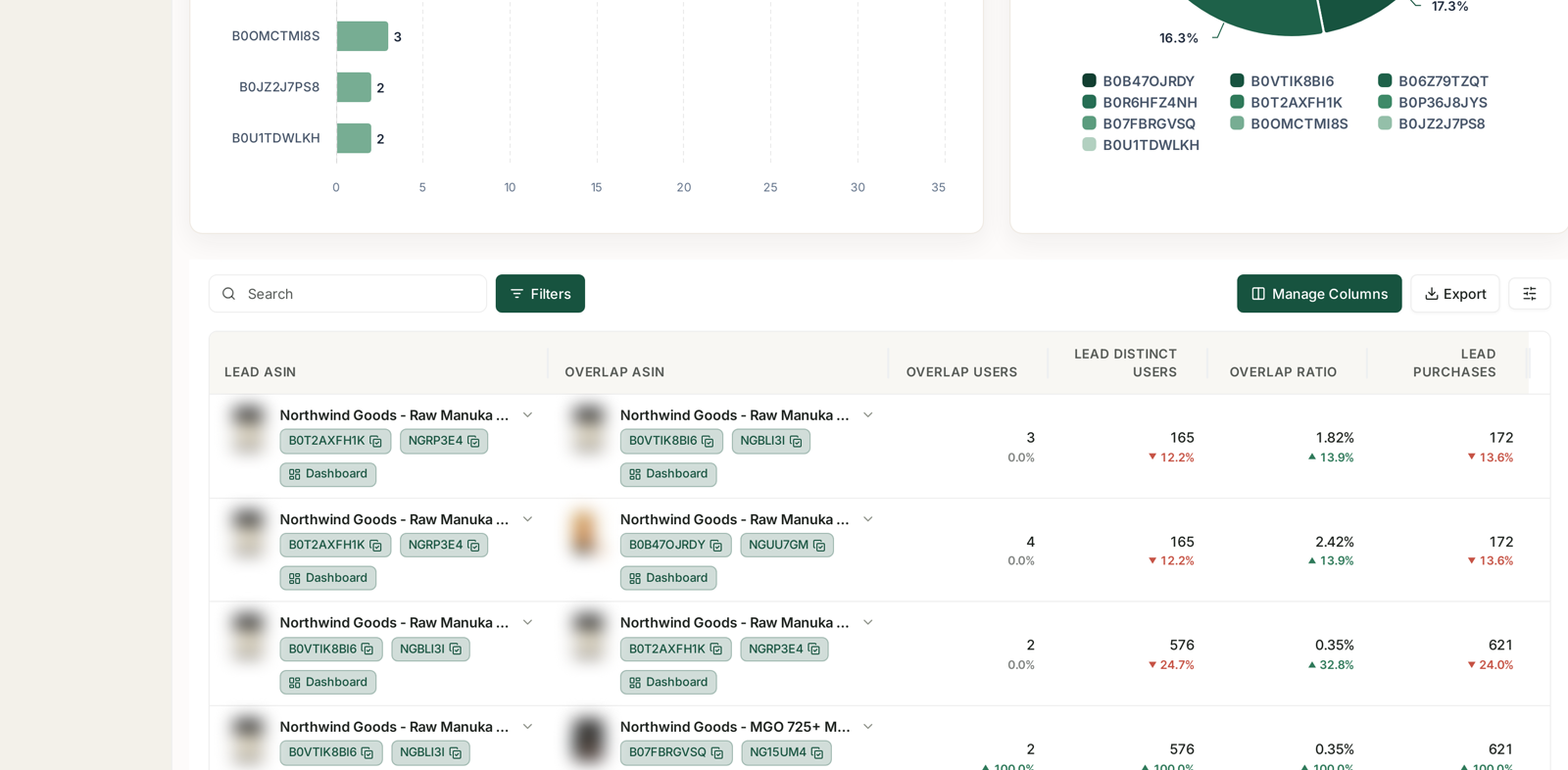
The table gives both products with Overlap Users, Lead Distinct Users, Overlap Ratio and Lead Purchases.
Seeing the denominator beside the ratio is the whole point. Overlap ratio = overlap users ÷ lead distinct users, so three overlap users against 165 lead buyers is 1.82% — a number you should treat as a whisper, not a signal.
Sort your shortlist by overlap users and take the top three or four pairs. That is your candidate list.
Step 4 — Sort the candidates into three kinds
Not every pair means the same thing, and they lead to different actions:
The obvious pair. A product and its refill, or a set and its accessory. You did not need AMC to find this, but it confirms the demand is real. Bundle it.
The complementary pair. Two products used together that you had not connected — different categories, same occasion. This is the valuable one. It is a genuine discovery about how customers use what you sell.
The substitute pair. Two variants of the same thing, bought by someone who tried one and switched, or bought both to compare. Do not bundle these. Nobody wants two of the same product in a box. This is a signal about your variant strategy, not a bundle.
Telling them apart takes product knowledge, not data. Look at the two listings and ask whether a customer would want both at the same time.
Step 5 — Remarket before you bundle
Bundling costs inventory, a new listing, and photography. Remarketing costs a campaign.
So test the hypothesis the cheap way first. The audience is customers who bought the lead product and not the overlap. That is a DSP remarketing campaign with an unusually specific brief: they own one thing, show them the other.
If that campaign converts, you have validated the pair with real money and you can bundle with confidence. If it does not, you have learned the same thing for the price of a test.
See DSP Campaigns.
Step 6 — Then build the bundle
If the remarketing worked, a listed bundle removes a step for the customer and usually lifts average order value.
Price it below the sum. The point is convenience plus a small saving; if it costs the same as buying both, it is only a convenience.
Watch which one is the gateway. If one of the pair is a product that recruits new customers, bundling can reduce acquisition — you have raised the entry price into your brand. Check it against NTB ASINs Analysis before you make the bundle your headline offer.
Keep both singles listed. A bundle should be an addition, not a replacement.
What good looks like
One or two validated pairs a year is a good return from this. It is not a high-frequency exercise, and the value is concentrated in the complementary pairs you would never have guessed.
What not to do
Do not treat a ratio as a finding without its denominator. Step 3 exists for this reason.
Do not assume order. The dashboard pairs a lead and an overlap ASIN; it does not tell you which was bought first.
Do not read causation into it. Both purchases may follow the same need rather than one leading to the other.
Do not forget it is ad-attributed. Purely organic cross-purchase is not represented, so your real overlap is higher than the dashboard shows.
Small numbers move violently. A pair going from 2 to 4 customers is a 100% increase and means nothing.
Related
- ASIN Purchase Upsell: Finding Bundle and Remarketing Pairs — the dashboard in full.
- NTB ASINs Analysis: Finding Your Gateway Products — check before bundling a recruiter.
- DSP Campaigns — where the cheap test gets built.
- Sales Performance: Product-Level Reporting — what each product does on its own.
- Six Ways to Find Product Candidates — five more ways to generate candidates.
- Before You Add a Product — whether a new product is the right move at all.