

Upper-funnel advertising has a measurement problem: the whole point is that people do not buy immediately, so the campaign gets no credit. Brand Keywords is the dashboard that gives it credit anyway — by counting the brand searches your ads caused.
Somebody who sees your ad and later types your brand name into Amazon has changed their behaviour because of it. That search is the evidence.
Prefer to watch? Seventy-seven seconds on counting the brand searches your ads caused.
The headline numbers
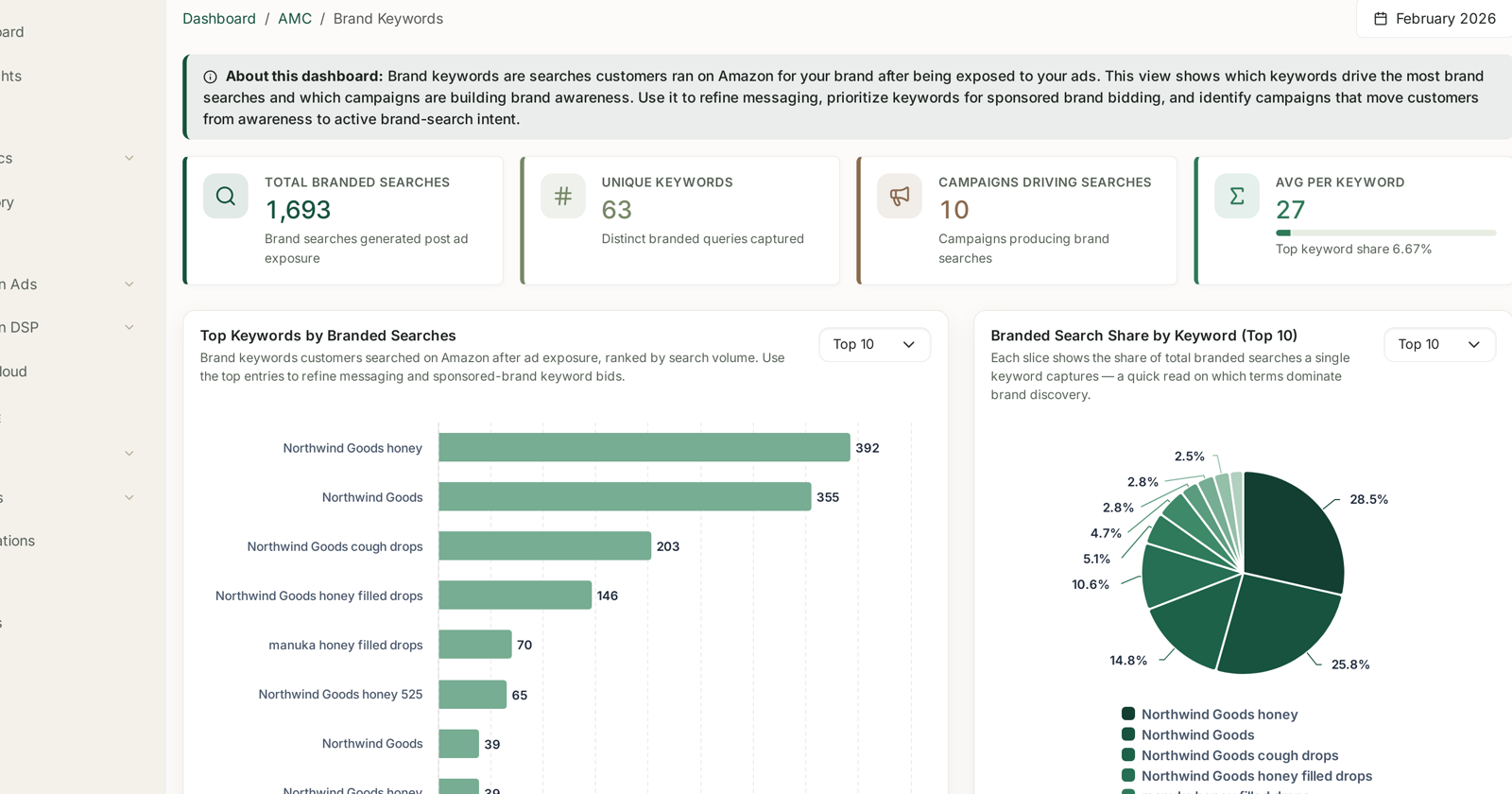
Brand keywords are searches customers ran on Amazon for your brand after being exposed to your ads. This view shows which keywords drive the most brand searches and which campaigns are building brand awareness.
| Tile | Reads |
|---|---|
| Total Branded Searches | brand searches generated post ad exposure |
| Unique Keywords | distinct branded queries captured |
| Campaigns Driving Searches | campaigns producing brand searches |
| Avg per Keyword | searches divided across those keywords |
The phrase that matters is post ad exposure. These are not all your brand searches — they are the ones AMC can tie to somebody who saw an ad first.
Top Keywords by Branded Searches
Brand keywords customers searched on Amazon after ad exposure, ranked by search volume. Use the top entries to refine messaging and sponsored-brand keyword bids.
The list is more interesting than the totals, because the words people add to your brand name tell you what your advertising made them think of.
A representative shape:
| Query | Searches |
|---|---|
| brand + category noun | 392 |
| brand alone | 355 |
| brand + a specific product | 203 |
| brand + a product variant | 146 |
| brand + a spec or strength | 65 |
Brand alone versus brand plus product is the split to read first. Brand alone means the ad built general awareness. Brand plus a product means it built awareness of a specific thing — which converts far better, because the shopper already knows what they want.
A product appearing that you did not advertise is a discovery. Somebody saw one ad and went looking for a different item in the range.
A competitor's product name attached to your brand is worth knowing about too, and it usually means your creative sat next to theirs.
Branded Search Share by Keyword
Each slice shows the share of total branded searches a single keyword captures — a quick read on which terms dominate brand discovery.
Concentration here is normal and mostly healthy. Two or three phrases usually take more than half the volume. What you are looking for is change: a phrase that climbs after a campaign launches is that campaign's fingerprint.
What it is actually for
Proving upper-funnel spend works. This is the honest answer to "what did the display campaign do?" when it produced few direct sales. Branded searches attributable to that campaign are real demand it created, and they will convert later through cheaper channels. See NTB Purchases: New Business by Campaign for the acquisition half of the same argument.
Deciding what to bid on in Sponsored Brands. Every phrase on this list is a term shoppers actually type. Bidding on your own brand is contentious, but bidding on brand + product phrases that your own advertising created is close to free money — the intent is already there.
Catching brand confusion. Misspellings and near-misses show up here. If a substantial share of your branded searches are a variant you do not bid on, a competitor may be picking them up.
Refining the message. If your campaign was about one benefit and the searches are all about another, the creative is landing differently than intended.
The relationship with the Ads brand split
The brand terms this dashboard uses are the same list that classifies your Amazon Ads queries as branded or non-branded. They are edited in one place — the Brand & Competitor Terms control on the SQP dashboard — and changing them changes both. See Generic, Branded and Competitor Terms.
That is worth knowing before you edit: adding a broad word to the list will inflate branded searches here and reclassify a large slice of your advertising at the same time.
What not to conclude
A branded search is not a sale. It is intent. Whether it converted is a different report.
Attribution is exposure-based. The customer saw an ad and later searched your brand. Some of them would have searched anyway — loyal customers do it constantly.
Low volume is normal for small accounts. A few hundred branded searches a month is a real signal; do not expect thousands unless you are running significant upper-funnel spend.
Monthly cohorts. One calendar month at a time, like every AMC dashboard. See Why AMC Data Is Monthly and Sometimes Empty.
Related
- Generic, Branded and Competitor Terms — where the brand list is edited.
- NTB Purchases: New Business by Campaign — the acquisition side of upper-funnel proof.
- Path to Purchase — where display actually sits in the journey.
- Prove your display campaigns created demand — the playbook.
- How Much to Spend on Branded Keywords — calibrating branded budget by market share.