

Most catalogs have one or two products that do the recruiting. They bring in people who have never bought from the brand before, and everything else sells to the customers those products earned.
Those products are worth defending differently from the rest of the catalog — and most accounts do not know which ones they are.
Time: about 30 minutes. Do it monthly.
Prefer to watch? Eighty-three seconds on finding the gateway ASINs and funding them differently.
Step 1 — Find the gateway products
AMC Cloud → NTB ASINs Analysis.
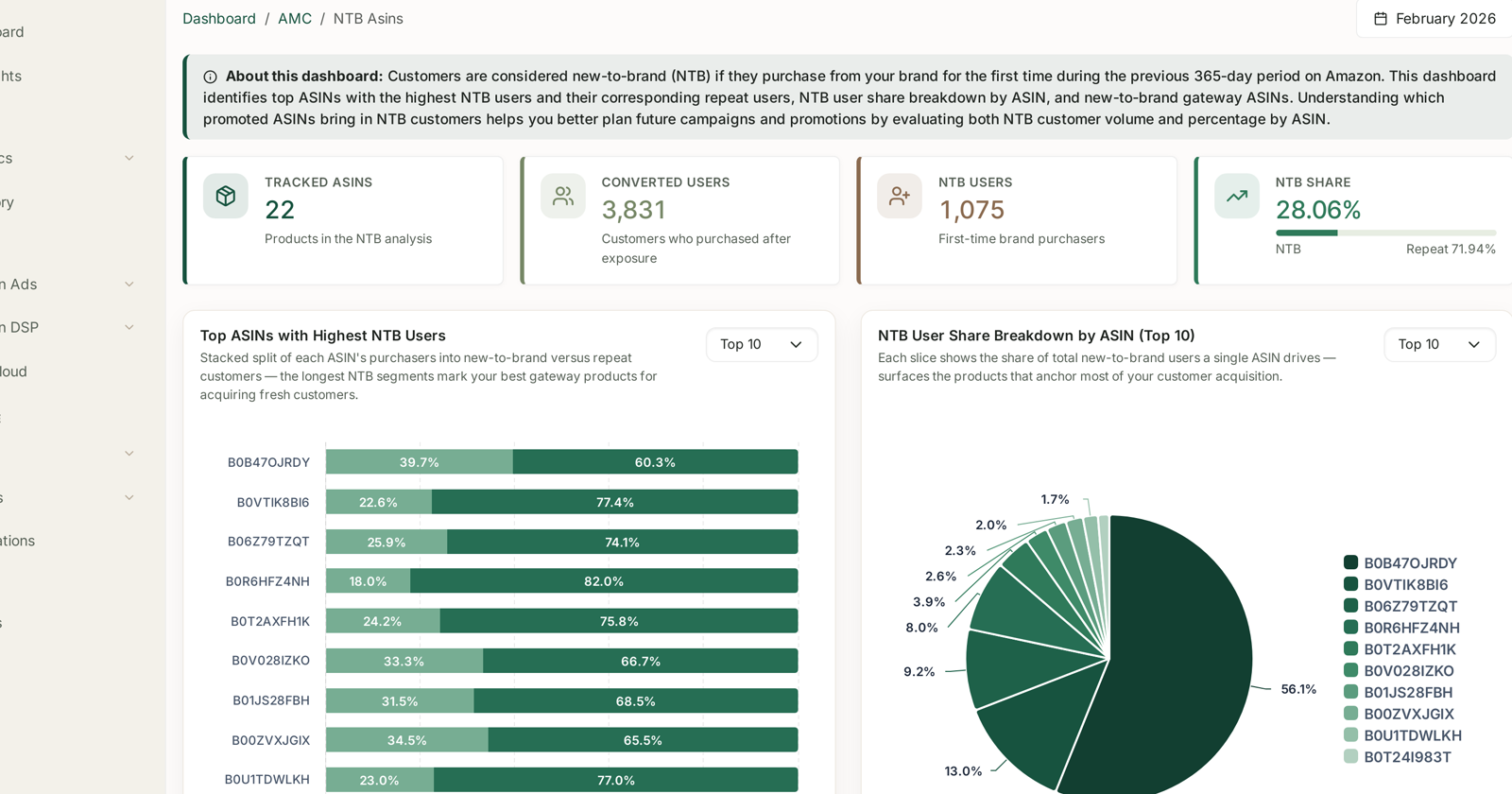
Read the two charts in the right order, because they answer different questions:
The doughnut first. It shows what share of all your new customers each ASIN brought. This is volume, and it is what actually matters to the business. Write down the products above roughly 10%.
Then the bars. These show each ASIN's rate — what proportion of its buyers were new. A product can be 80% new-to-brand and irrelevant, because almost nobody buys it.
Check the legend. On this dashboard the NTB segment is the lighter one, on the left. The other NTB dashboards do it differently. If your per-ASIN rates do not roughly average to the headline NTB Share tile, you have read them backwards.
What you are looking for: the shortlist of ASINs that between them account for most of your new customers. It is usually two or three, and it is usually more concentrated than anyone expects.
Step 2 — Check they cannot run out
Inventory.
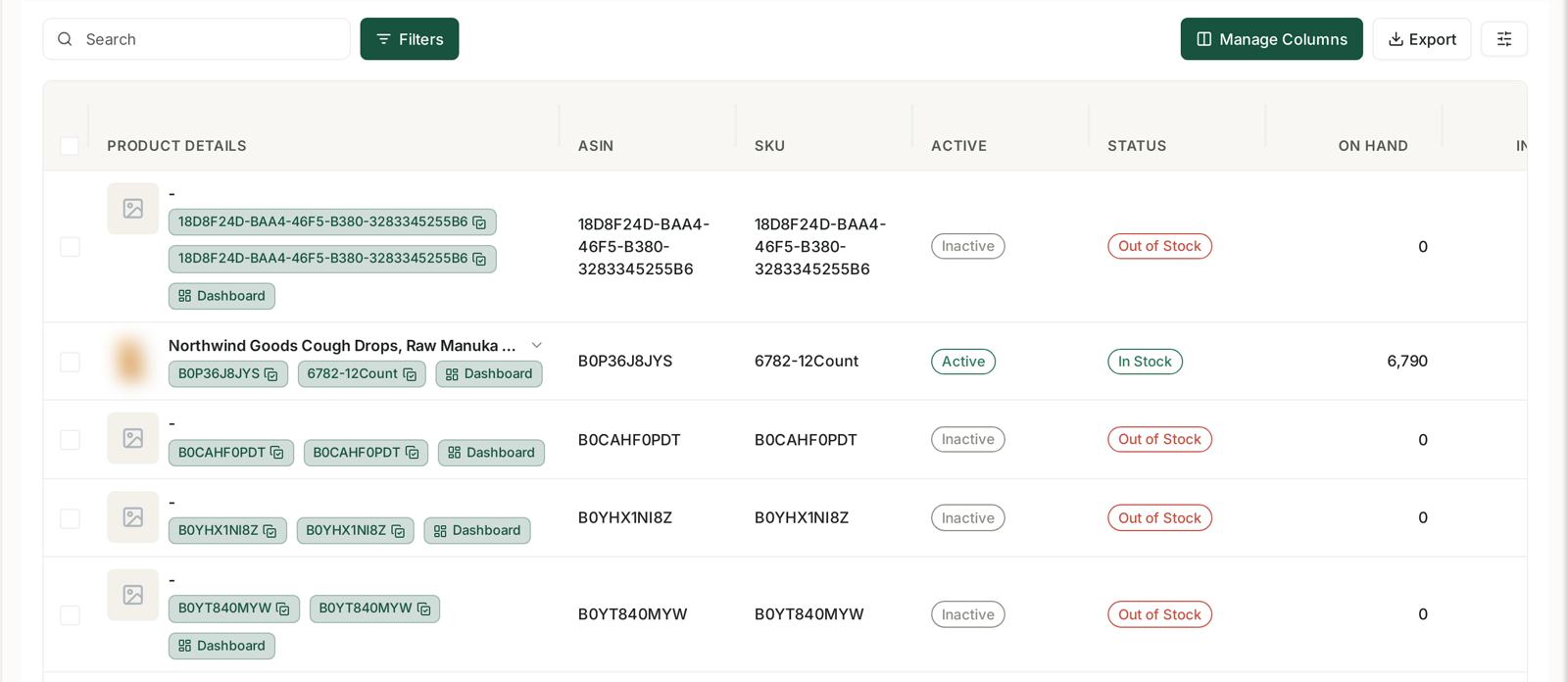
For every product on your shortlist, look at days of cover and the inbound quantity.
A stock-out on a gateway ASIN is not a sales problem for one product. It is an acquisition outage for the whole brand — for as long as it lasts, the thing that recruits your customers is switched off, and the effect shows up months later as a thin repeat cohort.
Set a higher bar for these products than for the rest of the catalog. If your general reorder point is three weeks of cover, make it five or six here. The extra holding cost is cheap next to a month of not acquiring anybody.
Step 3 — Alert on them specifically
Insights & Alerts.
The stock alerts fire on the whole catalog at fixed thresholds — Low Stock below three weeks of cover, Critical Stock below one week, Stockout Forecast at fourteen days' projected runway. See Alert Categories, Priorities and What Actually Triggers Them.
Those are the right rules and the wrong priority. A Critical Stock alert on a long-tail ASIN is routine; the same alert on a gateway product is an emergency, and the alert screen cannot tell the difference.
So keep the shortlist somewhere you will see it — a rule group name, a saved view, a note in the report you read every Monday. When an inventory alert fires, the first question is "is it one of the three?"
Step 4 — Fund them differently
Gateway products deserve a worse ACoS target than the rest of the catalog, and that is not a typo.
You are not buying that sale. You are buying a customer, and the return arrives on their second, third and fourth orders — none of which will ever be attributed to the ad you paid for. Judging a recruiting product on the efficiency of a single transaction guarantees you underfund it.
In practice:
- Give gateway ASINs their own rule group, so bid rules can treat them separately. See Rule Groups.
- Set their Target ACoS above your catalog average — how far above depends on how much a customer is worth to you over a year.
- Never let an automated pause rule touch them. Add them to a group your pause rules do not run on.
Step 5 — Watch their rank, not just their sales
Rank Tracker.
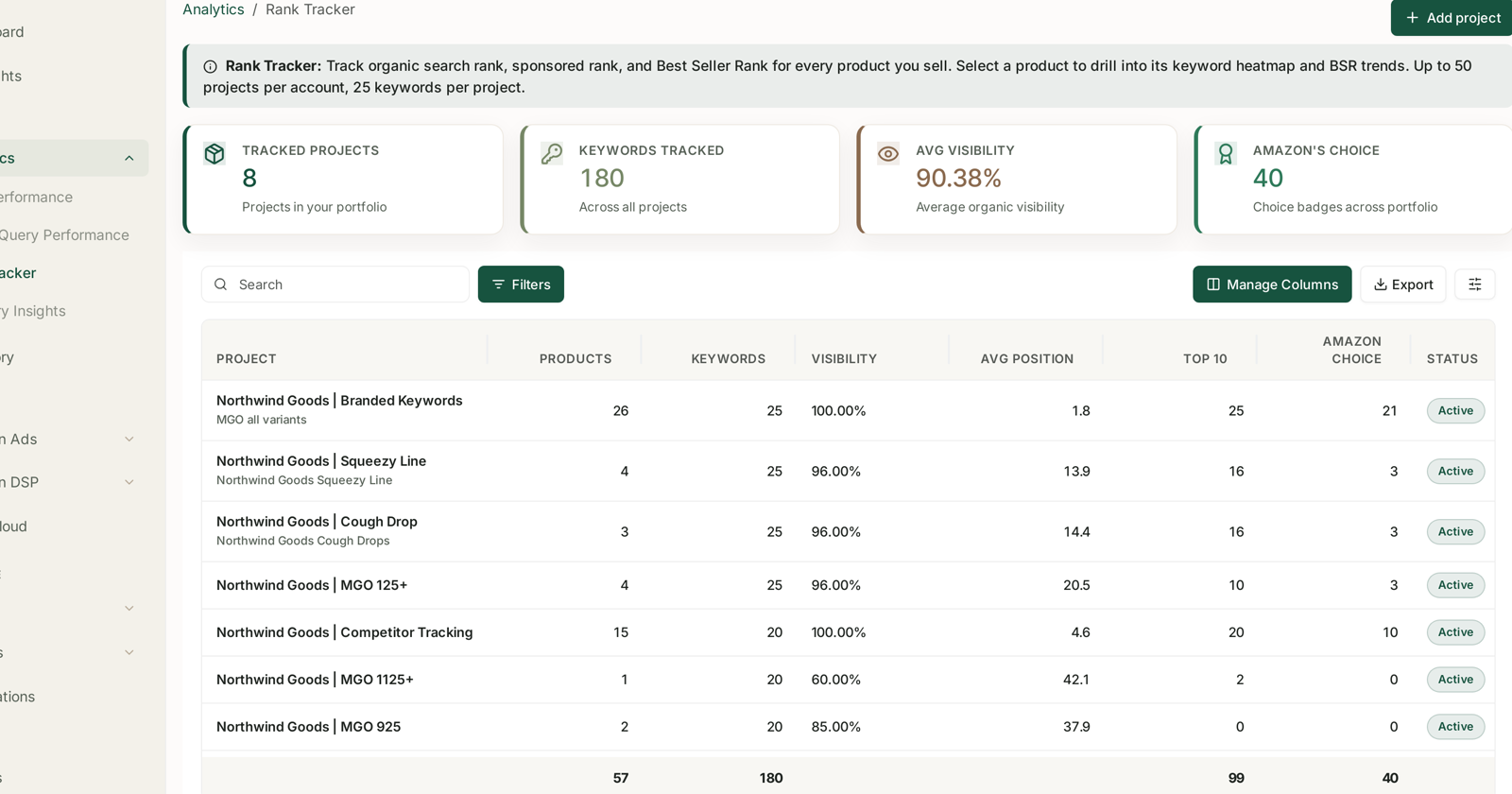
Put the shortlist in their own Rank Tracker project. Two things to watch:
Visibility and Top 10 — a gateway product sliding out of the first page stops being discovered by people who do not know you, which is precisely its job.
Amazon's Choice — the badge is worth more here than anywhere else in the catalog, because it moves the shopper who is not comparing. That shopper is, by definition, new to you.
What good looks like
After a month of this you should be able to answer four questions without opening anything:
- Which two or three ASINs bring most of our new customers?
- What is their stock cover today?
- What ACoS are we willing to pay on them?
- Has their rank moved this month?
If any answer is "I would have to check", that product is not yet protected.
What not to do
Do not confuse a gateway product with a best seller. They are often different, and the best seller usually sells to people who already know you.
Do not act on one month. NTB share moves with seasonality — gifting periods inflate it. Confirm the shortlist across two or three months before you rebuild budgets around it.
Do not assume it is permanent. A launch can become the gateway within two months. Re-run step 1 monthly; it takes five minutes once you know where to look.
Related
- NTB ASINs Analysis: Finding Your Gateway Products — the dashboard in step 1.
- Inventory: On Hand, Inbound, Days of Cover and Velocity — step 2.
- Rule Groups — how to fund them separately.
- Catch a stockout before it costs you rank — the companion playbook.
- Why Inventory Is the Second Pillar — why a stockout on a gateway product costs most.