

Most Amazon brands have three things holding them up. The products themselves. The inventory to sell them. And advertising, which is what makes anyone see either.
Get the first two right and a bad advertising account will still cap your growth. Get advertising right and it becomes the single largest lever you have on profit.
Prefer to watch? One hundred and four seconds on why advertising and organic rank are the same conversation, and why efficiency has to come before ranking.
What advertising is actually doing
An Amazon listing does not get discovered on merit. It gets discovered because it ranks, and it ranks largely because it sells. Advertising is how you buy the first sales that start that loop.
So sponsored ads do two jobs at once:
They sell directly. Someone searches, sees your ad, buys.
They raise organic rank. Those sales feed the sales velocity that decides where you sit organically for that search — which then brings sales you did not pay for.
That second job is the one people underrate. A campaign judged only on its own ACoS is being judged on half of what it did.
Growing the brand means growing profit
This is worth being blunt about, because it changes every decision that follows.
Revenue is easy to buy. You can double ad spend tomorrow and revenue will rise. Whether you kept any of it is a different question.
The number that matters is profit, and advertising affects it from both directions: it adds sales, and it is a cost. A brand can grow revenue for a year while its advertising quietly eats the margin that growth was supposed to produce.
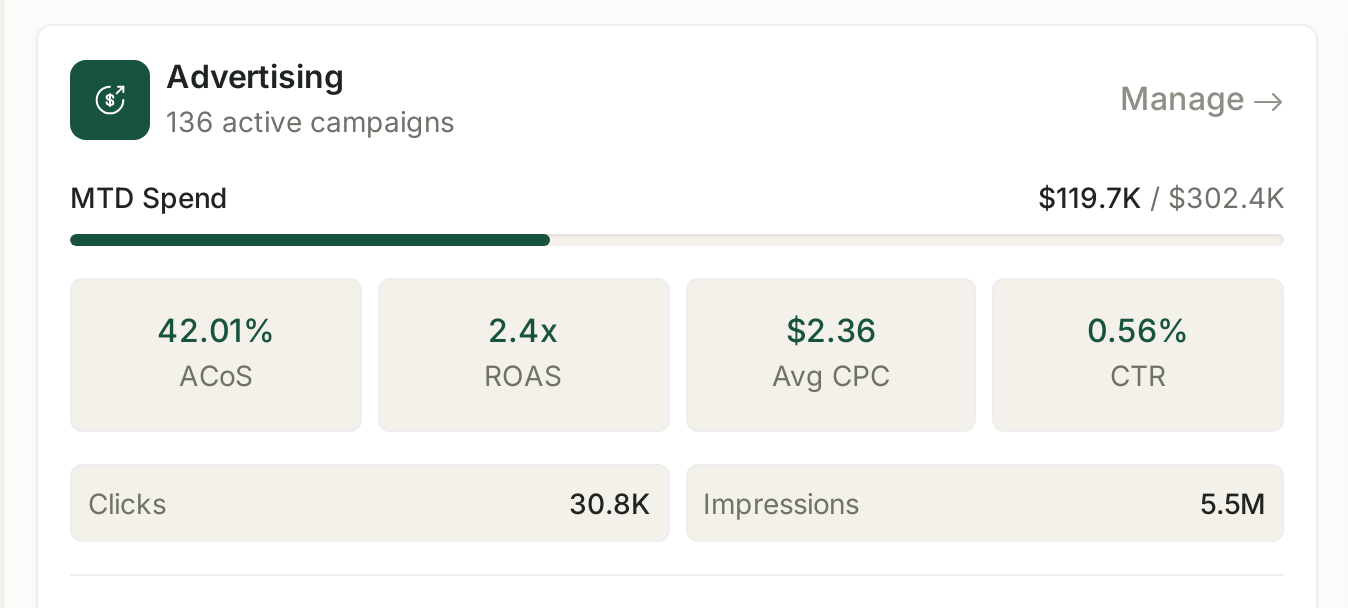
Which is why TACoS — ad spend as a share of total sales — is the honest measure of the account. ACoS tells you whether a campaign is efficient. TACoS tells you whether the business is.
Efficiency first, ranking second
There are two distinct pieces of work, and doing them in the wrong order wastes a lot of money.
Stage one is making existing spend efficient. Most accounts are carrying targets that have not converted in months, placements bid above what they return, and search terms that were never turned into keywords. None of that requires new budget to fix. It requires finding it.
Stage two is ranking, which means deliberately buying traffic on chosen keywords to move organic position, accepting a worse short-term ACoS in exchange for a position that keeps paying afterwards.
Do stage one first. Ranking campaigns are expensive by design, and running them on top of an account that is already leaking means you cannot tell which cost was the investment and which was the waste. Fix the leak, then open the tap.
What that looks like in practice
The work is unglamorous and mostly consists of reading the same handful of reports on a schedule:
What spent and did not convert. See Cut Wasted Ad Spend in an Afternoon.
What converted and is not yet a keyword. See Harvest Winning Search Terms into Exact-Match Campaigns.
Where the ads appeared, and whether the bid matched. See Audit Your Placement Multipliers.
How spend is distributed across ad types and placements.
Done every week or two, that is most of the job. The reason accounts drift is not that the work is hard, it is that nobody is scheduled to do it.
Why the reports matter more than the tactics
Advertising advice tends to arrive as tactics — a bid rule, a match type, a structure. Tactics are fine, but they only help if you can see what is happening.
An account you cannot read is an account you cannot improve, and the console makes reading it harder than it needs to be: the answer is scattered across screens, the date range resets, and the ad types report on different attribution windows.
That is the gap TrackIQ exists to close. Every screen in Amazon Ads holds the date range you set, keeps consistent columns, and puts campaigns, keywords, search terms and placements in one place so a fortnightly review takes minutes rather than an afternoon of exports.
Where to start
Score what you have before changing anything. Score Your PPC Performance walks through eight reports that tell you, numerically, which parts of the account are being managed and which are not.
Then fix the lowest scores first. That is almost always where the money is.
Related
- Profit Campaigns and Ranking Campaigns — the two jobs a campaign can have, and why they are judged differently.
- Amazon PPC: Core Terms and Metrics — the vocabulary this assumes.
- Understanding ROAS and Key Amazon Advertising Metrics — the metrics, defined.
- The Nine-Report PPC Routine — the routine that keeps existing spend efficient.
- Setting Target TACoS per Product — turning the TACoS argument into a number per product.
- Before You Add a Product — maximising what you have before adding more.