

The weekly meeting works because it puts the same numbers in front of you every week — and the value is entirely in the comparison, not in any single week's figure.
Five weeks in, you know what normal looks like for each product. A drop that would be invisible on its own becomes obvious against the run of weeks beside it.
These are the four checks, in the order to run them.
Prefer to watch? One hundred and seventy-five seconds on reading each metric against its own recent history, checking the market before judging a sales trend, and only tracking what you will act on.
Start with the 80/20
Work your best products first, while you are fresh.
They deserve the most attention and they get it least, because a meeting that runs top to bottom alphabetically spends its energy on products that do not matter.
Check 1: sales trend
Weekly sales, daily sales, revenue.
Read the trend against the previous weeks, not the absolute number.
Then check the market, for your leading products
Search your main keyword, look at the top and direct competitors, and judge whether the market overall is normal, up, or down.
This is what makes the sales trend interpretable. Sales up 10% while the market is up 100% is a bad week wearing a good number.
After ten or fifteen weeks of doing this you will know your competitors' normal ranges by eye, which is when the check gets fast.
Then act on what you find
Trend positive → change less. If it is compounding, let it compound. Confirm ACOS and TACOS are in range, confirm inventory is adequate, and keep whatever is working running — deals, outside traffic, promotions.
Trend negative while the market is normal → act now. That is your product losing ground rather than the category softening.
Your options, in rough order of speed: raise TACOS and push it through advertising, run a deal, drive outside traffic, start a promotion. Then, deeper: check whether ACOS has deteriorated, test new campaigns, or work on the listing itself.
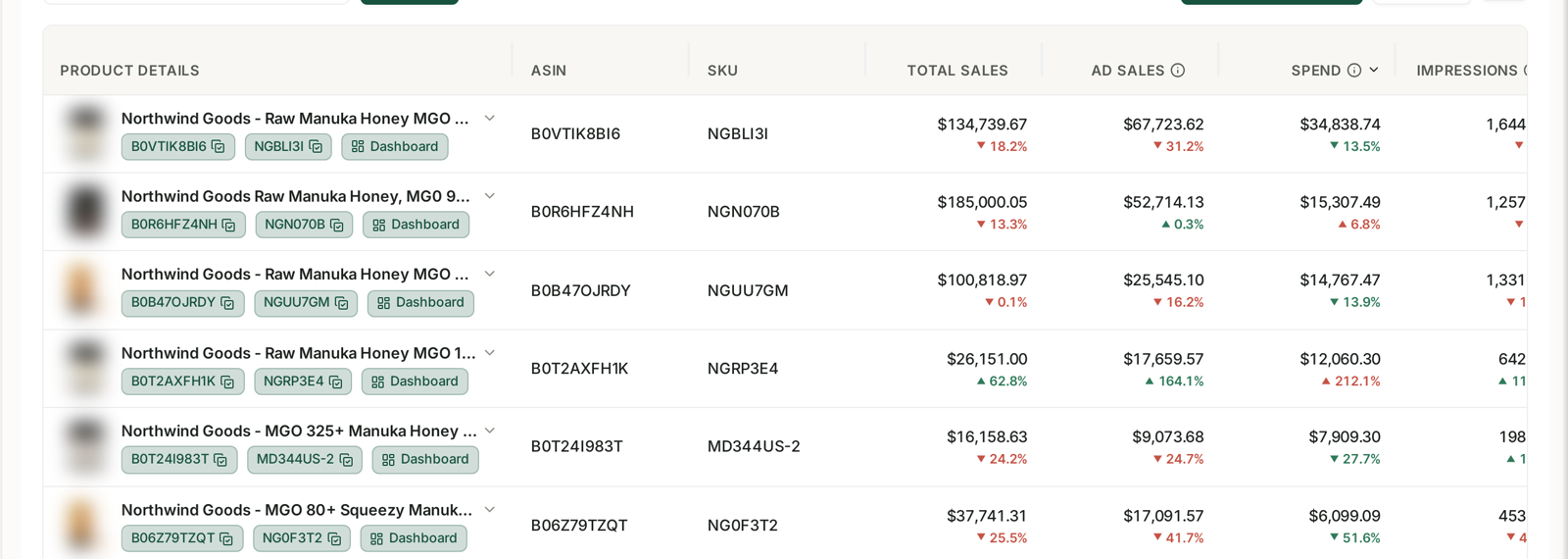
The whole method depends on last week sitting next to the previous ten, per product — see Understanding Business Reports. A single week's export tells you a number; the run of weeks tells you whether to act.
Check 2: sales against inventory
Compare the sales pace to the cover you have left — see Monitoring Inventory Against Sales.
Selling faster than planned is only good news if you can supply it. This is where budgets get cut on products heading for a stockout and raised on products back in stock — see Going Out of Stock.
Check 3: sessions and conversion
Both from Business Reports, both read against the previous weeks.
Sessions. Five weeks running at 5,000–6,000 a week, then suddenly 3,000, is a dramatic change that has to be investigated this week.
Block time for it. Look at the market, the listing, the back end — something specific caused it, and a fall that size will show up in sales immediately.
Conversion. Five weeks at 65–75% in Business Reports, then 55%, is a ten-point drop and worth one to two hours of dedicated investigation.
Business Reports conversion is not your true conversion rate — it is calculated its own way. That does not matter here, because you are comparing it against itself.
Check 4: rating
Watch the trend, not the value.
4.5 → 4.4 is alarming, even though 4.4 is a perfectly good rating. The direction is what matters, because a trend continued takes you to 4.0, and at that point the product is in serious trouble.
Address negative rating trends the week you see them — see The Rating Recovery Action Plan.
Only track what you will act on
You can add as many columns as you like. Add only the ones that will change what you do.
A metric you look at and never act on costs you time every single week, forever.
Why the weekly cadence is the point
Every one of these checks is a comparison against recent history, and that only exists if you look at the same numbers on the same schedule.
The output is tasks. Each check that fails produces a specific investigation with time blocked against it — see The Brand Manager's Calendar.
That is what makes the meeting powerful: you find negative trends within a week of them starting, rather than at the end of a quarter.
Common mistakes
Reading this week's number without the previous weeks beside it.
Working the catalogue in order rather than starting with your best products.
Judging sales without checking the market, and misreading a category-wide move as your own.
Investigating a session drop next week. A 40% fall is this week's job.
Reacting to a rating value rather than a rating trend.
Adding columns you never act on.
Leaving the meeting without tasks. The checks are only useful if they produce blocked time.
Related
- The Weekly Meeting — the meeting these checks make up.
- TACOS and ACOS Range Monitoring — the two advertising checks that follow these.
- Triage a Rank Drop Across Your Top Keywords — where a session drop investigation usually goes next.