

Amazon credits a sale to an ad click for up to 7 days on Sponsored Products and 14 on the other formats. Time to Conversion shows you how much of that window you actually use — and for most accounts the honest answer is: almost none of it.
Prefer to watch? Eighty-two seconds on the nine buckets, and how soon you may judge a campaign.
The question it answers
How long does it take your customers to have an attributed conversion after last seeing your ad? Sometimes conversions happen rapidly within a few minutes, while other times it might take days for customers to complete the purchase.
Two controls sit above the dashboard: Campaign Types (all, or one format) and Metric (Purchases, and the other conversion measures).
The headline numbers
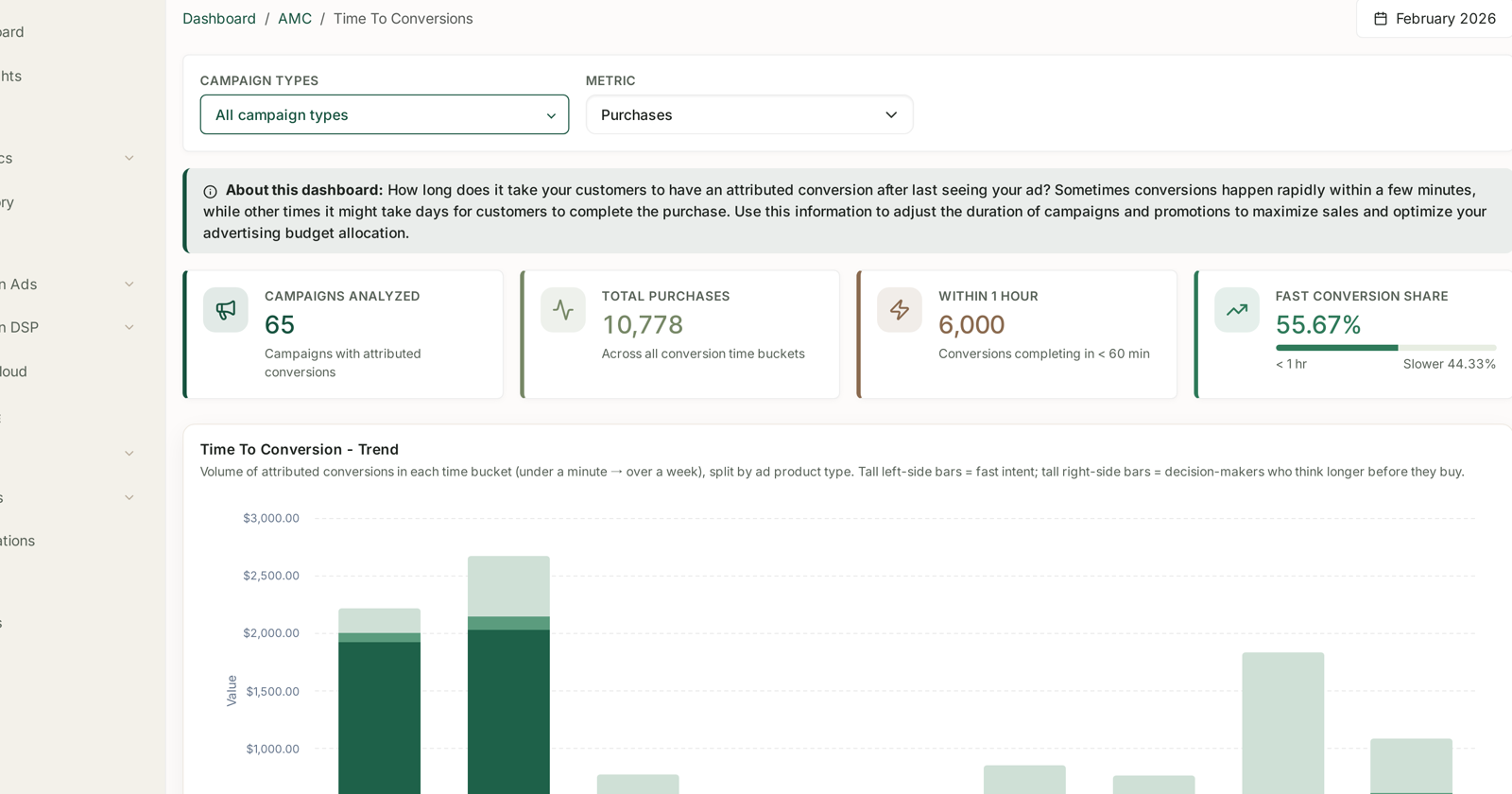
| Tile | Reads |
|---|---|
| Campaigns Analyzed | campaigns with attributed conversions |
| Total Purchases | across all conversion time buckets |
| Within 1 Hour | conversions completing in under 60 minutes |
| Fast Conversion Share | the same as a percentage, slower beside it |
A fast conversion share around 56% is typical for a considered-but-familiar category. Over half of everything the ads got credit for happened inside the first hour.
The nine buckets
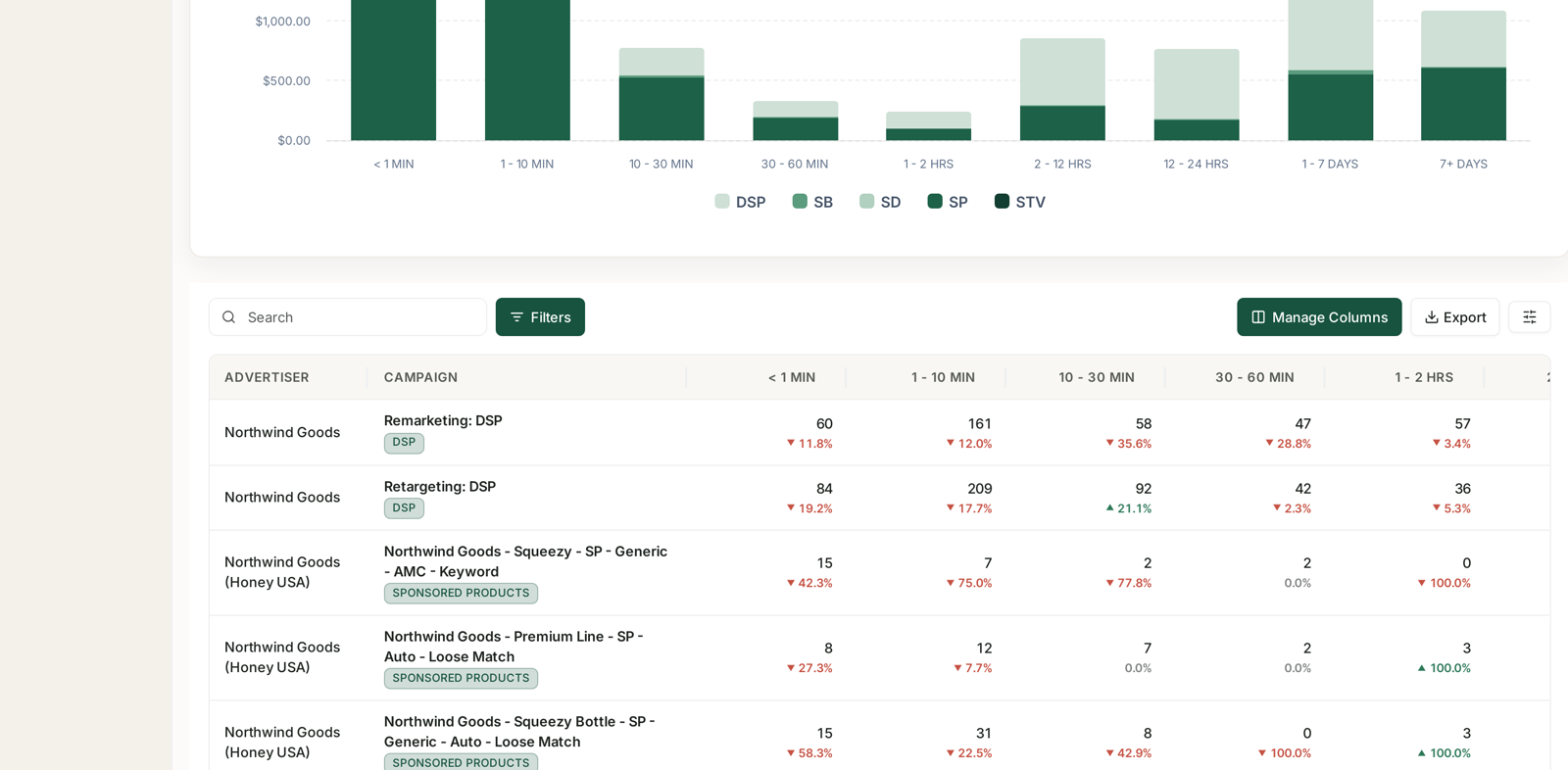
Volume of attributed conversions in each time bucket (under a minute → over a week), split by ad product type. Tall left-side bars = fast intent; tall right-side bars = decision-makers who think longer before they buy.
< 1 min · 1–10 min · 10–30 min · 30–60 min · 1–2 hrs · 2–12 hrs · 12–24 hrs · 1–7 days · 7+ days
The legend carries five ad types — DSP, SB, SD, SP and STV (Streaming TV) — so a format that appears nowhere else in TrackIQ's reporting shows up here if you run it.
The shape is usually a U
The distribution that turns up most often is bimodal: a large spike in the first ten minutes, a trough through the middle of the day, then a second rise at 1–7 days and beyond.
Those are two different customers, and they are worth naming separately:
The first spike is intent that already existed. Somebody searching for the thing, clicking, buying. The ad did not create the demand; it captured it. This is where most Sponsored Products volume sits.
The second rise is consideration. People who saw the ad, left, thought about it, and came back. Higher-priced items, first-time buyers of a category, gift purchases.
The trough in between is real, not noise. Nobody spends four hours deciding. They either buy now or they buy another day.
What it changes
Your attribution window. If 95% of conversions land inside 24 hours, the 7- and 14-day windows are contributing almost nothing — and the reporting lag they cause is a real cost. It explains why yesterday's numbers look thin, and it tells you how many days to ignore in a rule's look-back. See Look-back Windows and Adjustment Frequency.
Promotion length. A 24-hour promotion on a catalogue that converts in minutes captures nearly all of the available lift. On one with a heavy 1–7 day tail, the same promotion ends before half the buyers have decided.
How soon you judge a campaign. If your conversions arrive within an hour, a new campaign can be read in two or three days. With a long tail, reading it that fast will make it look like a failure.
Which format you blame. Filter by campaign type. Sponsored Products usually skews fast; DSP and Streaming TV skew long, because they reach people who were not shopping when they saw the ad. A DSP campaign judged on same-day conversions will always look worse than it is.
The campaign table
Below the chart, every campaign appears with a column per time bucket, a count in each cell and a change against the previous period. Advertiser is shown too, so multi-entity accounts can tell the DSP advertiser from the seller account.
Sort by the long buckets to find the campaigns doing the patient work — those are the ones most likely to be undervalued by a short attribution view, and the ones most at risk from a rule that pauses on recent performance.
What not to conclude
Fast does not mean better. A conversion at 30 seconds may have happened without the ad. A conversion at five days is more likely to have been influenced by it.
This is time since last ad exposure, not time since first. A customer who saw four ads over a fortnight and bought an hour after the fourth appears in the < 1 hr bucket. Path to Purchase is the dashboard for the full journey.
The buckets are conversions, not customers. Repeat buyers appear repeatedly.
Monthly cohorts. Like every AMC dashboard, one calendar month at a time. A promotion inside the month will bend the shape.
Related
- Path to Purchase: Which Ad Sequences Actually Convert — the whole journey, not the last step.
- Why SP, SB and SD Numbers Don't Add Up — the attribution windows themselves.
- Look-back Windows and Adjustment Frequency — putting this into a rule.
- Why AMC Data Is Monthly and Sometimes Empty — the reporting cadence.