

Asking a supplier to lower their price gives you one number to argue about, and no basis to argue from.
Asking them to break that price into its components gives you twenty numbers — and every one you can compare across suppliers becomes a negotiating point.
It also surfaces something you would never otherwise see: which parts of your product cost far more than they are worth.
Prefer to watch? One hundred and seventy-nine seconds on when to send the breakdown, comparing line items across suppliers, and sourcing a component your supplier never negotiated on.
Where this sits in sourcing
Get quotes from 30–50 suppliers.
Shortlist the best and order samples.
Then, while you are waiting for samples, send your top 5–10 a cost breakdown sheet.
That waiting period is otherwise dead time, and it is when suppliers are most motivated to be transparent — they are still competing for the order.
What the sheet asks for
The supplier fills in only their own cells. Keep the structure fixed so the responses stay comparable.
Company information: contact name, email, company.
Then, line by line, every cost component:
| Field | What it captures |
|---|---|
| Material description | raw material, purchased part, labour, external process, or overhead |
| Gross weight per part | where applicable |
| Material price per unit | the cost of that line |
The sheet totals to the unit price they quoted you.
A worked example — a garlic press
| Component | Weight | Cost |
|---|---|---|
| Raw material | 1.25 kg | $1.70 |
| Steel sieve insert | 1.1 kg | $0.35 |
| Chrome plating process | ||
| Labour | ||
| Overhead / factory | ||
| Total unit price | $1.75 |
The value is not the total. You already knew the total. It is the lines.
Two things the breakdown gives you
1. Line-by-line comparison across suppliers
Supplier A quotes $0.35 for the steel insert. Supplier B quotes $0.50.
That is a specific, evidenced negotiating point — far stronger than "your price is too high", because it is a question the supplier has to answer with a reason rather than a discount.
Do this across every line and you find the few cents each, repeatedly, that add up.
2. Components that cost more than they are worth
Sometimes a line comes back far higher than expected relative to what it contributes. An insert card, a piece of packaging, a secondary process.
Then you have two options:
Remove it, if the cost outweighs the benefit.
Or source it yourself and send it to your supplier.
That second option is genuinely underused, and it works for a structural reason. Your supplier sources that component too, but it is a trivial part of their overall production — so they never negotiated hard on it. You, buying it for one product at real volume, frequently can.
Most worthwhile on high-revenue products, where a few cents a unit is a serious annual number.
Doing the arithmetic before you negotiate
Work out what a cent per unit is worth to you — annual volume × the saving — before the conversation.
That number decides how hard to push, and on which lines. Five cents on a product selling 200 units a day is $3,650 a year; on one selling 5 a day it is $91 and not worth the relationship cost.
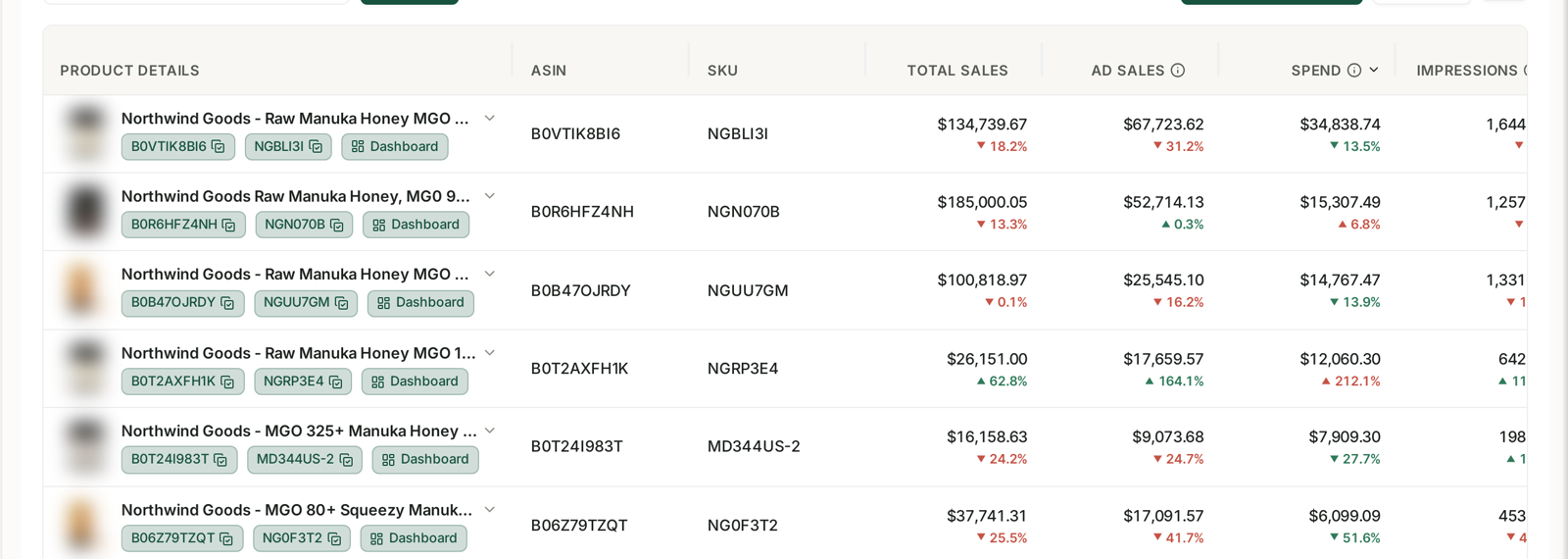
Knowing which products carry enough volume to justify a hard negotiation is the input to all of this — see Where Your Margin Actually Goes. It also tells you where a COGS reduction actually lands: on margin, or on the room you have to advertise.
Common mistakes
Asking for a lower price instead of a breakdown, and having nothing to negotiate with.
Letting each supplier use their own format, so nothing is comparable.
Sending it after you have chosen a supplier, when their incentive to be transparent has gone.
Only comparing totals, and missing the line items where the real difference sits.
Never considering self-sourcing a component the supplier has no reason to negotiate on.
Negotiating hard on a low-volume product, where the saving does not justify the relationship cost.
Related
- Negotiating Lower COGS — the wider sourcing negotiation.
- Where Your Margin Actually Goes — what a COGS reduction is worth.
- Better Payment Terms From Suppliers and Freight — the other thing to ask the same supplier for.