

An Optimization Group is a named set of campaigns you want to see and manage together. It sits under Amazon Ads, at the top of the section — above Campaigns, because it is the layer you organise everything else with.
First, a name clash worth clearing up.
Prefer to watch? Seventy-two seconds on the name clash with rule groups, and grouping by intent.
Optimization Groups are not Rule Groups
Two different features, two different screens, similar names.
| Optimization Group | Rule Group | |
|---|---|---|
| Lives under | Amazon Ads | Automations |
| Is for | reporting on a set of campaigns | targeting a set with a rule |
| Screen shows | performance totals | a campaign count |
An Optimization Group answers “how is this part of my account doing?” A Rule Group answers “what should automation act on?”
Most accounts want both, organised the same way. See Rule Groups.
The screen
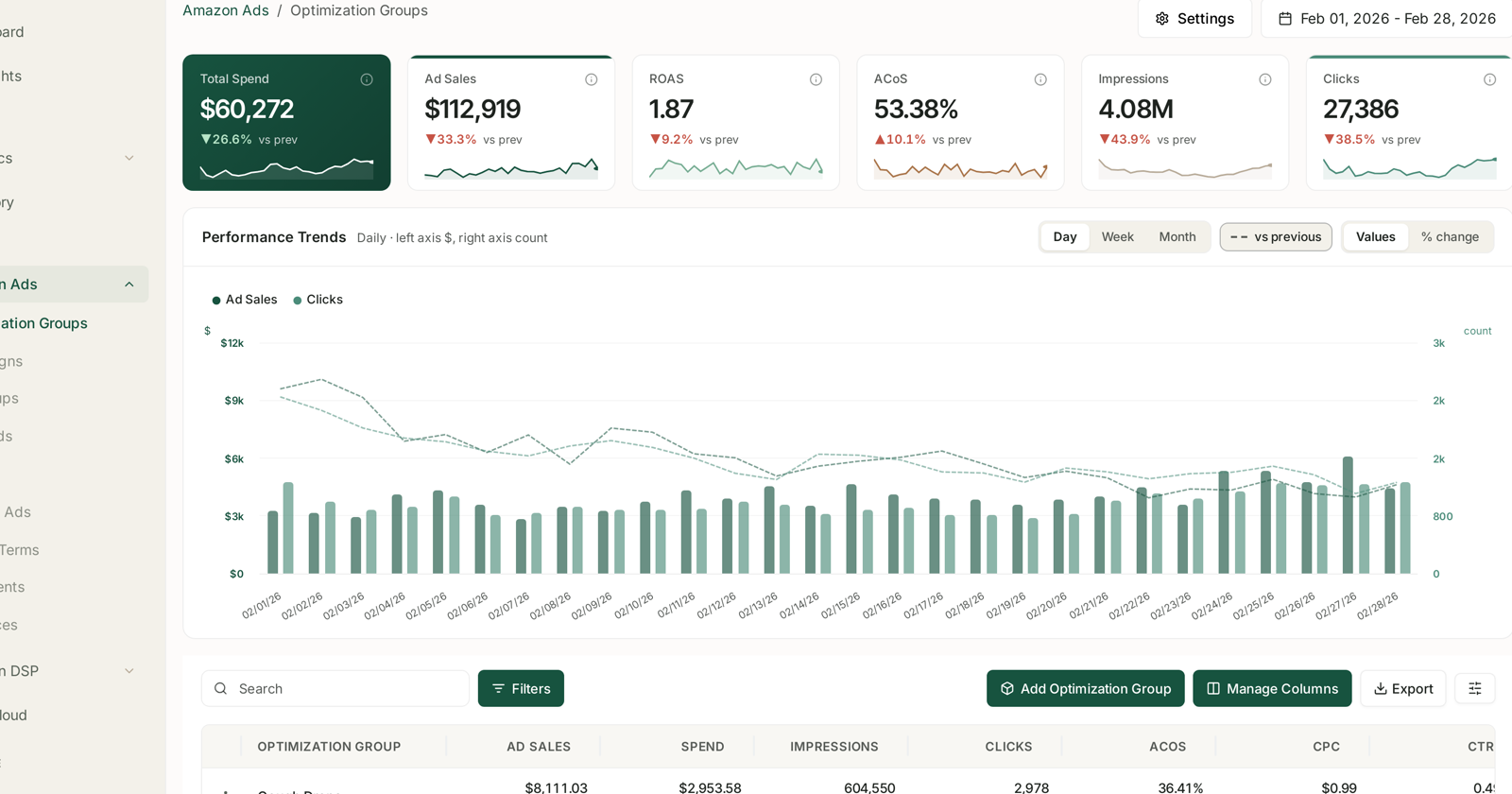
Standard Amazon Ads layout — six headline tiles, Performance Trends with the Day/Week/Month and Values/% change controls — plus + Add Optimization Group.
The table gives you performance per group:
Optimization Group, Ad Sales, Spend, Impressions, Clicks, ACoS, CPC, CTR.
That is the value in one line: a P&L per part of your account, rather than per campaign. A campaign list of two hundred rows does not tell you whether your hero product line is working. A grouped view does.
Group by intent, not by convenience
The same argument as rule groups, and it matters more here because these groupings usually become your rule groups too.
Campaigns do different jobs, and a group that mixes them produces an average that describes nothing:
| Job | What good looks like |
|---|---|
| Defending a term you own | a higher ACoS is the price of holding ground |
| Launching | ACoS is expected to be poor — you are buying rank |
| Harvesting | the efficiency target genuinely applies |
Put all three in one group and its ACoS is a blend of three intentions. It will look stable while each part drifts.
Group instead by product line, and then split defended campaigns out from the rest. That is the structure well-run accounts converge on.
What to do with it
Read groups before campaigns. Six group rows tell you where to look faster than two hundred campaign rows.
Compare groups against each other, not against a single target. Your launch group should look worse than your harvest group.
Use vs previous. A group whose ACoS moved while its spend did not is the one to open.
Then point rules at the same structure. Once a group reflects a real intent, a rule scoped to the matching rule group inherits that intent. See Targeting Rules and Campaign Rules.
Two cautions
A campaign in the wrong group corrupts two numbers — the group it left and the group it joined. Worth a check when performance moves for no obvious reason.
Groups do not change what a rule sees. A rule acts on its rule group, not on an optimization group with the same name. Keeping the two aligned is a discipline, not something the product enforces.
Related
- The Automations Screen — where rules and rule groups live.
- Rule Groups — the automation-side equivalent.
- Campaigns: Budgets, Placement and Audience Adjustments — the level below this one.
- Restructure Your Campaigns Before You Optimise — portfolios, naming and one parent ASIN per campaign.