

The Rank Tracker records, for every keyword and product in a project, where that product appeared in Amazon's search results on a given day.
Prefer to watch? Fifty-seven seconds on reading rank correctly.

Two ranks, recorded separately
Organic rank is your position in the unpaid results. It reflects relevance, sales history and conversion — the things you influence slowly.
Sponsored rank is your position among the sponsored placements for that keyword. It reflects your bidding, and it can change within a day.
They are tracked independently, and one does not imply the other. A product can rank well organically for a keyword you are not bidding on at all, and vice versa.
Lower is better
Rank is a position, not a score. Rank 1 is the top of the results. A product moving from rank 12 to rank 4 has improved.
This catches people out when sorting: sorting a rank column ascending puts your best positions first.
A blank rank is not rank zero
If a cell is empty, the product was not found within the depth that was checked that day. It does not mean the product ranked zero, and it does not mean it was delisted.
The practical reading of a blank is “not visible for this keyword”. That is meaningful information — a product that used to appear and now does not has lost visibility — but it is different from a numeric drop.
A product may also have a blank sponsored rank simply because you were not running ads against that keyword that day. Sponsored data is naturally sparser than organic.
Only tracked keywords are recorded
The Rank Tracker records what you have asked it to record. A keyword that is not part of a rank project has no history, and adding it today does not backfill yesterday.
This is worth planning: decide the keywords that actually matter for a product and add them early, because the value of rank data is in its history.
Your products and your competitors'
A rank project can track ASINs that are not yours. Each tracked product is marked as either your own listing or an external one added purely for comparison.
That makes a project a genuine head-to-head: the same keywords, the same day, your position and theirs side by side. When you are losing ground on a keyword, this is what tells you whether it is because a specific competitor gained.
Rank tells you position, not demand
The Rank Tracker does not tell you how many people search a keyword. Ranking first for something nobody searches is worth nothing.
For search volume, use Search Query Performance, which reports market-wide impressions per query. The two together are the useful pair: SQP tells you which keywords are worth winning, Rank Tracker tells you whether you are winning them.
Related
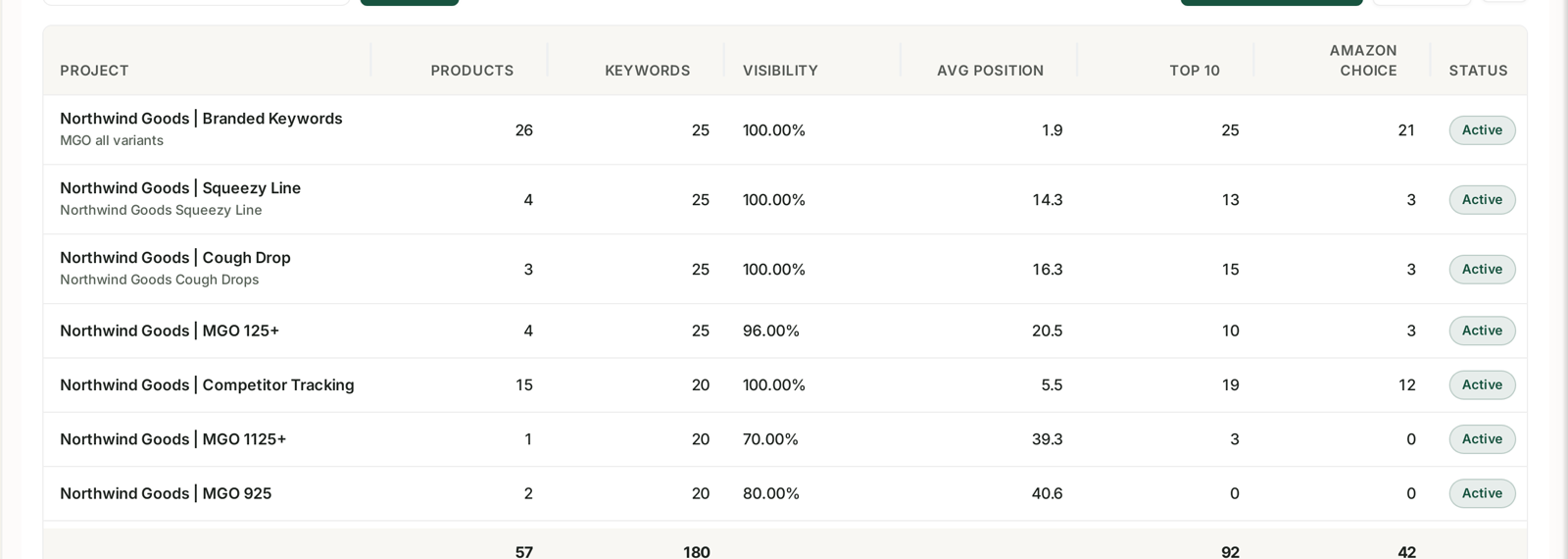
- Reading Visibility, Average Position and Top 10 — the tiles above the split.
- Rank Tracker: Creating Your First Project — setting tracking up.
- Rank Data Shows Blank — when one side is empty.