

DSP ad groups are where a campaign's strategy becomes concrete. A single remarketing campaign typically splits into several ad groups — one per supply source and device combination — and this screen shows which of those splits is actually working.
Prefer to watch? Sixty-seven seconds on reading the names, and the comparisons they make possible.
Ad Groups by Campaign
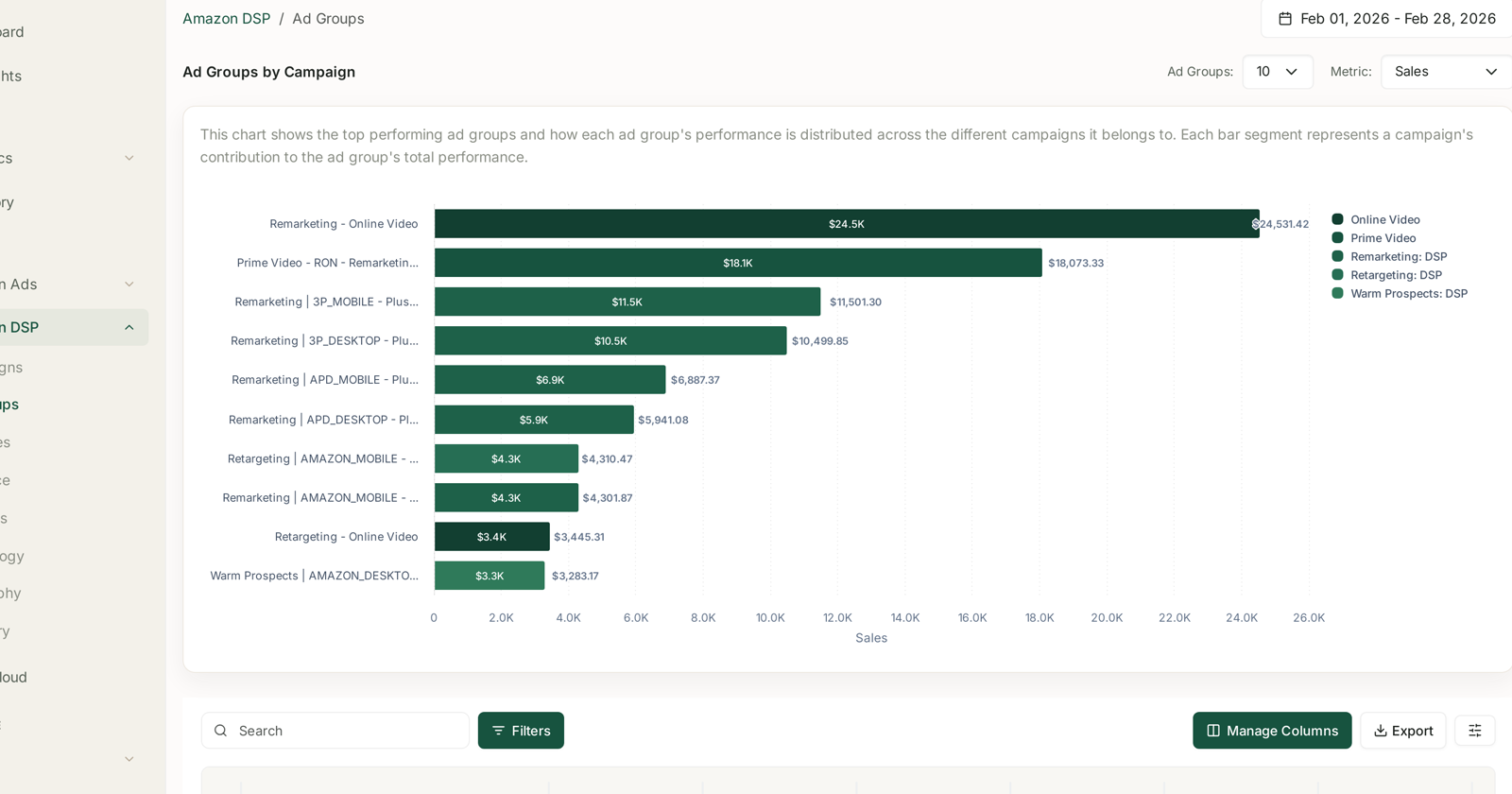
The same stacked treatment used on Creatives and Products: a bar per ad group, segmented by the campaigns contributing to it, with Ad Groups (how many to show) and Metric controls above.
The legend names the campaign types — Online Video, Prime Video, Remarketing: DSP, Retargeting: DSP, Warm Prospects: DSP.
Read the names — they carry the structure
DSP ad group names are unusually informative, because they encode the three things that define the ad group:
Remarketing | 3P_MOBILE — … Retargeting | AMAZON_MOBILE — … Warm Prospects | AMAZON_DESKTOP — …
| Part | What it says |
|---|---|
| Audience strategy | Remarketing, Retargeting, Warm Prospects |
| Supply source | AMAZON (Amazon-owned), APD (Amazon Publisher Direct), 3P (third-party) |
| Device | MOBILE, DESKTOP, or a format like Online Video |
That naming is what makes the screen readable. Two ad groups from the same campaign differing only in supply source is a controlled comparison — same audience, same creative, different inventory. The gap between them is attributable.
The comparisons worth making
Same audience, different supply. Remarketing | AMAZON_MOBILE against Remarketing | 3P_MOBILE. Amazon-owned inventory is usually more expensive and better-converting; third-party is cheaper and more variable. Whether the premium is worth it is exactly what this comparison answers, and it is invisible at campaign level.
Same supply, different device. 3P_MOBILE against 3P_DESKTOP. Usually mirrors the pattern on DSP Technology — mobile carries volume, desktop converts better.
Same everything, different audience stage. Remarketing against Warm Prospects. Remarketing will always look better on efficiency. That is not a finding; it is the definition of the two strategies. See DSP Campaigns.
Change the metric
Sales is the default and it rewards whichever ad group got the most budget. Switch it to see efficiency, and the ranking usually rearranges.
The ad group with the largest bar is often just the one that was funded most. The interesting one is the small bar with good rates — an ad group that works and is not being given room.
What not to conclude
Do not cut prospecting ad groups on efficiency. They feed the remarketing pools that look so good. Cutting them improves your averages this month and starves the funnel next quarter.
Small ad groups are noisy. A handful of orders makes any rate meaningless.
14-day attribution. Recent days under-report. See Why SP, SB and SD Numbers Don't Add Up.
Changes happen in Amazon's DSP console. TrackIQ's DSP reporting is read-only — this is diagnosis, not the control panel.
Related
- DSP Campaigns — the funnel these ad groups sit inside.
- DSP Technology — the device split, across all ad groups at once.
- DSP Creatives — which asset is running in them.