

A new product has three jobs: collect reviews, climb organically, and find the keywords and ASINs it converts on. All three run on advertising, and advertising runs on conversion rate.
Which is the problem. A new listing has no reviews, so shoppers have no reason to choose it, so it converts badly, so ACOS is high — and the very campaigns meant to fix the review problem are throttled by it.
Price is the fastest lever you have on that loop.
Prefer to watch? One hundred and sixty-eight seconds on checking ACOS against your margin first, finding the price that makes you the best offer, and why the test is reversible.
First, check whether you have the problem at all
If your ACOS is running 10–20% above your gross profit margin, your PPC is converting acceptably. Leave the price alone and keep working the campaigns.
This framework is for the other case: hard to find any keyword or ASIN with a decent ACOS, and a conversion rate that is low against your category.
It fits best on products with high gross margins, or products whose average ACOS has been very high from the start.
Step 1: find out where you actually stand
Build the comparison — 7–10 direct competitors, their prices, their pack sizes, their price per unit, reviews and ratings. See The Product Comparison Table.
What you are looking for is who currently offers the best value for money in the niche, and where you sit against them.
Done when your product sits in a table beside its real competitors, not beside a category average.
Step 2: find the price that makes you the best deal
Read off the price at which you become the strongest value-for-money offer in the niche.
That is your target price.
A large share of Amazon shoppers are explicitly looking for the cheapest reasonable option, so becoming the best deal in a niche moves conversion rate more than almost anything else you can do in a fortnight.
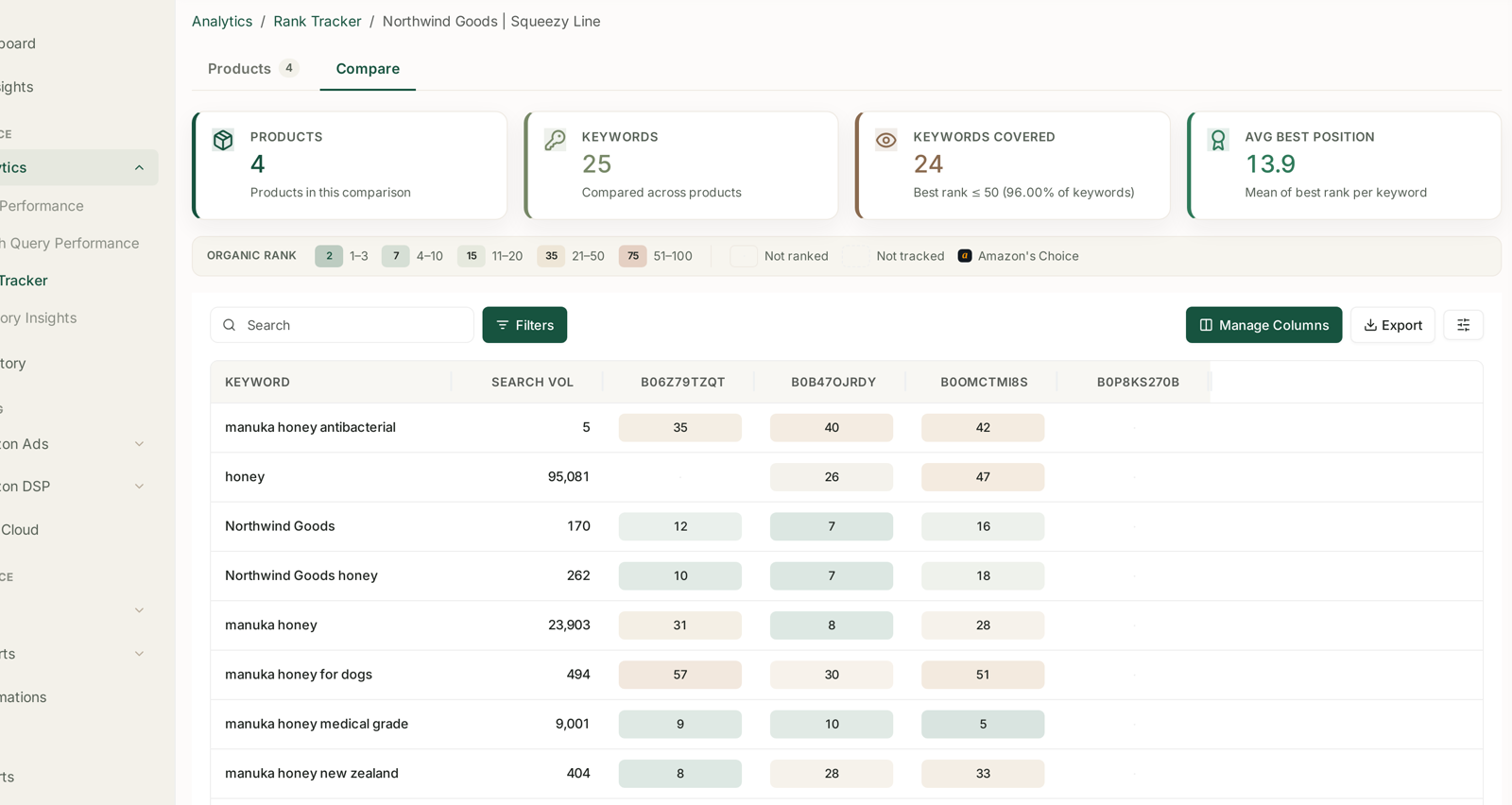
Knowing the price that makes you the best offer means watching competitor prices as they move, not once — see Tracking Competitor ASINs Alongside Your Own. A price set against a snapshot from three weeks ago is set against a market that has moved.
Step 3: check what that price does to your margin
Put the target price into your pricing table and read the gross profit margin before PPC — see Where Your Margin Actually Goes.
Above 10–20% — worth testing for the next 2–4 weeks, then raise the price slowly once sales have real traction.
Below 10% — raise the price until you clear 10–15% gross margin before PPC, then check the comparison again. If that price still puts you in the top 5 offers in the niche, test it.
And there is a deliberate exception. If you genuinely believe in the product, you can go to a negative gross margin to buy traction and raise prices afterwards. That is an explicit bet, not an oversight — take it knowingly or not at all.
The decision, and why it usually goes this way
Two options:
Lower the price and see whether conversion and sales traction improve.
Keep the price and try to make PPC better through targeting alone.
PPC is the largest expense in growing a new product, so anything that makes every campaign convert better improves the economics across the whole account — which is why the price lever usually wins.
It is reversible, which is the point
A price change is one of the few genuinely reversible decisions here. It might work very well, it might do nothing, it might land somewhere between.
If it works, good. If it does not, put the price back.
But if the product will not sell even as the best deal in the market, price was never the problem. That points at the design, the offer, the bundle, or simply the absence of reviews — see Designing the Offer and Vine: Reviews for a New Product.
That is a useful answer too, and cheaper to learn from a two-week price test than from six months of advertising.
Common mistakes
Cutting price on a product whose PPC is already converting acceptably.
Comparing shelf prices instead of price per unit, and mispricing the whole exercise.
Testing a price without checking the margin, and discovering the cost afterwards.
Reverting after four days. Two to four weeks is what it takes for conversion to show.
Leaving the launch price in place after traction arrives, instead of raising it slowly.
Concluding the product is fine when it will not sell even as the best deal in the niche.
Related
- The Product Comparison Table — the input to this decision.
- Pricing and Gross Margin — the margin side of the same trade.
- Deciding Your PPC Daily Budget — the other launch-stage decision.