

Every bid change you make is a bet. You might be right and improve the campaign, or wrong and make it worse — and no amount of care removes that.
So the goal is not to be certain. It is to place as many high-probability bets as possible, and to size each one against what it would cost to be wrong.
Read this before your first few optimisation rounds. It is the mindset the bid, placement, bleeder and harvesting rules all sit on top of.
Prefer to watch? One hundred and fifty-two seconds on sizing a change to the cost of being wrong, steering campaigns toward target ACOS, and leaving the sweet-spot campaigns alone.
The core rule
If a change has a high chance of helping, make it — even if it is small. A 3% keyword bid rise in the right place compounds across months.
If it has a low chance of helping, either skip it or shrink it. Not 7% on the keyword — 3%. Not 25% on the placement — 10%.
And if it has a serious chance of backfiring, do not make it at all.
That is the whole discipline. Small positive changes stack up. One large negative change on a major campaign undoes a quarter of them.
Size the change to the size of the campaign
Large, established campaigns are a car at 100 mph. A sharp turn crashes it. Keep placement changes to 5–10% and keyword bids to 3–5%.
Small campaigns are a car at 20 mph. You can make sharp turns and even U-turns safely, because there is very little at stake.
| Campaign | Placement bid change | Keyword bid change |
|---|---|---|
| Large / 80-20 campaigns | 5–10% | 3–5% |
| Mid-size | 10–15% | 5–7% |
| Small / new | larger changes are fine | larger changes are fine |
The asymmetry is the point. On your biggest campaign, being wrong is expensive and being right is only slightly better than doing nothing. On a small one, being wrong costs almost nothing.
Steering, not solving
Optimisation is not a maths problem with a correct answer. Treating it as one is the most common reason people's changes backfire.
Think of each campaign as a ship on a course, where the course is your target ACOS.
On course — 30-day and 7-day ACOS both sitting near target. Do nothing. It is sailing correctly.
Well below target — say 20% against a 35% target. That is a promising campaign, not a finished one. Raise bids and placement adjustments gradually and let ACOS drift up toward target while spend grows. You are buying more volume at a price you can afford.
Above target — 39%, 43%, 47%. Correct downward, gradually, over two to four weeks.
And let the gap set the aggression. A campaign at 39% against a 35% target needs a nudge. One at 55% needs real correction.
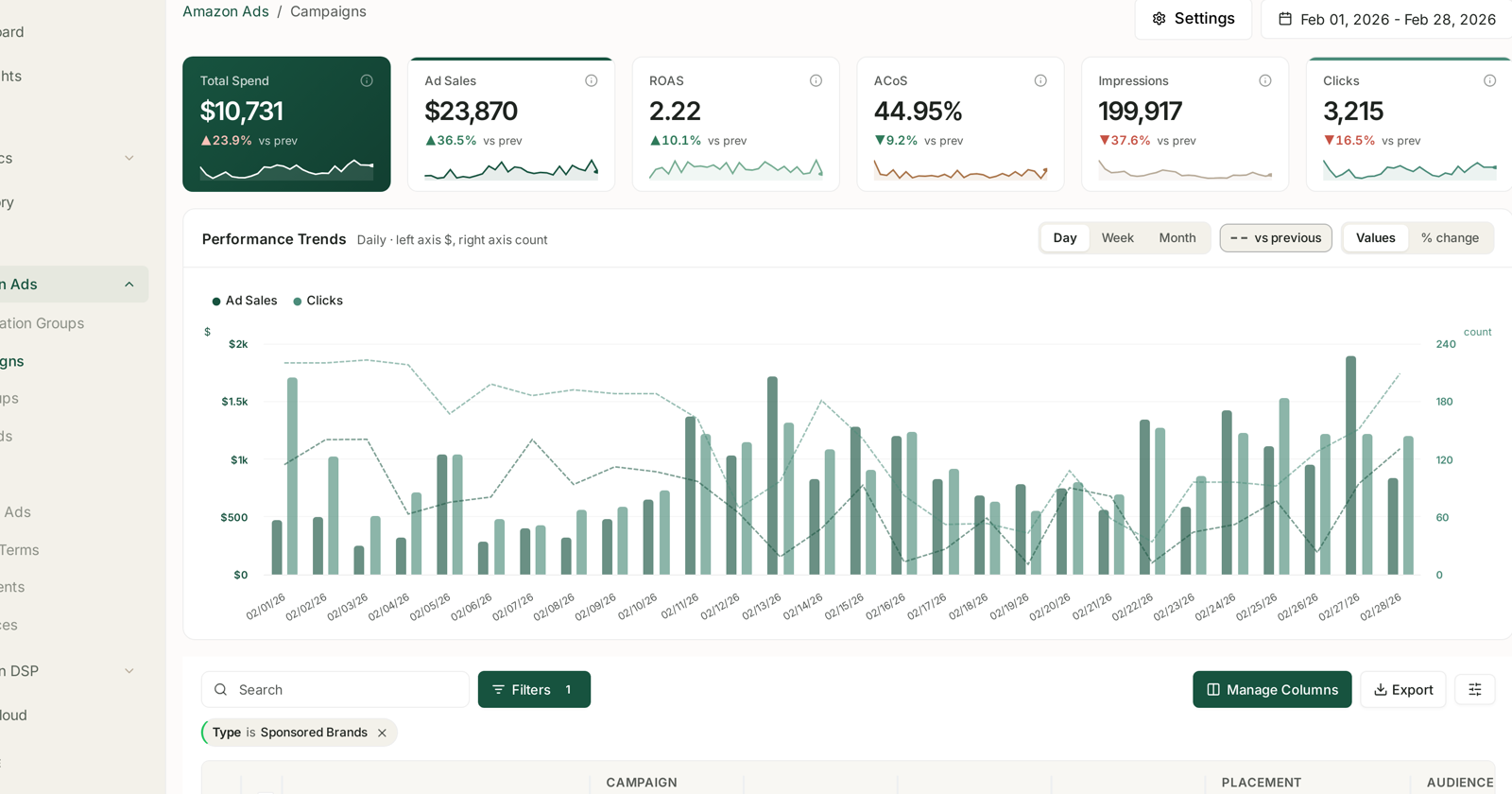
Reading the gap between each campaign's ACOS and its target across a whole portfolio is the input to every decision here — see Campaigns: Budgets, Placement and Audience Adjustments. Rebuilding that view by exporting reports and pivoting them each week is hours of assembly before you have made a single decision.
Nurture the young, leave the mature alone
A keyword or campaign that launched recently and immediately produced low ACOS and strong conversion is a young player with obvious potential.
Invest in it. Raise bids, raise placement adjustments, give it budget, and give it attention. You are trying to turn it into one of your main campaigns.
A campaign that has run for weeks or months at an ACOS you are happy with is at its peak.
Leave it alone. Frequent tweaking of something already performing has more downside than upside — the realistic outcomes are unchanged or worse.
The bands, against a 35% breakeven
ACOS 15–24% — exceptional. Push it. Grow spend deliberately and let ACOS rise toward the high twenties.
ACOS 25–33% — the sweet spot. Stop optimising and let it run. A campaign spending $150 a day at 28% is worth far more than the same campaign spending $50 a day at 20%.
ACOS at or above target — correct it, at the pace the gap justifies.
Over-optimising a campaign in the sweet spot is how you push it to 40%. Which is no longer excellent — merely acceptable.
When one backfires
It will happen. Not if, when.
Document changes on your biggest campaigns — the ones carrying a meaningful share of account spend. A short log of what you changed and when.
Watch those campaigns for the following few days. A big campaign going from 30% to 39% shows up quickly.
When it does, undo the change. The campaign and ad group history in the console shows exactly what you did.
Then check it daily until it recovers. Put the bids, placement adjustments and keywords back where they were when it was working. Re-enable what you paused; remove what you added.
Do not panic, and do not compound it with a second correction. Most campaigns recover fully.
Common mistakes
Treating optimisation as arithmetic, and expecting a formula to produce the right bid.
Making large changes to large campaigns, where the downside dwarfs the upside.
Optimising campaigns that are already in the sweet spot, and pushing them out of it.
Making every change the same size, regardless of confidence or campaign size.
Not documenting changes on major campaigns, so you cannot undo what you cannot remember.
Panicking after a backfire and making a second aggressive change on top of the first.
Related
- Bid Optimisation: Six Rules — the rules this mindset governs.
- Placement Bid Optimisation — the same logic applied to placements.
- Setting Target TACOS per Product — where the target you steer toward comes from.