

Most optimisation moves money between keywords. Placement optimisation moves it between positions, and that makes it the rare routine that improves efficiency and organic rank at the same time.
It is also the one where a single number — Top of Search Impression Share — tells you whether a bid increase will do anything at all.
Prefer to watch? One hundred and four seconds on the four columns that decide each move, why impression share settles it, and the budget-capped distinction people get wrong.
What a placement bid actually does
For every Sponsored Products campaign, Amazon lets you raise your bid for a specific placement by a percentage.
A 100% Top of Search multiplier on a £1.50 keyword bid means you bid £3.00 in that placement, and £1.50 everywhere else.
That is a second lever on top of keyword bids, and used well it reshapes where a campaign's money goes without touching any individual keyword.
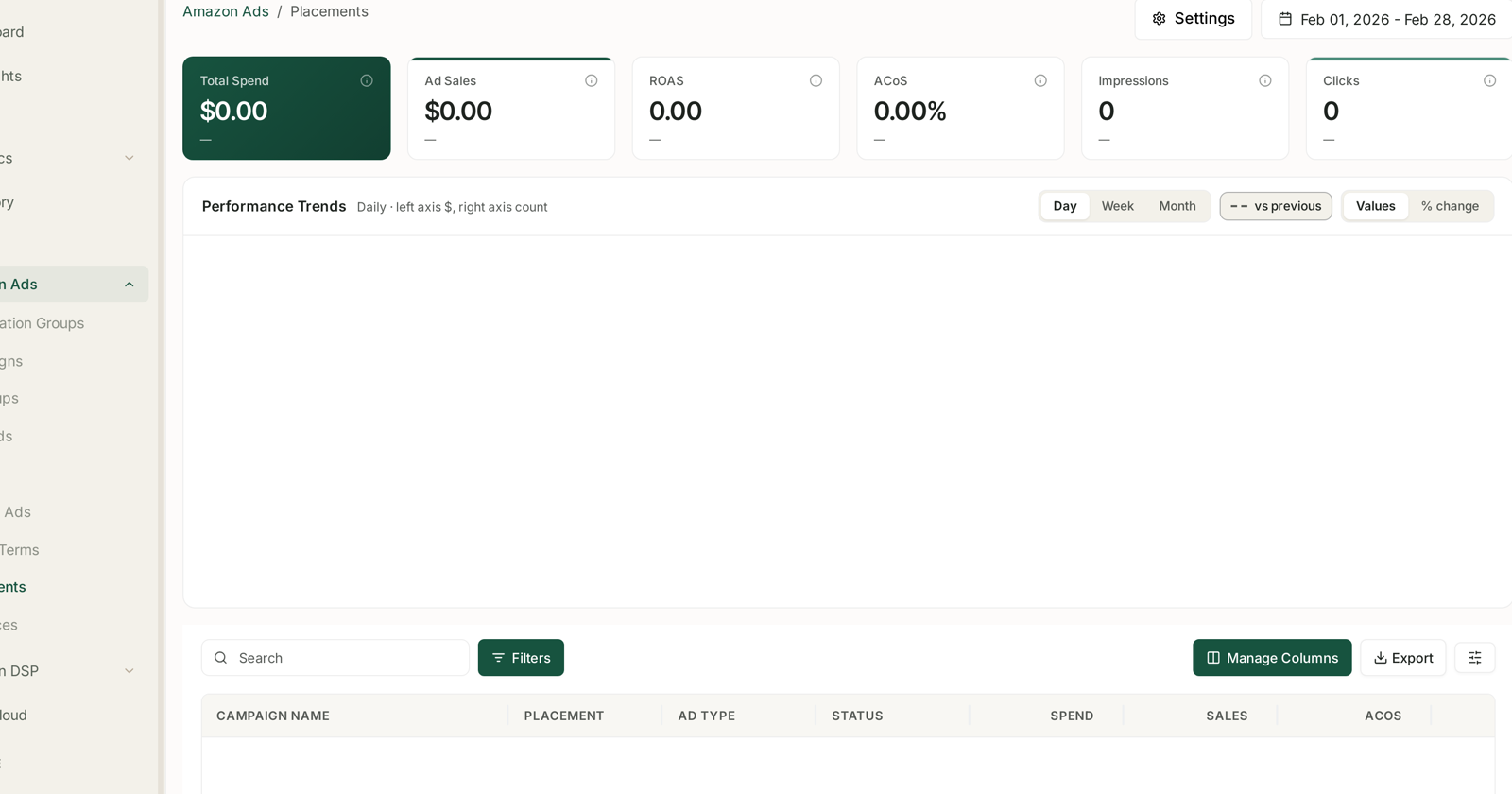
Why it does two jobs
Most optimisation chases efficiency alone. This one chases both, because for most products Top of Search converts best — higher CTR, higher CVR, better ACoS — and it is also where the sales velocity that moves organic rank happens.
So shifting spend from Rest of Search and Product Pages toward Top of Search tends to lower ACoS and push rank. That combination is why this is worth doing weekly.
Run it weekly, and change little
Weekly, deliberately. Frequent small adjustments beat occasional large ones: the downside of any single change is small because you will revisit it in seven days, and you get to see whether last week's change helped.
Work in spend order. Top-spending campaigns on your best-selling product first. The more a campaign spends, the more thought it deserves.
The four things to read
For each campaign, four columns decide the move.
1. ACoS trend: 30 days against 7 days
Is efficiency improving or worsening in this placement?
Improving, and already at a good level — you can raise the bid with reasonable confidence.
Improving, on a campaign spending heavily — consider leaving it entirely. It is going the right way; let it.
Worsening — reduce.
One caveat that catches people out. If the 7-day ACoS is only 2–4% worse than the 30-day, treat that as flat, not as a decline. Recent days always understate because attribution has not landed yet. See Amazon PPC: Core Terms and Metrics.
2. Top of Search Impression Share
This is the number that decides whether raising a bid can achieve anything.
Low (roughly 5–15%) — there is a lot of Top of Search traffic you are not getting. A bid increase has room to work.
High (40–60% or more) — you are already taking most of the available impressions. Raising the bid further will mostly just raise your cost per click, regardless of how well the placement performs.
That second case is the useful one. If Top of Search is performing well but impression share is already 55%, the honest answer is that there is little left to buy.
And it works the other way: if Top of Search is performing badly and impression share is high, cutting the multiplier is a low-risk move — from 40% to 20%, say — because you will still capture the traffic that was converting.
3. Yesterday's spend, and the day before
This sizes the risk of whatever you are about to do.
Low daily spend — changes will have a small absolute effect. Be decisive; the downside is trivial.
High daily spend — changes matter in both directions. Make small adjustments, and open the campaign itself before deciding.
4. Budget against spend
If a campaign is hitting its budget, raising bids is pointless. The budget caps the spend regardless of what you bid; all a higher bid does is spend the same money faster and at a worse cost per click.
When a campaign is budget-capped, the choice is: raise the budget if ACoS justifies it, or lower bids to buy more clicks with the same money.
The common shape, and the fix
The pattern you will meet repeatedly: one placement performs well, the others do not, and the poor ones are taking most of the spend.
Say Product Pages runs at a poor ACoS but took 27% of the campaign's spend last month, while Top of Search performs well.
If the campaign is budget-capped, raising the Top of Search multiplier is enough. The campaign has a fixed pot, so pulling spend toward Top of Search necessarily starves the others.
If it is not budget-capped, raising one placement does not reduce the others — it just increases total spend. Lower the bids on the underperforming placements instead.
That distinction is the one most often got wrong.
The advanced move: keyword and placement bids together
When a campaign spends evenly across placements but only one placement works, raising a single multiplier takes a long time to shift the balance. There is a faster, riskier route.
Cut the keyword bids, then raise the Top of Search multiplier to compensate.
| Target's ACoS | Bid change |
|---|---|
| above 40–45% | reduce by 50% |
| 30–40% | reduce by 25% |
| below 30% | leave alone |
Then raise the Top of Search multiplier by 100%.
The arithmetic: lower keyword bids largely remove you from Rest of Search and Product Pages, while the doubled multiplier keeps your effective Top of Search bid near where it was. Over the following weeks, spend migrates to Top of Search.
This is genuinely risky. Cuts that aggressive can stall a campaign entirely, and it takes weeks to stabilise. Once it has settled, bring it back gradually — raise the Top of Search multiplier 10–20% a week until spend is where you want it.
Use it on a campaign that fits the pattern: Top of Search performing well on a low multiplier and low impression share, while the other placements consume the budget. Do not use it on your largest campaign as a first experiment.
Common mistakes
Raising bids on a budget-capped campaign. Nothing to gain.
Raising Top of Search when impression share is already high. You are buying the same impressions at a higher price.
Reading a 7-day dip as a decline. Attribution has not landed.
Setting multipliers from a hunch rather than from measured placement performance. See Audit Your Placement Multipliers.
Making large changes on your biggest campaign because the numbers looked clear in a spreadsheet.
Related
- Placements: Top of Search, Rest of Search and Product Pages — the screen, in full.
- Ad Type and Placement Mix — the monthly structural view of the same question.
- The Nine-Report PPC Routine — where this sits in the schedule.
- Running a Launch: Stabilise, Scale, Scale Back — forcing spend to Top of Search during a launch.