

A new product has no reviews, and no reviews means no conversion. Vine is Amazon's own early-reviewer programme: you give units away, a selected group of reviewers receives them, and some of them post reviews.
It is the fastest and cheapest way to get a new listing past zero.
Prefer to watch? One hundred and fifty seconds on why the arithmetic favours Vine so heavily, taking the maximum units, and the margin distortion the giveaways create.
Why the arithmetic favours it so heavily
The organic review rate is roughly 2–3% of orders.
So 30 organic reviews means selling 1,000–1,500 units — which on a new product takes months you do not have, at a conversion rate depressed by the very absence of reviews you are trying to fix.
Vine gets you there on 30 units.
Not all 30 reviewers post. In practice 70–90% do, so 30 giveaways produces roughly 20–25 reviews. Still a completely different order of magnitude from 1,000 sales.
What it costs
Amazon charges an enrolment fee per ASIN, banded by how many units you offer:
| Units offered | Fee |
|---|---|
| 1–2 | Free |
| 3–10 | $75 |
| 11–30 | $200 |
Take the maximum. The fee is flat across the 11–30 band, so offering 12 units and offering 30 units cost the same $200. There is no reason to offer fewer.
The units themselves are free to the reviewer and you receive no payout for them, so the real cost is the fee plus your landed cost on 30 units.
Check the current fees before enrolling — Amazon has changed this structure before and may again.
Enrolling
- Advertising → Vine.
- Enter the ASIN of the new product.
- Begin enrollment.
- Select the number of units to offer.
- Confirm.
Do it per marketplace. Vine runs in each marketplace separately, so a product selling in several can gather reviews in each — which matters, because reviews do not fully carry across.
One reporting trap worth knowing
Vine orders now appear as ordinary orders with a full promotion applied.
Which means your profit margin percentage will look dramatically worse than it is for as long as the giveaways are running. Thirty units at full discount inside a low-volume month is enough to make a healthy product look like it is losing money.
Do not react to that number. It is the giveaway, not the product — see Where Your Margin Actually Goes.
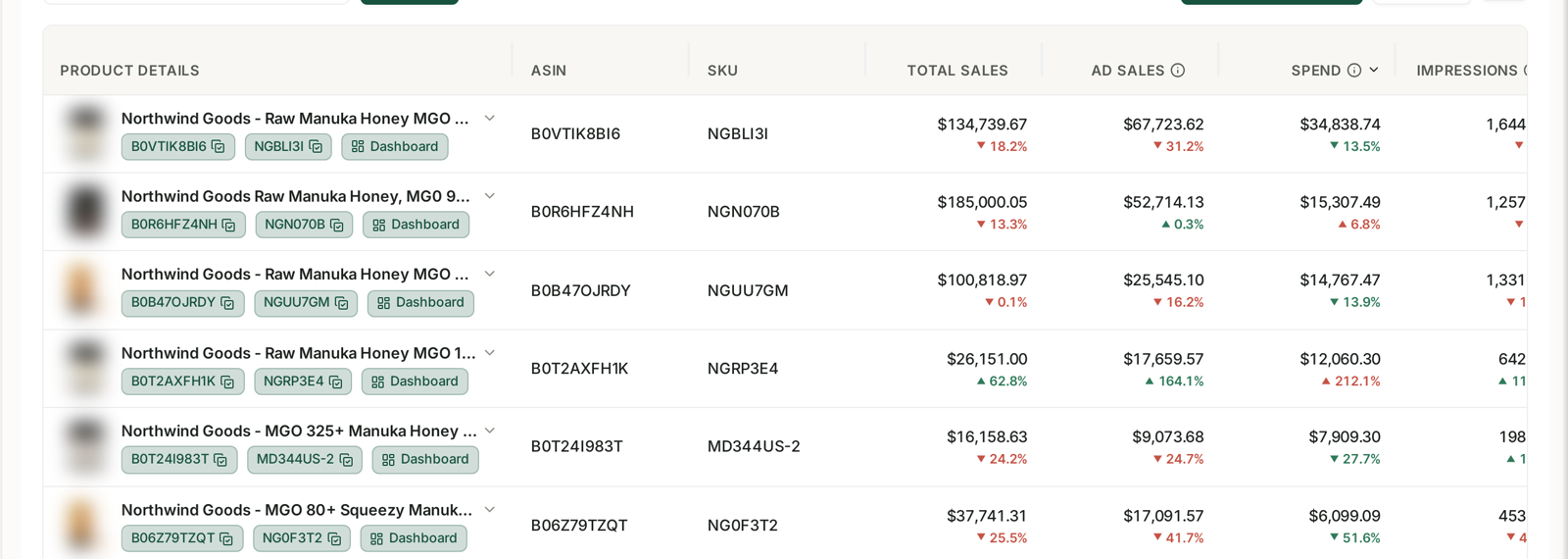
Being able to see the period a distortion belongs to is what stops it becoming a false alarm — see Understanding Business Reports. Reading a single blended margin figure for the month is how a Vine enrolment turns into a panic about pricing.
What Vine will and will not do
It will get you from zero reviews to twenty-odd, which is the threshold where a listing starts converting like a real product.
It will not fix a bad product. Vine reviewers are not selected by you and are frequently critical. A product with genuine defects gets 20 reviews saying so, permanently, at the top of a brand-new listing.
So make sure the product is right first — see Fix the Product by Studying Competitors.
And make sure the listing sets accurate expectations, because a reviewer disappointed by the difference between the images and the object will say so — see Answer the Complaints in Your Content.
Where it fits in a launch
Enrol at the start, so reviews accumulate while you are building campaigns rather than after.
Do not wait for reviews before starting PPC — but do expect early conversion to be weak until they land, and read your launch data with that in mind. See Preparing a Launch.
Common mistakes
Offering 10 units instead of 30, and paying $75 for a third of the benefit when $200 buys the lot.
Enrolling a product that is not ready, and permanently attaching honest negative reviews to a new listing.
Enrolling only in the US, and leaving other marketplaces at zero.
Panicking at the margin distortion the giveaways create in reporting.
Treating Vine as a substitute for a rating strategy. It gets you to twenty reviews; everything after that is the ordinary work — see Why a Rating Drop Costs More Than It Looks.
Related
- Preparing a Launch — where enrolment sits in the sequence.
- Short-Term Rating Recovery — what to do once reviews exist.
- Where Your Margin Actually Goes — reading margin around a giveaway.