

Your auto, broad and phrase campaigns are a research budget. Amazon shows your product against searches you never chose, and some of them convert better than the keywords you picked yourself.
Harvesting is the routine that finds those, promotes them into targeted campaigns, and turns a lucky match into a controlled one.
Prefer to watch? Ninety-nine seconds on the four criteria, the starting-bid maths for each match type, and the negation step that gets skipped.
Keyword and search term are not the same thing
Worth being precise, because the whole process depends on the difference.
Keyword (or target) — what you bid on. black blanket
Search term — what the shopper actually typed. big black blanket for king size bed
Under exact match the two are nearly the same. Under auto, broad and phrase they diverge enormously, and that gap is where the opportunity lives.
The criteria
You are looking for search terms that are not already targeted and performed well. Four thresholds define "well", and all four should be adjustable per product:
| Criterion | A reasonable default |
|---|---|
| Minimum orders | 2 |
| Maximum ACoS | 35% |
| Minimum clicks | 6 |
| Minimum CVR | 10% |
Tune these to your product, not to the defaults. A 10% conversion rate is poor in some categories and excellent in others. If your product converts at 5% across the board, a 10% floor will return nothing and you will conclude, wrongly, that there is nothing to harvest.
Minimum orders matters most. One order is luck. Two is the smallest number that is not obviously noise.
Cap the list at fifteen
If the pass returns more than about fifteen terms, tighten the criteria rather than promoting all of them.
Two reasons. A new target needs budget and time to prove itself, and thirty new targets at once means none of them gets either. And a long list is usually a sign the thresholds are too loose, so you would be promoting mediocre terms alongside good ones and diluting the campaign's average.
Fifteen good terms, promoted properly, beats forty promoted carelessly.
Where to put them
Into an existing campaign if one fits the theme, or into a new campaign built for them.
Target each term in exact, plus one of broad or phrase. Exact gives you control over the term you now know works. The broader match keeps the research going, finding the next variation. You do not need both broad and phrase — use whichever your account has historically done better with.
Isolate the big ones. If a harvested term is genuinely large — a head term for your niche — give it its own single-keyword campaign. That way its budget and bids are not competing with thirty smaller terms, and you can push it for rank deliberately.
The starting bids
This is the part most people guess at, and there is a straightforward rule.
For exact match: take the term's current CPC and add 10%. Multiply by 1.1. You already know roughly what the click costs, because you have been paying for it. The uplift buys you position on a term you now know converts.
For broad or phrase: 15% below your exact bid. Multiply the exact bid by 0.85. The broader match will pull in less qualified traffic, so it should not pay as much.
For a new ASIN target, go lower: 0.8× the CPC. Product targeting behaves differently from keyword targeting, and the evidence from a search term does not transfer cleanly to an ASIN. Start conservative and raise it if it works.
Then negate in the source
This is the step that gets skipped, and skipping it costs money.
Once a term is targeted in its own campaign, add it as a negative exact in the campaign it came from. Otherwise your auto or broad campaign continues bidding on the same term, and you are competing with yourself — two of your campaigns in the same auction, pushing your own cost per click up.
Promote and negate. Always both.
Cadence
Fortnightly. Harvesting needs enough clicks accumulated on a term to judge it, and a weekly pass would have you promoting on noise. Monthly leaves good terms unpromoted for too long.
Why this compounds
Every promoted term does three things at once: it expands impression share on a search you already win, it pushes organic rank for that term because ad sales feed velocity, and it moves spend toward proven traffic and away from speculative traffic.
Run consistently, the effect is cumulative. Accounts that do this for a year end up with dozens of campaigns holding fifteen to twenty proven keywords each — a network of terms that were all discovered by the algorithm and then taken under control. That network is what a mature account actually is.
Common mistakes
Promoting on one order. Not enough evidence.
Using the default thresholds on a product whose conversion rate is nothing like the default.
Promoting forty terms at once, so none of them gets the budget to prove itself.
Forgetting to negate in the source campaign, and then bidding against yourself indefinitely.
Starting exact bids at the CPC rather than above it, then wondering why the new target gets no impressions.
Harvesting from a campaign that mixes match types, so you cannot tell which match produced the term. See Create a Sponsored Products Campaign.
Related
- Harvest Winning Search Terms into Exact-Match Campaigns — the same routine on the TrackIQ screen.
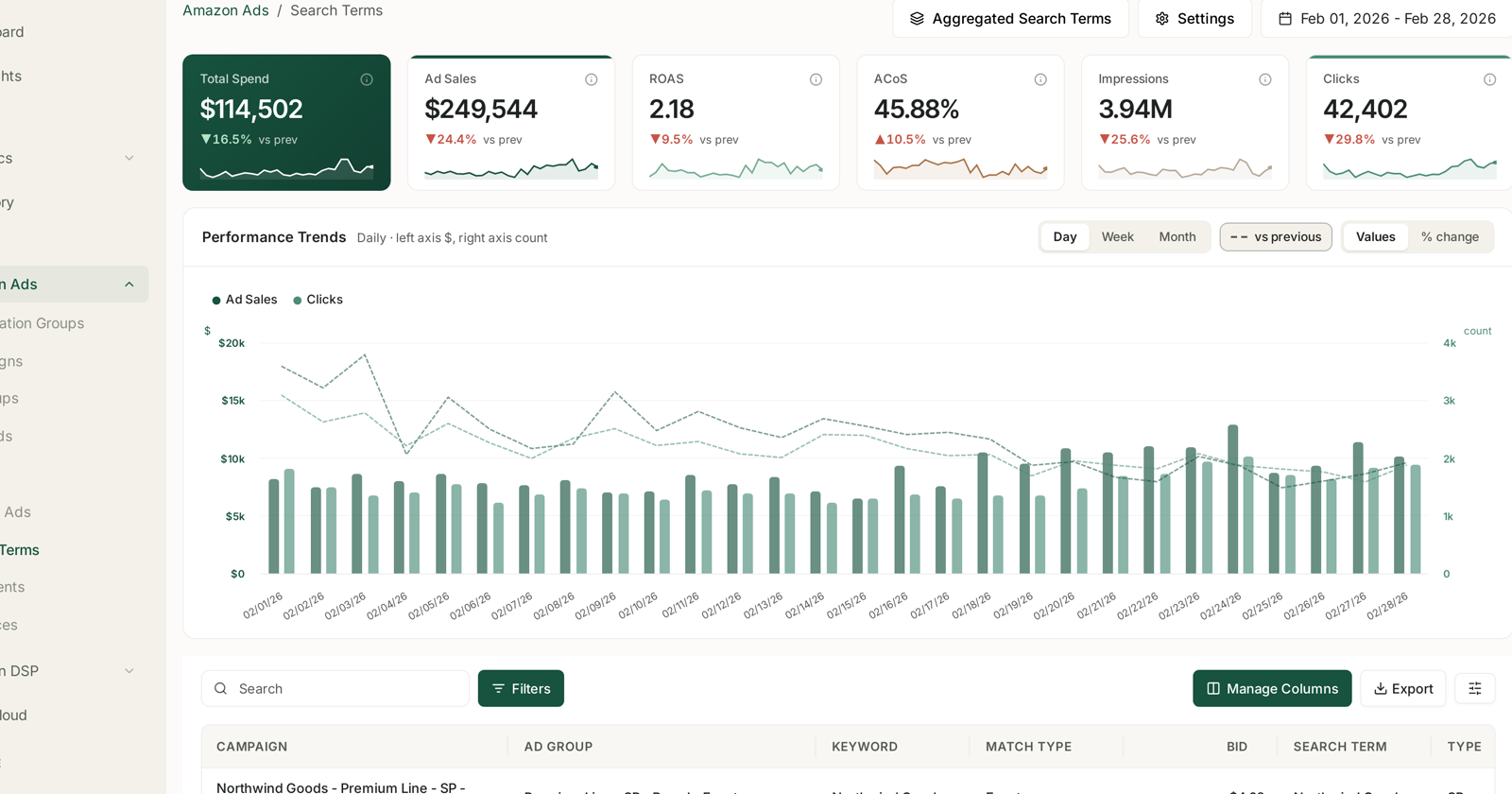
- Search Terms and Aggregated Search Terms — reading the report this comes from.
- The Nine-Report PPC Routine — where harvesting sits in the schedule.
- Outlier and Trending Keywords — finding terms your own campaigns will never surface.