

Pushing a product forward costs money and attention, and both are finite. Spreading them across eight products means none of them gets enough of either.
So if you are doing under about $20–30k a month, work on two or three parent ASINs at a time — even if you have twelve.
And then do something explicit about the rest, which is the half people skip.
Prefer to watch? One hundred and fifty-five seconds on why the number is two or three, diagnosing which parents are bleeding and why, and the four options for everything you are not working on.
Why the number is two or three
More investment per product means a higher chance that product works. That is the whole argument.
For scale: eight-figure sellers launching new products work on five or more at once — with a full team behind them, deep pockets, and a process they already know.
Assuming a smaller operation can match that is not ambition, it is arithmetic that does not work.
Once you have run three products through the full process and know it properly, duplicating it across the rest is much easier. The constraint is not the products; it is you.
This only applies if you have more than three parent ASINs. With three or fewer there is nothing to choose.
Step 1: find the best opportunities
Put every parent ASIN through the comparison table — see The Product Comparison Table.
That gives you the two or three strongest opportunities on offer strength, margin, review position and headroom.
Do not commit yet. The next step frequently changes the answer.
Step 2: find what is bleeding
Open your P&L, make sure landed costs and advertising costs are complete, and look at last month — or month-to-date if you are past the 15th.
Group by parent ASIN, sort by profit, and list every parent that lost money.
Then work out why, for each one. There are only two answers:
TACOS too high — you are overspending on advertising relative to what the product returns.
Gross margin too low — and then the follow-up: is the price too low, or is COGS too high?
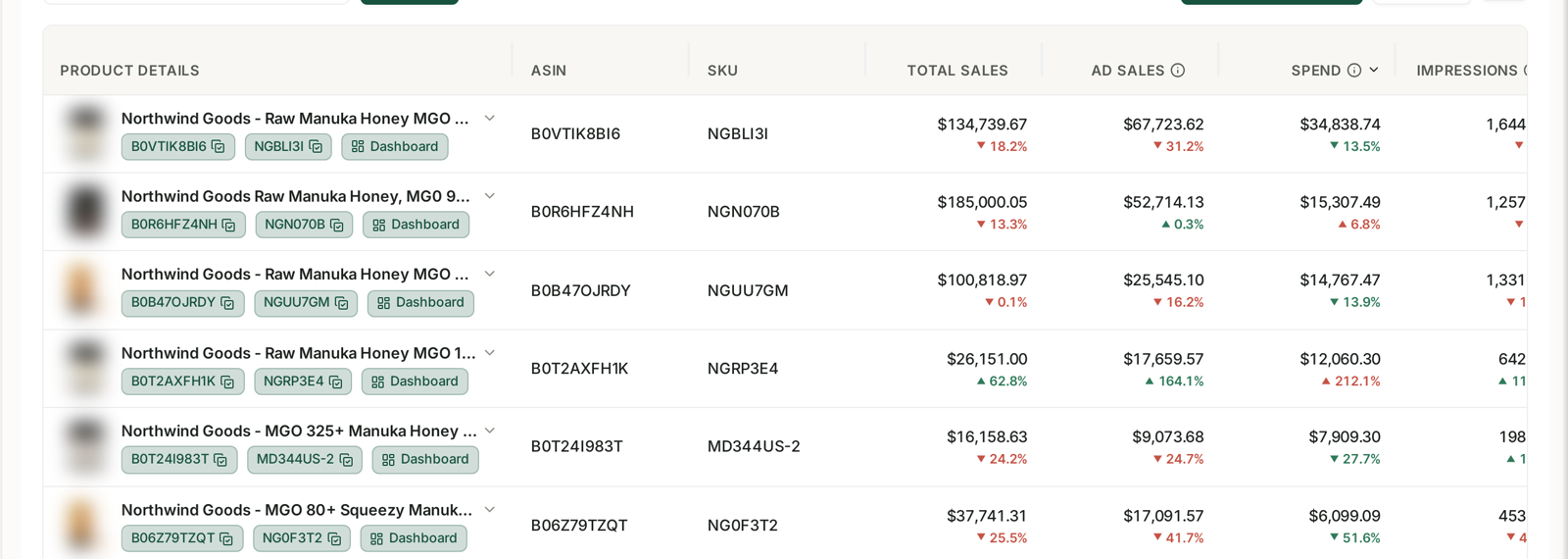
Grouping by parent, sorting by profit and reading TACOS and gross margin beside it is the whole diagnostic — see Understanding Business Reports and Where Your Margin Actually Goes. Reconstructing a per-parent P&L from settlement reports and ad exports every month is exactly the task that stops happening in a busy quarter.
Step 3: choose
You now have both halves: where the opportunity is, and where the money is going.
Pick on two criteria:
Highest likelihood of success.
Highest upside if it works.
The comparison table's winners usually get picked — unless there is an inventory situation that makes pushing one impossible. There is no point launching a product you cannot keep in stock; see Deciding Your PPC Daily Budget.
Step 4: deal with everything else
This is the step that actually frees the resources, and it is the one that gets skipped.
For every product you are not focusing on, do one of four things:
Cut most of its advertising spend.
Pause its advertising entirely, so it cannot lose money.
Raise its price until it is at least breaking even — see Raising Your Price Safely.
Discontinue it, if the opportunity is weak and cash is tight.
The rule underneath all four
The only products allowed to lose money are the ones you are actively working on.
A loss on a focus product is an investment with a plan attached. A loss on an ignored product is just a loss.
The exception is a product you have a clear plan for — a relaunch scheduled, a new variation coming, a supplier change landing. Then a deliberate loss is fine. What is not fine is a product quietly losing money because nobody looked.
Common mistakes
Choosing focus products from the comparison table alone, without checking which products are bleeding.
Picking four or five because they all look promising.
Doing steps 1–3 and skipping step 4, so the resources you were freeing up are still being spent.
Ignoring the inventory position on a product you intend to push.
Discontinuing too fast, before checking whether price or COGS explains the loss.
Never revisiting. When a focus product stabilises, it leaves the list and something else comes on.
Related
- The Product Comparison Table — the opportunity half of the decision.
- Where Your Margin Actually Goes — diagnosing why a product loses money.
- Setting Target TACOS per Product — how the non-focus products get held at breakeven.