

Every keyword on Amazon is a shopping centre, and your organic rank is your unit's position in it.
Top 10 is the entrance — the traffic walks past you. Rank 10–30 is further inside. Page two is a back corridor. Below that is the car park.
The difference from a real shopping centre is that you cannot buy the entrance. Amazon gives it to whichever product shoppers behave best toward. A relaunch is the process of deliberately becoming that product for a chosen keyword.
Prefer to watch? One hundred and twenty-four seconds on why organic rank is the goal, the three metrics behind it, and the budget mistake that sinks most launches.
Why organic rank is the goal
Organic sales are free. Every position you climb produces sales you do not pay for, permanently, until someone displaces you.
That is why relaunching is treated as the second half of an advertising system rather than a separate activity. The first half makes your existing spend efficient. This half spends deliberately to buy a position that then pays you back.
Three things must be true first
Do not start a relaunch until:
Your offer, product and gross margin are as good as you can make them. You are about to spend heavily to show this listing to more people. If the offer is not competitive, you are buying traffic that will bounce.
Your inventory is solid — 98%+ in stock. A stockout mid-launch destroys the velocity you paid for and the rank it bought.
Your advertising is already optimised weekly. See The Nine-Report PPC Routine.
If any of those is missing, fixing it will make you more money than relaunching will. They are foundations, and this is a building.
What Amazon is actually measuring
Amazon has never published the algorithm, but consistent testing across many sellers points to three metrics:
Conversion rate (CVR) — of the people who clicked your product from that keyword, how many bought? (orders ÷ clicks)
Click-through rate (CTR) — of the people who saw your product for that keyword, how many clicked? (clicks ÷ impressions)
Sales velocity — how many of that keyword's total purchases were yours, and are you selling more units than competitors?
The logic follows directly. If your product has the best CVR and CTR and drives the most sales for a keyword, Amazon has no reason to rank anything else above you. So the entire process is: prove you convert well, then buy enough velocity to be undeniable.
The five steps
| Step | What happens |
|---|---|
| 1 | Find keywords where your CVR or CTR already beats the average |
| 2 | Group them by root keyword, and prioritise |
| 3 | Improve CTR and CVR further, then build the campaigns |
| 4 | Drive velocity, monitoring CVR the whole way |
| 5 | Once ranked, move to the next group |
Step 1 is the gate. You are not choosing keywords you want to rank for; you are finding keywords where the data already says you deserve to. That distinction is what makes the process data-driven rather than hopeful.
One keyword group at a time
Start with one or two products, and one keyword group each.
This is where most sellers go wrong. They take a limited budget and split it across many keywords, which means they never win any of them.
To rank, you must be among the products driving the most sales for that keyword. That is a relative measure. Half the required spend on one keyword achieves nothing; it does not get you halfway.
And relaunching is expensive. It is genuinely high-risk, high-reward: you spend heavily on advertising to drive velocity until rank arrives, and only then do organic sales start carrying the product and free the budget for the next group.
If the upfront spend is uncomfortable, start slower and look for early indicators before committing more. But do not spread it thin.
Is your product worthy?
The uncomfortable question, and the process exists to answer it honestly.
Look at the five products currently at the top of your target keyword. If you offered exactly what they offer at three times the price, why would shoppers choose you? They would not, and no amount of advertising changes that.
So the data decides whether you push. If your CVR and CTR for a keyword are already at or above average, you are worthy and pushing will work. If they are not, you improve the listing first — or you pick a different keyword.
Nothing here guarantees a win. What it does is stop you spending heavily on keywords where you were never going to rank, and concentrate spend where the evidence says you can.
Two starting positions
A product with data — existing advertising history and Search Query Performance figures — can go straight into step 1.
A product with little or no data needs a preliminary phase to generate some before the same process applies. A listing nobody has clicked cannot tell you whether it converts.
Where the data lives
Every gate in this process is a data check: is my CVR above the keyword average, is my impression share rising, has organic rank moved. Historically that means Search Query Performance exports, advertising reports and rank checks, reconciled by hand each week.
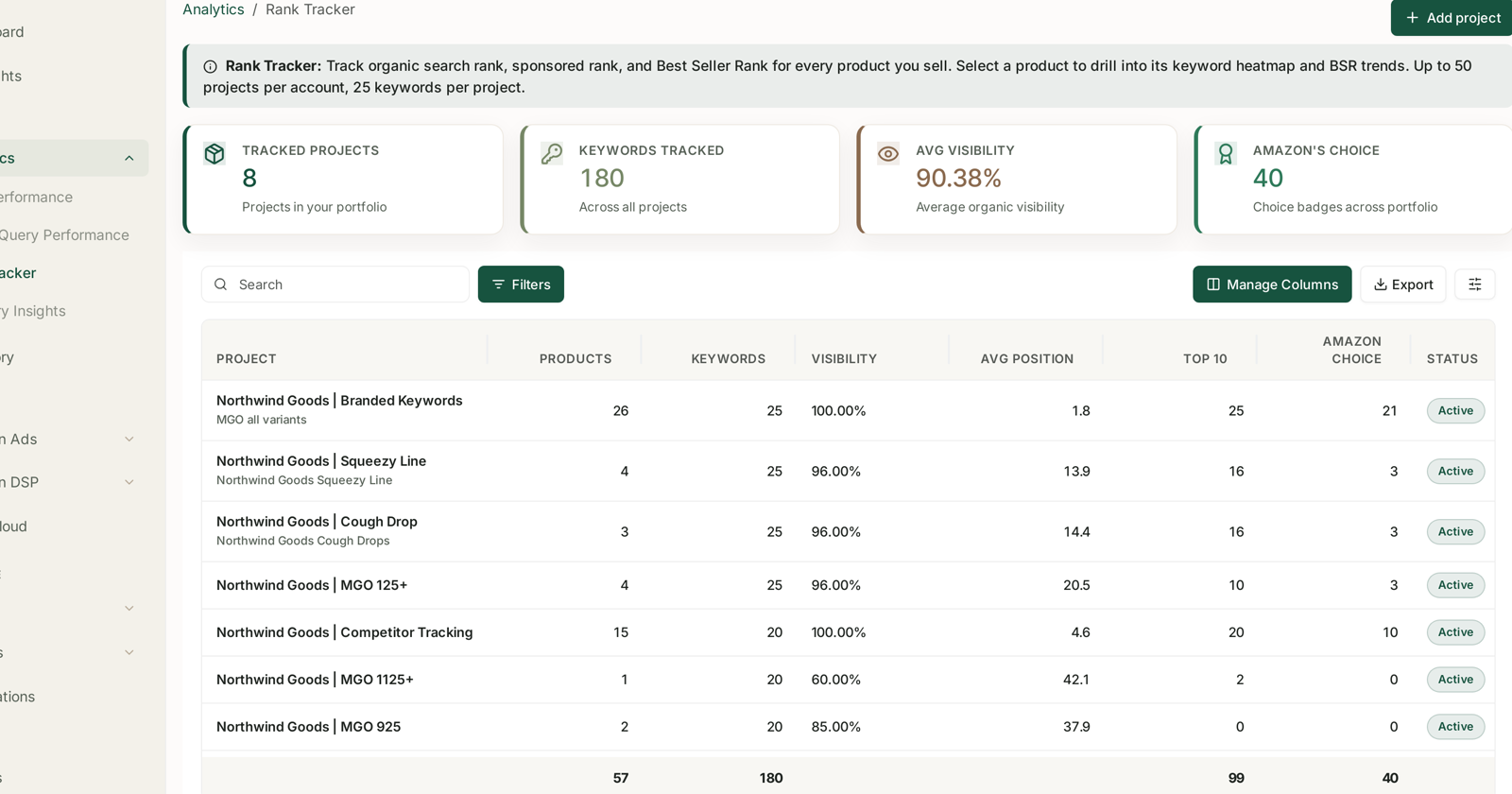
In TrackIQ those are three screens over one date range. See Understanding Search Query Performance for the CVR and CTR benchmarks, Placements: Top of Search for impression share, and the organic rank views for whether any of it is working.
Related
- Keyword Research from Search Query Performance — step 1, finding keywords you deserve to win.
- Profit Campaigns and Ranking Campaigns — why a launch campaign is judged differently.
- Setting Target TACoS per Product — what a launch is allowed to cost.
- Why Inventory Is the Second Pillar — the stock precondition a launch assumes.