

Advertising accounts do not fail dramatically. They drift — a few non-converting targets here, a placement bid that stopped matching reality there — and six months later the account is expensive and nobody can point to the decision that made it so.
The defence is a schedule. Nine reports, on three cadences, each answering one question. Run them and the drift never accumulates.
Prefer to watch? One hundred and four seconds on the nine reports and their cadences, why bids get reviewed weekly, and the half of the work that does not need you at all.
The schedule
| Cadence | Report | Question it answers |
|---|---|---|
| Weekly | Bleeders | what is taking clicks and returning nothing? |
| Weekly | Placement bids | is spend sitting on the placement that performs? |
| Weekly | Bid optimisation | are bids pointed at the targets that work? |
| Weekly | Main keyword performance | how are we doing on the terms that define the niche? |
| Bi-weekly | Search term harvesting | what is converting that we are not yet targeting? |
| Bi-weekly | Bleeders 2.0 | what converts, but at a price we cannot afford? |
| Monthly | Lifetime bleeders | what has never converted, across the account's whole life? |
| Monthly | Placement mix | is the spend split across placements sensible? |
| Monthly | Ad type mix | is the spend split across ad types sensible? |
Four weekly, two fortnightly, three monthly. That is the whole system.
Why the cadences differ
Weekly, for anything involving bids. Two reasons, and they are both about risk.
Small changes made often beat large changes made rarely — if a bid change was wrong, you find out in seven days and reverse it, rather than discovering it after a quarter. And running weekly means you can see whether last week's change helped, which is the only way judgement improves.
Fortnightly, for anything that needs volume to be readable. Harvesting needs enough clicks on a search term to know it converts. Judged weekly, you would promote terms on noise.
Monthly, for anything structural. Ad type and placement mix are strategy, not maintenance. They move slowly, and reacting to a week of movement would mean reacting to attribution rather than to reality.
The 80/20 that makes it survivable
Nine reports sounds like a full-time job. It is not, provided you spend your attention where it matters.
Sort by spend, and work downward. Start with the top-spending campaigns on your best-selling product, then the next product, and so on.
Give a campaign attention in proportion to what it spends. A campaign spending £200 a day deserves a careful look, possibly opening the campaign itself before deciding. A campaign spending £8 a day deserves a glance. The downside risk on the small one is trivially small, so do not spend twenty minutes on it.
Doing nothing is a valid decision. If a campaign has good ACoS and a healthy trend, leaving it alone is often the best available move — every change carries risk, and a campaign performing well does not need saving.
Where the time actually goes
The work splits cleanly in two, and only one half needs you.
Gathering. Downloading bulk reports, filtering them, pasting them into sheets, rebuilding pivots. Entirely mechanical, and it is most of the hours.
Deciding. Reading the assembled numbers and choosing what to change. This is the part that needs judgement and product knowledge, and it is a small fraction of the time.
The traditional answer is to hand the gathering to someone else. The better answer is for the gathering not to exist.
What this looks like in TrackIQ
Most of the nine are already screens, which removes the gathering half outright:
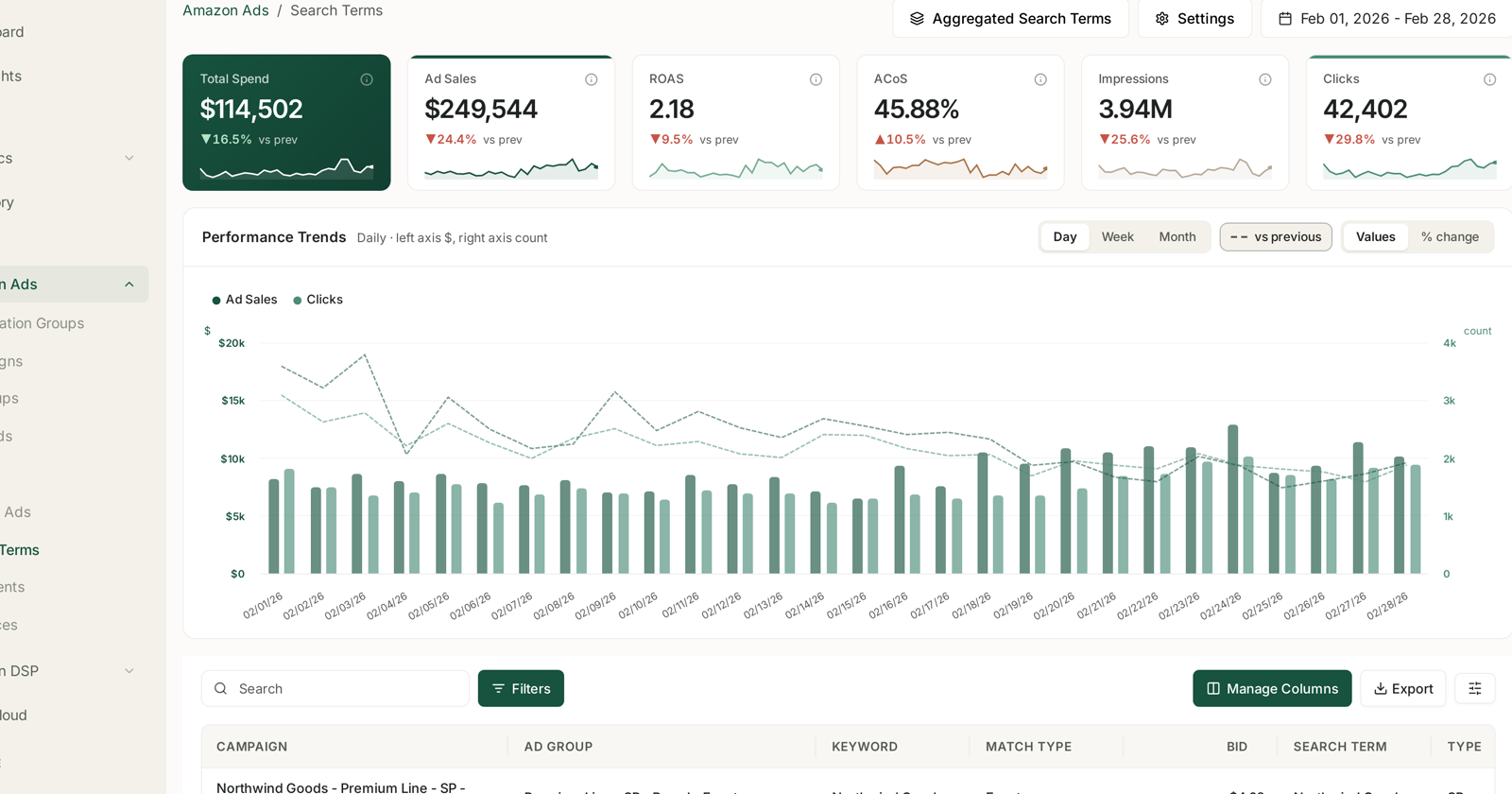
Bleeders, Bleeders 2.0 and lifetime bleeders — Amazon Ads → Search Terms and Targets, sorted by spend, with the date range set to the window you want. Same screen, three date ranges. See The Bleeder Reports.
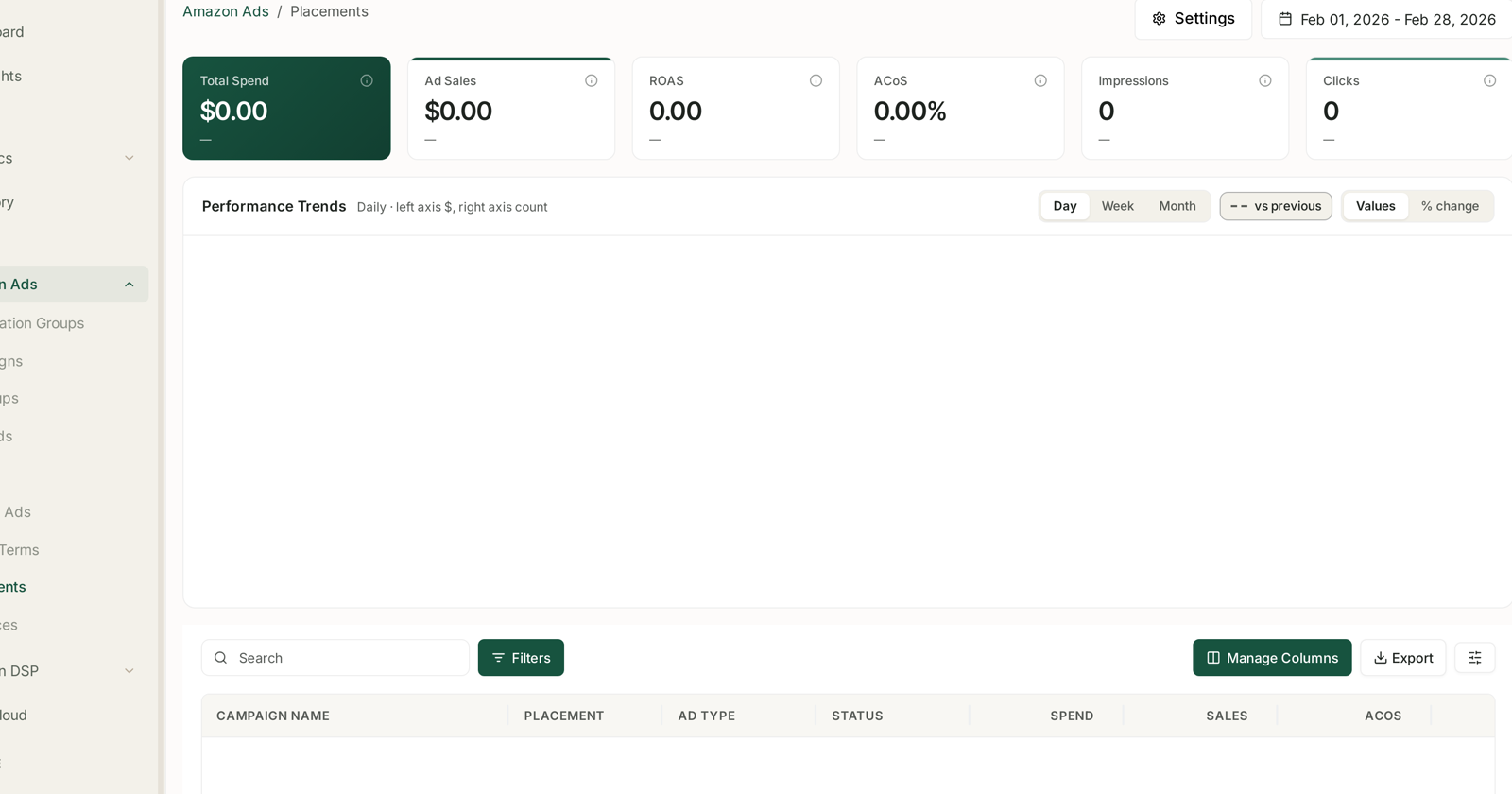
Placement bids and placement mix — Amazon Ads → Placements, which puts performance beside the multipliers.
Bid optimisation — Amazon Ads → Targets and Keywords, at 7 and 30 days.
Harvesting — Amazon Ads → Search Terms, filtered to converting terms not yet targeted.
Ad type mix — Amazon Ads → Campaigns, grouped by ad type.
Main keyword performance — the keyword and rank views together.
The date range holds as you move between screens, which is what makes a nine-report pass a morning rather than a project.
What to automate, and what not to
Some of this is genuinely mechanical and can run without you.
Reasonable to automate: the bleeder rules, once you trust the thresholds. They act only on targets with no sales, so the downside is small and bounded.
Keep manual: placement bid changes and bid optimisation on your largest campaigns. These need context — whether a product is launching, whether stock is short, whether a competitor has just moved — that no rule can see.
See Rule-Based Optimization, and read Guardrails Before You Automate before switching anything on.
Expect it to be slow at first
The first pass will take much longer than you expect, and the tenth will take a fraction of the first. That is not a sign it is not working; it is what learning a routine looks like.
The value is not in any single pass. It is that nothing gets six months to compound quietly.
Related
- Score Your PPC Performance — the same reports, used once to grade the account.
- Restructure Your Campaigns Before You Optimise — the foundation these routines assume.
- Ad Type and Placement Mix — the two monthly structural reports.
- Setting Target TACoS per Product — the monthly target the weekly work serves.
- Scaling Profit Campaigns — the offensive half, once the routine is holding.
- What a Relaunch Is, and When to Run One — the second half of the system, once the routine holds.