

The barrier to Sponsored Brands Video has always been the video. Commissioning creative takes weeks and costs real money, which is why most sellers test one video and scale it regardless of whether it was any good.
Amazon's own generator removes that constraint. It builds videos from the images, title and description already on your listing — which means you can produce tens of them and keep only the ones that work.
Prefer to watch? One hundred and seventy-one seconds on generating from listing assets, the edits every output needs, and testing twenty variations instead of three.
Where it lives
Campaign Manager → Creative tools → Creative Studio.
Three tools sit there: an image generator, a video generator, and an inspiration library.
Open the video generator and choose Generate video.
Generating
Pick a product and generate.
Amazon produces three different videos from your existing listing assets — images, title, description.
Then watch them and judge. Some will be usable, some will not. That is expected, and it is why three come back rather than one.
Editing — where the value actually is
The raw output is a starting point, not a finished ad. Every generated video needs a pass.
What is worth fixing:
Text placement. The generator routinely puts copy over the product itself, which defeats the point of the shot. Move it.
The copy. The generated line is generic. Replace it with something specific to what your product actually is — see Answer the Complaints in Your Content for what specificity buys you.
Your logo, added where it belongs.
Which images appear, and in what order.
A call to action at the end.
Scenes, added or removed as the story needs.
Narration and on-screen text.
The text edit is the highest-value change. These ads play on mute, so the on-screen copy carries the message entirely — see Sponsored Brands Video at Scale.
Straight into a campaign
Create Sponsored Brand Campaign generates the campaign from the video directly, and you carry on through the normal setup.
Convenient — but do not let it replace the testing structure. A campaign built in two clicks is still a campaign that needs the right keywords, match types, bids and budget.
What this actually changes
It changes the economics of creative testing.
Commissioned video means three videos and a real cost, so the test is expensive and you run it once.
Generated video means ten or twenty variations at effectively no cost — so you can test properly, discard most of them, and keep the few that genuinely perform.
The method does not change:
Test on identical traffic — same keywords, same match type, same bid, same budget, differing only in the creative.
Judge at 200 clicks each.
Lowest ACOS and highest CTR wins.
Scale only the winner — see Sponsored Brands Video at Scale.
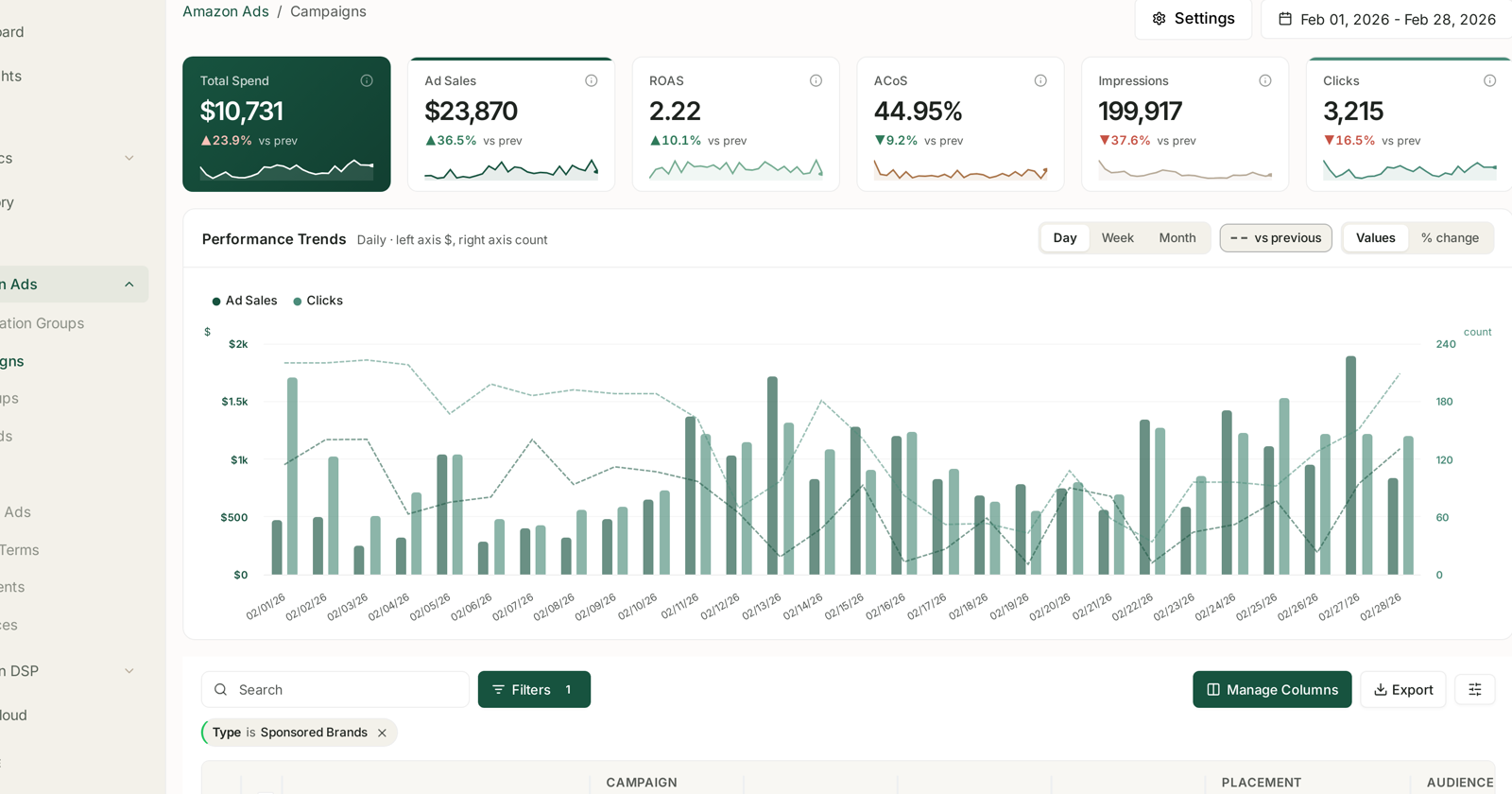
Comparing several near-identical campaigns on CTR and ACOS is the part that decides which creative survives — see Campaigns: Budgets, Placement and Audience Adjustments. With twenty generated videos in flight, doing that from exports is where the method quietly breaks down.
What it will not do
It cannot show your product being used in a way your listing images do not already show, because it only has your listing images to work with.
It is not a substitute for genuine demonstration or review-style creative where that is what the product needs.
And it inherits your image quality. Weak listing images produce weak videos — see Why the Main Image Decides Your CTR.
So treat it as a way to test many angles cheaply, and commission real creative once you know which angle works.
Common mistakes
Running the raw output unedited, with copy sitting over the product.
Generating one video and skipping the comparison entirely.
Letting the one-click campaign button stand in for a properly structured test.
Ignoring on-screen text, on ads that play silently.
Expecting it to fix poor listing images, which are its only input.
Related
- Sponsored Brands Video at Scale — the testing and scaling method these videos feed.
- Create a Sponsored Brands Video Campaign — the campaign mechanics.
- Why the Main Image Decides Your CTR — the assets the generator is built from.