

Amazon fees are charged on every unit you sell, which makes them the most reliable margin lever there is. A saving found once keeps paying, on every order, indefinitely.
A 75p reduction on 20,000 annual units is £15,000 a year, and it takes no ongoing effort after the change.
Prefer to watch? One hundred and thirty-two seconds on why dimensions are the biggest lever, the surcharges worth auditing, and how deals and coupons move your referral fee band.
FBA fees
FBA fees are driven by dimensions, weight, size tier and surcharges — almost all physical properties, which means they respond to packaging changes rather than negotiation.
How the fee is calculated
Size tiers run from small standard through large standard to the oversize bands. Crossing a tier boundary changes the fee sharply, which is why a small dimensional change can be worth far more than a large one.
Shipping weight is whichever is greater: the actual packaged weight, or dimensional weight.
| Marketplace | Dimensional weight |
|---|---|
| US | (L × W × H in inches) ÷ 139 |
| UK / EU | (L × W × H in cm) ÷ 5,000 |
That formula is why empty space in a box costs money directly.
1. Reduce dimensions — the biggest lever
Smaller packaging reduces dimensional weight, can drop you a size tier, and lowers storage fees at the same time. One change, three savings.
How to find it:
Identify your current dimensions, size tier and fee.
Find the nearest threshold — both within your tier and to the tier below — and work out what your packaging would have to achieve.
Then look for the centimetres. Repositioning or folding the product inside the box. Vacuum sealing. Reducing the longest side, which often drives the tier. Removing empty space. Nesting. Reducing count per pack.
Being marginally over a threshold is the most expensive place to be, and it is common, because packaging is usually designed without the fee table open.
2. Reduce weight
Especially valuable in European marketplaces. Thinner materials, lighter packaging, different inserts, hollow structures, fewer units per pack.
Check whether weight is actually driving your tier first. If dimensions are the binding constraint, weight reduction saves nothing.
3. Price below a fee threshold
Some categories charge lower fulfilment fees below a price point — under $10 in the US, under £20 or €20 in the UK and EU, in eligible categories.
Moving from $10.99 to $9.99 can reduce the FBA fee and the referral fee at once, and usually improves conversion as well.
Work out the full picture before deciding. Lower price means lower revenue per unit, but potentially more volume, better conversion and better rank. Sometimes total profit rises even though profit per unit falls.
Run it as a controlled test and revert if it is inconclusive.
4. Ship in your own packaging
Products with durable retail packaging can ship without Amazon's outer box, reducing the fee.
Do not enrol if: your packaging is fragile or easily damaged, the packaging is part of the perceived value, you already have damage-related returns, or your rating sits near a threshold where a small decline is costly.
That last one deserves attention:
| Rating band | What a small drop costs |
|---|---|
| 4.0–4.1 | may lose deal eligibility |
| 4.3–4.4 | display falls from 4.5 stars to 4 |
| 4.8–4.9 | display falls from 5 stars to 4.5 |
Near any of those, protect the rating over the fee — see Why a Rating Drop Costs More Than It Looks.
5. Surcharges worth auditing
Situational, but occasionally very large.
Mis-measurement. Amazon measures units on arrival automatically, and gets it wrong often enough to be worth checking — particularly with soft products that bulge, loose or deformable packaging, excess polybag material, protruding handles or straps, or dimensions sitting close to a threshold. Request a re-measurement if your recorded dimensions look wrong. You may have been overpaying for months.
Dangerous goods classification, which adds a handling fee and is sometimes applied in error.
Overmax handling in the US, for extra-large items beyond the size limits.
Low inventory cost coverage, charged when stock is persistently too thin relative to demand — another reason to hold buffers, see Inventory Forecasting and Purchase Orders.
European distribution surcharges, where allowing broader storage across the network avoids a fee.
Inventory placement fees, charged when Amazon has to redistribute stock you sent to too few centres.
Priority order
1. Dimensions. Largest savings, affects several fees at once.
2. Weight. Especially in Europe.
3. Price thresholds. Improves FBA and referral fees together, and often conversion.
4. Ship in own packaging, where safe.
5. Surcharge audit. Situational, occasionally enormous.
Referral fees
Charged as a percentage of the final price paid, typically 8–15% depending on category.
Know which category you are actually in
Three classifications exist and only one determines your fee:
Browse node — what shoppers see.
Product type — Amazon's internal classification.
Referral fee category — the one that sets the percentage, and the one to check. It is visible in the fee explainer for your own products.
1. Threshold pricing
Several categories change percentage at a price point — baby products dropping from 15% to 8% below $10, grocery below $15, some UK categories below £20. Others split the fee, charging one rate up to a price and a lower rate above it.
So look for products sitting just above a threshold — £20.49, $10.49 — where a small reduction changes the rate on the whole sale.
And note what counts as the price. Amazon uses the final price the customer pays, so deals, coupons and vouchers all affect which side of a threshold you land on. A promotion can move you into a lower fee band, or a price rise can quietly move you out of one.
2. Category reclassification
Some products legitimately fit more than one referral fee category, and the difference can be substantial — a baby monitor classified under Baby at 15% might reasonably sit in Consumer Electronics at 8%.
Amazon decides, so this is a request rather than a setting.
The approach: confirm your current category, look at how similar competing products are classified, decide whether another category is genuinely defensible, update your browse node, product type and title to match, then raise a case asking for referral fee reevaluation.
Only pursue this where the product honestly fits. A misclassification you argued for is a compliance problem waiting to happen.
Sizing it, as always
Annual units × saving per unit. Work the list in that order, and ignore percentage improvements on products that barely sell.
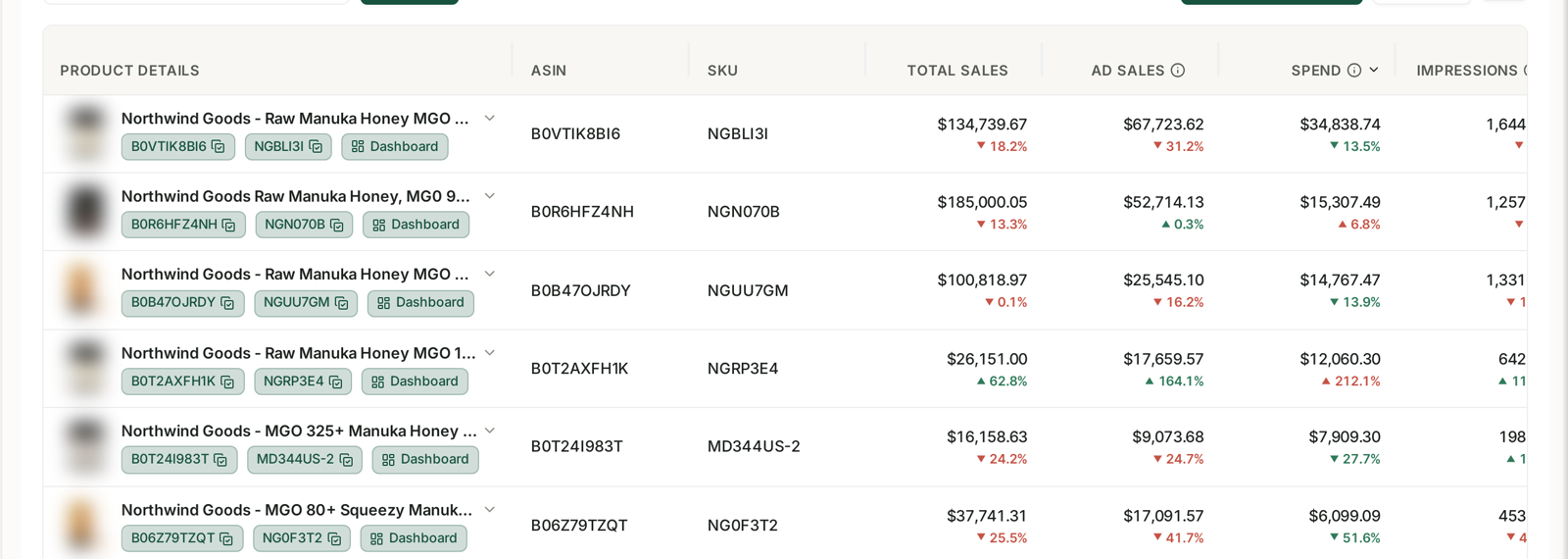
Sales and units by product — see Understanding Business Reports and Sales Performance: Which Products Carry the Business.
Related
- Where Your Margin Actually Goes — all five levers, sized.
- Negotiating Lower COGS — usually the largest one.
- Reimbursements, COGS and FBA Capacity — keeping cost data current.
- Inventory Placement: Split or Pay — the per-product freight decision behind the placement fee.