

Adding products is the obvious way to grow an Amazon brand, and it is usually the wrong first move.
A second product does not fix a first product that is under-ranked, under-priced or badly advertised — it just splits your attention and your cash across two problems instead of one.
Prefer to watch? One hundred and nineteen seconds on why you maximise what you have first, what high revenue on low reviews is telling you, and the four-listings rule that saves hours.
The precondition
Only start product research once your existing listings are genuinely maximised — in organic ranking, in sales, and in profitability.
That is a real test, not a feeling. If your current products still have obvious ceiling left, that ceiling is cheaper to reach than a new product launch, and far less risky. You already have the reviews, the rank and the sales history.
When every active product is optimised, the only remaining constraint on growth is having more things to sell. That is the moment this framework earns its place.
What you are actually looking for
The whole of product research reduces to one question: is there a market here I could realistically compete in?
Which, in practice, means finding markets where listings make good money on low review counts.
That single signal carries most of the weight. A listing turning over $50,000 a month with 150 reviews is telling you the market rewards a good offer rather than an entrenched position — and that in three months, that listing could be yours. A listing turning over the same money on 8,000 reviews is telling you the opposite.
A market worth entering
Several listings making $50k+ a month with under 200 reviews.
Average review count under 500 across listings making $25k+.
Few Amazon-owned or overseas-manufacturer-direct listings in the top results.
Room for a competitive offer at 40%+ margin.
Repeat purchase behaviour — anything eligible for Subscribe & Save has a second sale built in.
A market to walk away from
Revenue concentrated in one or two listings. That is a market with a winner, not an opening.
Multiple listings at 5,000+ reviews.
Recognisable brand names holding the top spots.
Many Amazon-owned or manufacturer-direct listings.
The single hardest rule to apply, and the most useful: if searching the main keyword returns more than four listings with over 5,000 reviews, walk away. Those four will hold the top organic positions almost permanently, and everything you do will be for fifth place.
The shape of the process
Five stages, narrowing hard at each one:
| Stage | What happens |
|---|---|
| 1 | Set up a scoring sheet so markets can be compared |
| 2 | Generate 50+ ideas across six research methods |
| 3 | Score them, take the top 15 |
| 4 | Deep-analyse those 15, cut to 7 |
| 5 | Define an offer and get real supplier costs, pick 1–3 |
The number that matters most is 50. Fifty ideas is the minimum, not the target. Most will fail on competition, margin or compliance, and the quality of your final choice is determined almost entirely by how many candidates it beat.
Being lazy at the generation stage is the most expensive shortcut available, because you cannot recover from it later — you can only choose the best of what you gathered.
Expectations, honestly
No process guarantees a winner. What a process does is raise the number of shots and improve the average quality of each one.
The framework's own track record makes the point: the same method produced 150 ideas in four weeks and two brands. One failed completely. The other reached $5M in revenue at 25% margin. That is roughly the distribution to expect, and it is why you do not bet everything on the first idea you like.
Where your existing account helps
You are not starting from nothing. Your current catalogue is data about what your customers buy and what sells alongside it.
What is bought with your products is one of the strongest signals for a next product, and it is in your own account rather than in any research tool. See Find Your Next Bundle and ASIN Purchase and Upsell Analysis.
What people search around your products tells you where adjacent demand sits. See Understanding Search Query Performance.
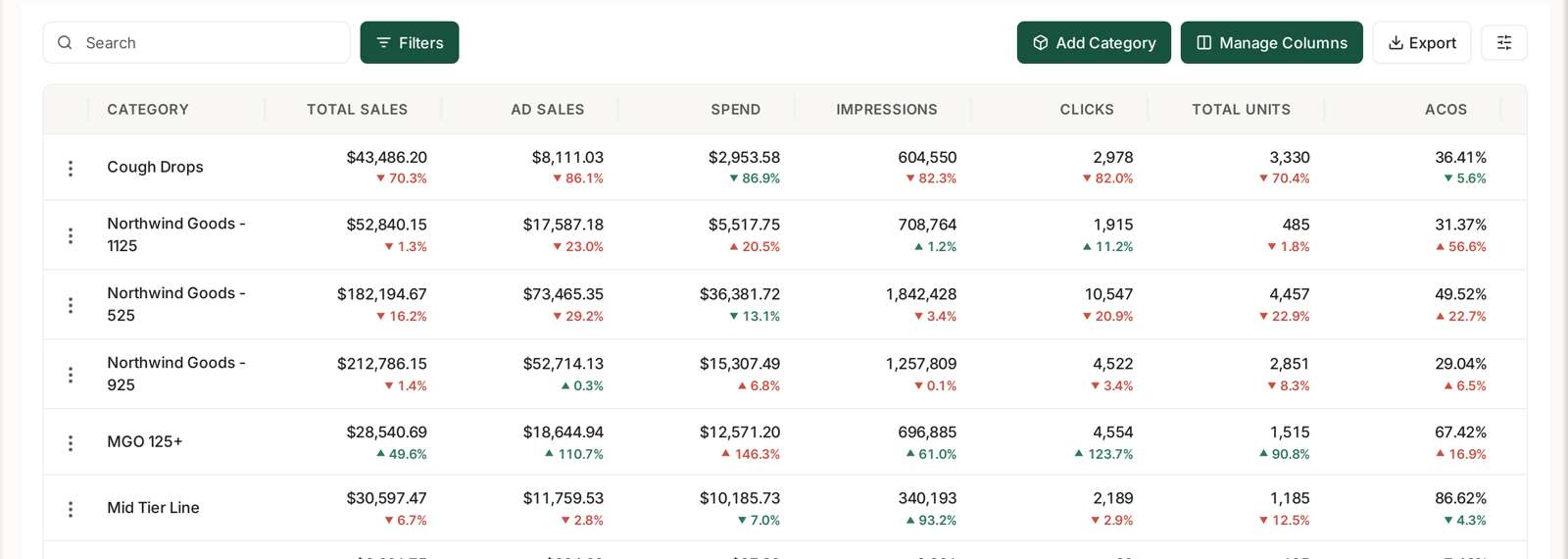
How your categories are performing tells you where you already have traction to build on. See Category Insights: Benchmarking Your Categories.
Related
- Six Ways to Find Product Candidates — generating the fifty.
- Scoring Product Opportunities — comparing markets on data rather than instinct.
- Designing the Offer — what you actually sell once you have picked a market.