

The DSP Campaigns screen does not look like the Sponsored Ads screens, and that is deliberate. It opens with a Conversion Funnel rather than a row of tiles, because display advertising is judged on the journey rather than on the click.
Prefer to watch? Sixty-four seconds on the funnel, and reading the stage rates.
The funnel
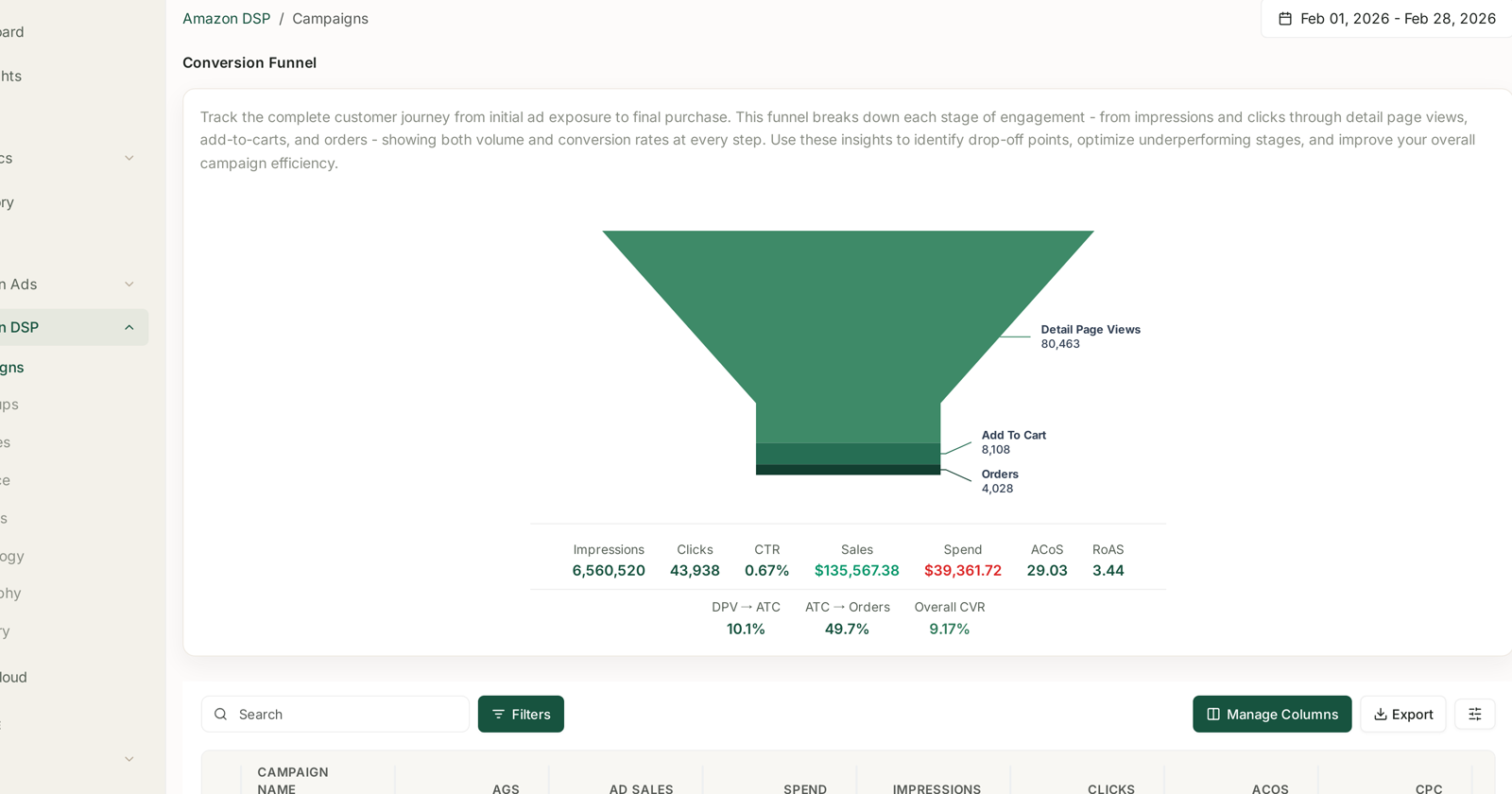
Three stages, with volume at each:
Detail Page Views → Add To Cart → Orders
Beneath it, the totals — Impressions, Clicks, CTR, Sales, Spend, ACoS and ROAS — and three conversion rates that are the point of the whole screen:
| Rate | What it measures |
|---|---|
| DPV → ATC | of people who viewed the page, how many added to cart |
| ATC → Orders | of those, how many bought |
| Overall CVR | the whole journey, end to end |
Why the stage rates matter more than the totals
A single ACoS figure tells you display was expensive. The stage rates tell you where it went wrong, and the two failures need opposite responses.
| Pattern | Diagnosis |
|---|---|
| DPV high, DPV→ATC low | you are buying the right volume and the wrong audience, or the detail page is not converting them |
| ATC high, ATC→Orders low | interest is real; price, availability or reviews are losing the sale |
| Both healthy, ACoS still poor | the targeting works — you are paying too much for it |
That last row is the one people misread. Good conversion with bad economics is a bidding problem, and cutting the campaign throws away targeting that was doing its job.
Why DSP should not be judged on ROAS alone
Display works higher in the funnel than Sponsored Products. It reaches people who were not searching for you, which means:
Attribution is 14 days, not 7. A DSP campaign judged after three days has eleven days left to be credited.
Some of its value lands elsewhere. Someone who sees a display ad and later searches your brand converts through Sponsored Brands. DSP created the demand; another channel is credited with the sale.
That is why detail page views is a headline number here and not on the Sponsored Ads screens — it captures interest that has not yet become a purchase, which is most of what display does.
To see the effect properly you need AMC: Path to Purchase shows which sequences convert, and Brand Keywords shows upper-funnel spend driving branded search. See Understanding AMC Cloud.
The table
Below the funnel, one row per DSP campaign — campaign name, AGS, ad sales, spend, impressions, clicks, ACoS and CPC. Standard Search, Filters, Manage Columns and Export.
Two behaviours differ from Sponsored Ads:
DSP uses ACTIVE and INACTIVE, not enabled and paused, and the default view shows ACTIVE only.
DSP is a separate connection. Having advertising connected does not give you DSP — see How to Connect Your Amazon Accounts. An empty DSP section usually means it was never connected rather than that nothing ran.
Reading it week by week
Daily display data is noisy, and the funnel compounds that — a small number of orders makes ATC→Orders swing wildly. Use Week for anything longer than a fortnight.
And do not compare DSP ACoS against Sponsored Products ACoS. Different windows, different job. See Why SP, SB and SD Numbers Don't Add Up.
Related
- DSP Metrics Explained: DPV, Add to Cart, NTB Purchases, CPA — the columns unique to display.
- DSP Technology: Device and Supply Performance — where those impressions landed.
- Analyzing Your DSP Performance — the section overview.