

The relaunch process is long, and every step exists for a reason. The thing that makes it work is not any individual tactic — it is that each step is gated on a specific data point.
Data looks good → proceed.
Data does not → fix the problem, or move to different keywords.
Skipping a gate is the single most common reason a relaunch fails, because you end up spending real money pushing a keyword the data had already told you not to.
Prefer to watch? One hundred and seventy-eight seconds on the data point that gates each step, why gating beats tactics, and why a failed gate costs you nothing.
What you are actually optimising for
Amazon ranks the listings that make its customers happiest, which it reads through three signals:
Conversion rate.
Click-through rate.
Sales velocity.
So the relaunch maximises all three on a chosen set of keywords, which raises organic rank, which drives organic sales, which is where the profit is — see What a Relaunch Is.
The four steps, and what gates each one
Step 1: keyword research
Find keywords where your conversion rate, your click-through rate, or both, beat the average for that keyword.
The sources are Search Query Performance — which gives you the keyword's own averages — and the search term report from advertising, which gives you yours. See Keyword Research from Search Query Performance.
The gate: you are above the keyword average on at least one of the two.
Because that is the evidence that shoppers respond to your product on that term. Push sales velocity on a keyword where you already convert well and you climb. Push velocity where you convert badly and you buy expensive traffic that does not stick.
Step 2: group and prioritise
Group the keywords, then rank the groups by likelihood of success — see Grouping and Prioritising Keywords.
The gate: the group you have chosen is genuinely the strongest available, not simply the biggest.
Step 3: prepare the launch
Improve CTR, conversion and velocity on those specific keywords before you spend — images, content, price, deals — see Preparing a Launch.
The gate: the preparation has actually moved the metrics.
Launching before this step has landed means paying to send traffic at a listing you already knew could be better.
Step 4: launch
Run the ranking campaigns and push the chosen keyword group — see Running a Launch.
The gate: daily checks on spend, placement and conversion, with defined responses.
Then move to the next keyword group, and the next, until you have covered your niche — see The Long-Term Ranking Plan.
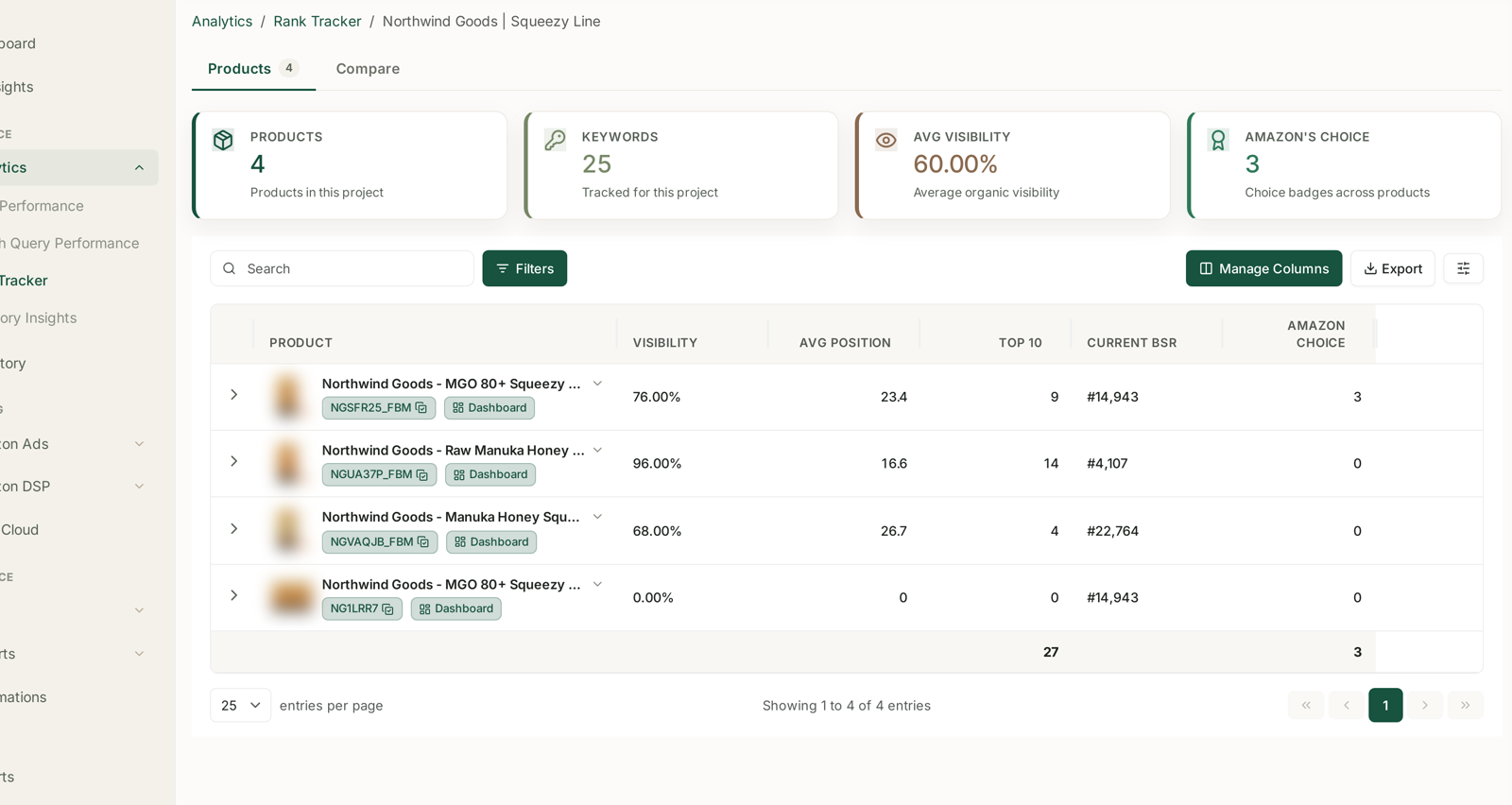
Every gate in this process compares one of your metrics against the keyword's own average, which means the whole framework depends on having both numbers per keyword — see Understanding Search Query Performance. Reconstructing that comparison by hand from separate reports is why the gates get skipped: not because people disagree with them, but because checking is expensive.
Why gating matters more than the tactics
None of the individual tactics here are secret. Better images, better content, targeted campaigns.
What makes the process reliable is that it refuses to proceed on bad data.
An ungated version of the same work — pick a keyword you like, improve the listing, spend hard — fails most of the time, and it fails expensively, because failure is only visible after the money is spent.
A gated version fails at step 1, for free.
This works on hard keywords
The process is used across hundreds of products in some of the most competitive categories on Amazon — including terms driving hundreds of thousands of searches a month, taken into the top ten, top six, top three.
The competitiveness of the keyword is not what decides the outcome. The data at each gate is.
Follow the steps exactly
Do not skip steps, and do not reorder them.
Each gate depends on the previous one having been passed. Preparing a launch for a keyword group you have not validated is preparing for the wrong thing; launching before preparation has landed spends money on a listing that was about to improve.
Common mistakes
Choosing keywords by search volume rather than by where you beat the average.
Skipping step 3 and launching on the current listing.
Proceeding through a gate the data failed, because the keyword is attractive.
Launching several groups at once, so no gate can be read cleanly.
Treating a failed gate as a setback. It is the process working, and it cost you nothing.
Related
- What a Relaunch Is — the mechanism underneath.
- Keyword Research from Search Query Performance — step 1 in detail.
- Running a Launch — step 4 in detail.