

Price is the top of your funnel. It is the first thing a shopper registers when they skim a search results page, alongside the main image and the review count — and they are sorting your listing into "cheap" or "expensive" before they have read a word of it.
Which is why a price test can change a product's trajectory more than almost anything else you can do in a week.
Prefer to watch? One hundred and sixty seconds on the three signals that justify a price test, testing safely before committing, and reading the result on rank and units rather than margin.
When to test a lower price
Gross margin above 45% — you may simply be overpriced, and that costs you conversion.
High TACOS — above 20–25% is high; above 25% is very high.
Conversion rate low against your competitors.
All three together is a strong signal. High margin, high TACOS and weak conversion is close to a diagnosis.
And if none of them are true, leave it. Good conversion, TACOS in range, ACOS near breakeven — the price is not your problem.
Do not run this in Q4. Peak traffic makes the result unreadable.
The margin bands
Across a large number of brands and products:
| Gross margin before PPC | Reading |
|---|---|
| 36–42% | ideal |
| 32–35% and 43–45% | borderline |
| above 45% | high — worth testing a lower price |
| below 32% | red flag |
True for about 90% of products. Some categories sit structurally higher — supplements commonly run 45–55%.
Test the price before you change the price
Four ways, in the order you should try them.
1. Prime Exclusive Discount. Create a discount to the price you are considering. It only applies to Prime members, and it does not reset your lowest-price-in-30-days, which is what deal eligibility is measured against. This is the safest first test.
2. A Lightning Deal at the target price. You get the deal badge as well, so read the result carefully.
But this only tells you something if you already sell in volume. At 10–50 units a day a Lightning Deal moves little either way. At 100–300 a day it moves a lot, and a deal that produces an unremarkable lift at your target price is a strong signal the price alone will not work.
3. A coupon to bridge the gap. Weakest of the four — a coupon reads as marketing rather than as price, and it does not shift perception the same way.
4. Lower the price directly. Only once one of the above has shown something.
Measure it properly
Compare the 7 days before against the 7 days after. Track:
Units sold.
Dollar profit.
Percentage margin.
CTR and CVR — from Top of Search only.
Organic rank on your core keywords.
Top of Search only matters more than it sounds. It is a single placement, so the conversion rate it reports is comparable week to week. Blended CTR and CVR across all placements moves for reasons that have nothing to do with your price.
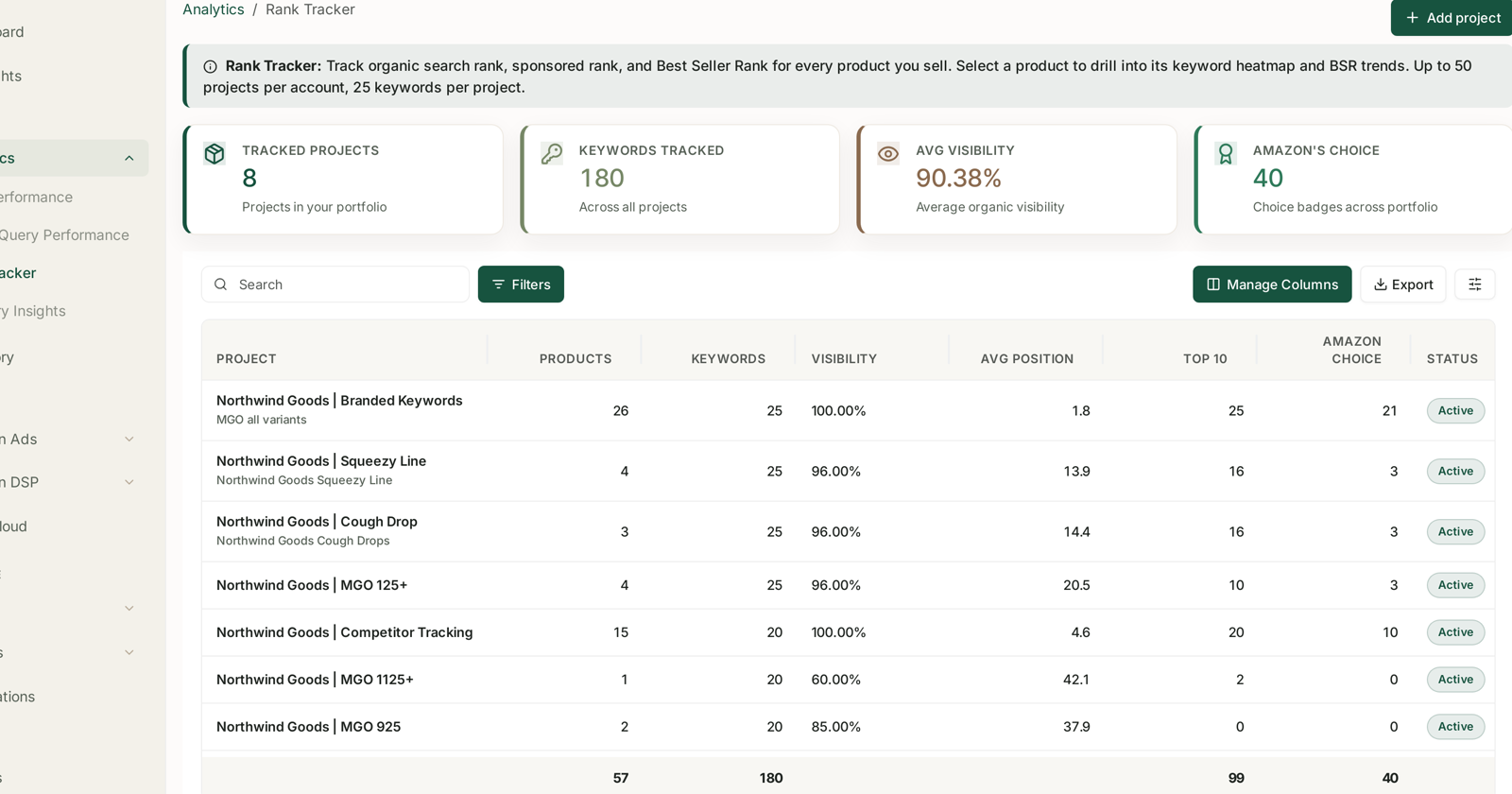
Holding units, profit, margin, Top of Search CTR and CVR, and organic rank side by side across the two weeks is the whole test — see Reading Organic and Sponsored Rank and Understanding Search Query Performance. Rebuilding it from four separate exports into a sheet every week is how price tests stop getting run.
Reading the result
The win
Units up. Dollar profit up. Percentage margin roughly flat or down 1–3 points. CTR and CVR up. Organic rank trending green.
Dropping from a 46% margin to 36% while sales rise 50% and rank improves is a strong win — even though the margin percentage looks worse.
Because the percentage is not the point. More units at a better rank means more organic sales, which means less reliance on PPC, which means TACOS and ACOS fall as well.
And seven days is only the start. If the core metrics are trending up, push. By day 60 the organic position has stabilised somewhere much higher, and the product may be selling double or triple what it was.
The ambiguous case
CVR and rank up, but you are making less money.
Give it another week or two. Those two metrics are the leading indicators; profit follows once the higher rank has settled.
The failure
Metrics barely move and profit falls. Revert, and try a different price point.
Revert fast. If three days of data look clearly bad, do not wait out the week.
Test fast, and keep what works
Monitor daily during the test, even though you only record the weekly comparison.
Revert the ones that fail. Keep the ones that work. Then test again on top of the winner.
Price increases can go wrong much faster than price decreases — a rise can cut sales in half overnight, where a drop rarely does anything sudden. Watch a rise more closely than a cut.
What you are actually buying
Not a better margin percentage. A better position.
Higher CTR and CVR mean higher organic rank, which means more organic sales, which means less spend on advertising for the same revenue.
That is the flywheel, and price is the cheapest place to start it — see Why a Rating Drop Costs More Than It Looks for the same mechanism running in reverse.
Common mistakes
Testing price when conversion and TACOS are already fine.
Going straight to a direct price cut instead of testing with a Prime Exclusive Discount first.
Reading a Lightning Deal result on a low-volume product, where it means nothing.
Using blended CTR and CVR instead of Top of Search only.
Judging on margin percentage rather than dollar profit, rank and units.
Reverting a working test too early, before rank has had time to settle.
Running it in Q4.
Related
- Pricing and Gross Margin — the bands this test works against.
- Pricing a New Product for Conversion — the same lever at launch.
- Amazon Deals: Lightning and Best — the deal mechanics used as a test.