

Who runs your advertising is one of the more consequential decisions you will make about the brand, and it is usually decided on cost — which is the wrong axis entirely.
Here is the honest case on both sides.
Prefer to watch? One hundred and sixty-four seconds on why speed of execution compounds, how many hours an agency account really gets, and the performance gap that is the real cost.
The case for in-house
Speed of execution
This is the largest single advantage, and it compounds.
Stock changes. Running low or back in stock — you adjust spend the same hour instead of waiting.
Deals and promotions. Budget adjusted in real time to protect profit through a Lightning or Best Deal.
Big sales days. Prime Day and Black Friday reward hourly attention. Raising budgets on the campaigns that are working, while they are working, is how record days actually happen.
Target TACOS changes applied the same day.
New campaign types tested when you think of them.
Performance problems investigated the moment you notice them.
Each of these is small on its own. Across a year they are most of the gap between adequate advertising and excellent advertising.
An agency can do all of it. It just happens more slowly — and speed here is not a convenience, it is the return.
Alignment with the actual business
Your team knows the brand, the products, the customers, the competitors, the keywords and what has already been tried. That context is not transferable in an onboarding call.
And an agency, structurally, optimises advertising performance. You optimise business profit. Those are not the same objective. Most agencies now track profit, but their processes are not built to maximise it — see Setting Target TACOS per Product.
In-house also means tailored process. An agency runs a standardised system across every client, by design. That is how it stays economic — and it is why the last increment of performance is hard to buy.
The arithmetic of attention
An account manager typically handles 6–12 accounts.
Take 8 accounts across a 45-hour week — a conservative assumption. That is 5.6 hours per account, and closer to 5 after breaks.
Five hours a week is not enough for full advertising management on a serious account. It produces something; it does not produce excellence.
And the limited time forces automation — standard rules applied across every account. That is genuinely good at getting you to about 7 out of 10. It is not how you get past it.
Then ask who is actually doing the work. Best case a Western-based manager; often an offshore assistant. Consider that alongside five hours a week when you judge what you are buying.
The case for an agency
Expertise you do not have yet
Advertising rewards depth. Overbidding, poor targeting, ignoring new ad formats — these are expensive mistakes and easy to make.
Reaching a genuinely expert level takes real time, and Amazon keeps changing, so it takes ongoing attention rather than a one-off effort.
Time — the strongest argument
Managing this in-house consumes a meaningful part of every week, even with a clean system.
And it grows. More products, more campaigns, more time.
That time comes out of inventory planning, product development, and new marketplaces — which are not small things to sacrifice.
If you genuinely do not have the time to learn this and run it, an agency is a real solution to a real problem.
How to decide
The honest answer is that it depends on you — your time, your comfort with numbers, and what else is competing for your attention.
But be clear about what the cost actually is.
Not the fee. An agency at $2,500–3,000 a month is $30–36k a year, and that is the number everyone fixates on.
The real cost is the performance gap. If you spend $50k a month on ads and your ACOS is two points worse than it could be, that is $12k a year on its own — before counting the growth you did not get.
Which cuts both ways. An agency that outperforms what you would do yourself is worth well above its fee. One that underperforms costs far more than it charges.
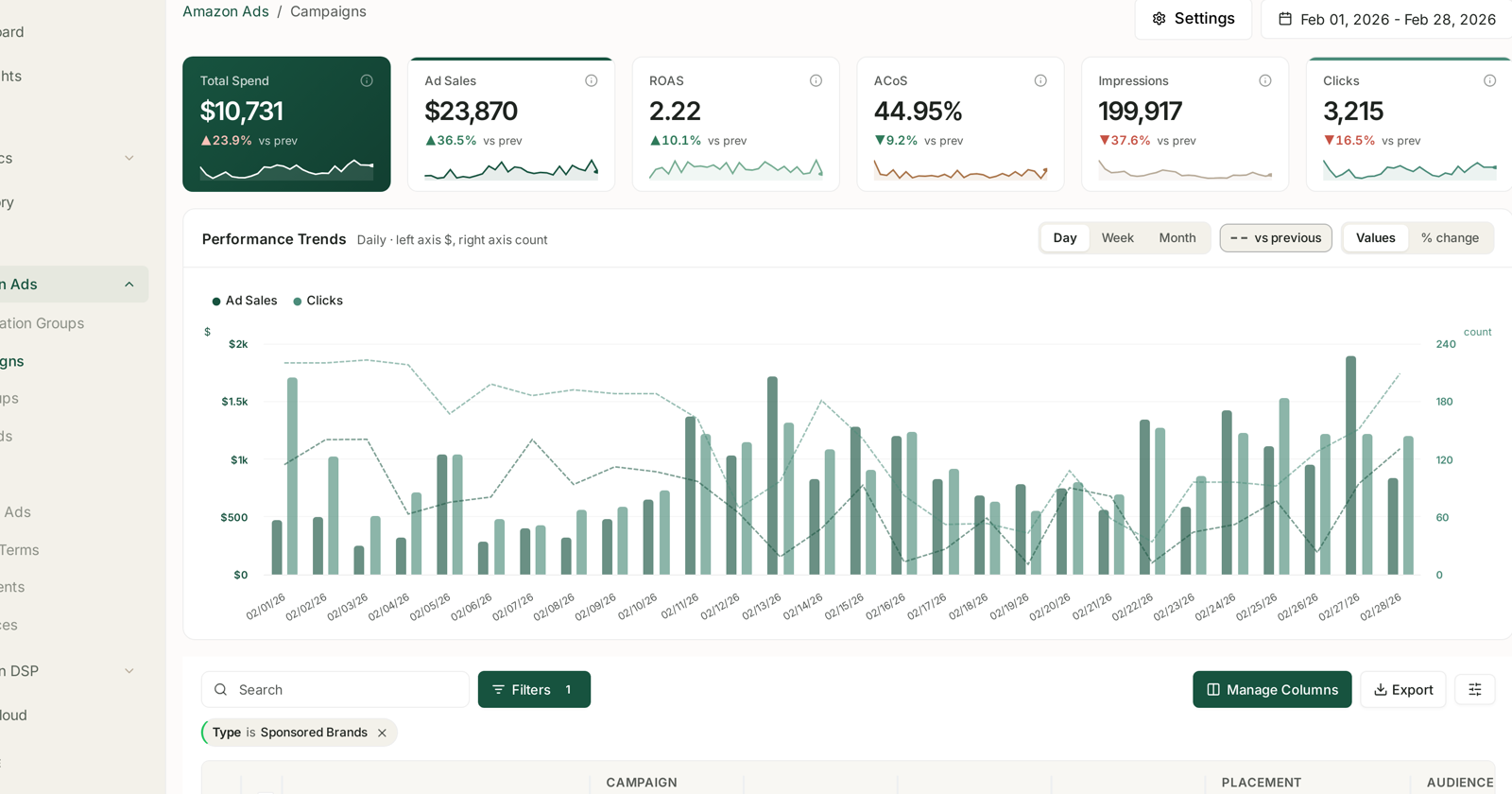
Knowing which side of that line you are on requires measuring performance rather than assuming it — see Score Your PPC Performance. That assessment is the same whether the work is done in-house or bought in.
The pattern worth knowing
Among successful Amazon brands, the large majority run advertising in-house — and they treat it as a skill they have deliberately built.
There are real exceptions, including very large and very well-run brands using agencies successfully. But the pattern is strong enough to be worth weighing.
And most of the argument for in-house rests on time and expertise being scarce. Both are addressable: a defined process removes most of the expertise problem, and the right tooling removes most of the time problem — which is what the rest of this training is for. See The Brand Manager's Calendar.
If you take it in-house
Give it six to nine months. Three months in you will be markedly better than on day one; by month seven the difference is substantial.
Follow a defined process from the start rather than improvising — see The Nine-Report PPC Routine.
And measure the handover honestly. Score performance before you change anything, so you can tell whether the switch worked.
Common mistakes
Deciding on the fee rather than on the performance gap.
Taking it in-house without allocating the time, and doing it badly.
Assuming an agency's standard process will beat a well-run in-house one on a mature account.
Switching without a baseline, so you never learn whether it helped.
Underestimating what in-house costs you in inventory and product work.
Related
- Score Your PPC Performance — the baseline this decision needs.
- The Brand Manager's Calendar — what in-house actually costs in hours.
- What Amazon PPC Is Actually For — the objective both options are serving.