

Amazon DSP → Geography maps your display performance by country, so you can see where impressions are landing and whether that matches where you sell.
Prefer to watch? Fifty-seven seconds on changing the metric, and impressions where you do not ship.
Country Performance
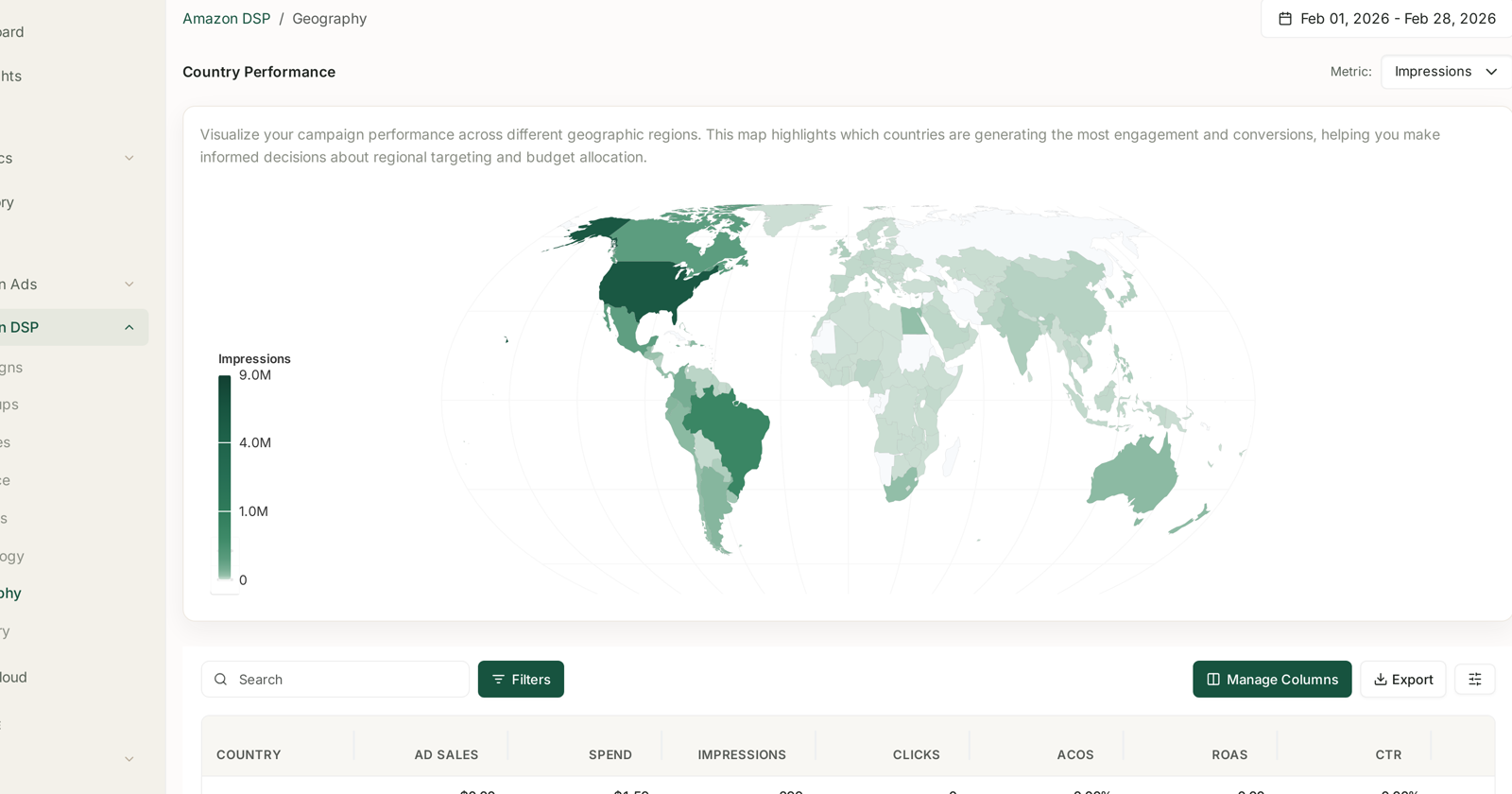
A world map shaded by country, with a Metric selector in the top right and a scale legend showing the range.
Below it, the same data as a table: Country, Ad Sales, Spend, Impressions, Clicks, ACoS, ROAS, CTR, with the usual Search, Filters, Manage Columns and Export.
Change the metric — the map defaults to Impressions
Impressions is the least useful geographic measure, and it is what the map opens on.
A map shaded by impressions shows you where inventory was cheap and plentiful. It tells you almost nothing about whether those impressions did anything.
Switch to spend, then to sales, then to a rate. The finding is the country that is dark on the first map and pale on the second.
The pattern to look for
Impressions concentrated somewhere you do not ship.
Display inventory is bought programmatically and can reach well beyond your selling geography. A country with meaningful impressions and effectively no sales is either:
- A delivery problem — you are paying to reach people who cannot buy from you, and the fix is geographic targeting in Amazon's DSP console.
- Or expected — expats, travellers, and cross-border shoppers exist, and a small tail is normal.
The distinction is scale. A thin spread across many countries is normal. A single non-selling country taking a visible share of spend is worth acting on.
Reading it honestly
A big country is not the same as a good country. The United States will dominate almost any map on volume. Compare countries on rates, not totals, or you will only ever conclude that your largest market is your largest market.
Small countries are noisy. A country with a handful of orders can show a spectacular or terrible ROAS, and neither means anything. Check the click and order counts before believing a rate — the same volume-threshold discipline the rule engine uses.
Unallocated rows are excluded from the geography breakdown, so the country totals may not reconcile exactly with your campaign totals. That is by design rather than a fault.
What it is good for
Sense-checking targeting. The quickest way to notice that a campaign is reaching further than intended.
Marketplace alignment. If you sell in several marketplaces, this is where you see whether display spend matches where your listings actually are.
Nothing is actionable here. DSP reporting in TrackIQ is read-only — geographic targeting changes happen in Amazon's DSP console. This screen tells you what to change.
Related
- DSP Technology — the same data split by device instead of country.
- DSP Campaigns — the funnel and campaign table.
- Marketplaces and Currency — where your listings actually are.