

In peak season there is far more traffic than your existing campaigns are structured to capture, and it does not behave the way it does in March. Running five auto campaigns per product at different bids is a way of buying that traffic without having to predict which bid is right.
You are not optimising. You are sampling — then killing the losers fast and tripling down on the winners.
Prefer to watch? One hundred and seventy seconds on building the bid ladder from your average CPC, the daily kill-and-scale rules, and watching TACOS rather than ACOS alone.
Who this is for
Your best-selling products only, and specifically those that do at least 1.5× their normal sales in peak.
Not the whole catalogue. This tactic needs daily attention, and spreading it across twenty products means none of them gets the daily attention it depends on.
Step 1: launch five auto campaigns per product
Five campaigns, identical except the bid.
Set the bid ladder from your current average CPC. The bids sit below it, spaced evenly:
| Your average CPC | Bid ladder |
|---|---|
| $1.80 | $0.75 / $0.80 / $0.85 / $0.90 / $0.95 |
| $1.00 | $0.35 / $0.40 / $0.45 / $0.50 / $0.55 |
All four targeting groups on: close match, loose match, substitutes, complements.
Close match bid 15–20% higher than the other three.
Top of Search modifier 30%.
Budget $10–30 per campaign.
The ladder is the mechanism. You do not know which bid clears in a market where everyone's CPC is inflated, so you buy five answers and let the data pick.
Step 2: the first seven days
Checked daily. Not weekly — daily. Peak season compresses everything, and a campaign wasting money for six days has wasted most of its season.
Three checks:
1. Is it spending? Under 75% of budget → raise under-clicked target bids 7%, or raise Top of Search 15%.
2. What is bleeding? A target with 15+ clicks and no sales → pause the target. A campaign with bad ACOS or heavy clicks and no sales → pause the campaign.
3. What is working? A campaign at good ACOS → triple the budget. Raise bids on strong targets 5–7%. Raise placement bids where placements perform.
Define good and bad against breakeven, not by feel
Bad ACOS = 15% above your breakeven.
Good ACOS = at least 5% below your breakeven.
Anything between the two is neither — leave it alone and let it run another few days.
One exception on placements: do not raise the Product pages bid, even when it looks like it is performing. Detail-page traffic in peak converts differently and scales badly.
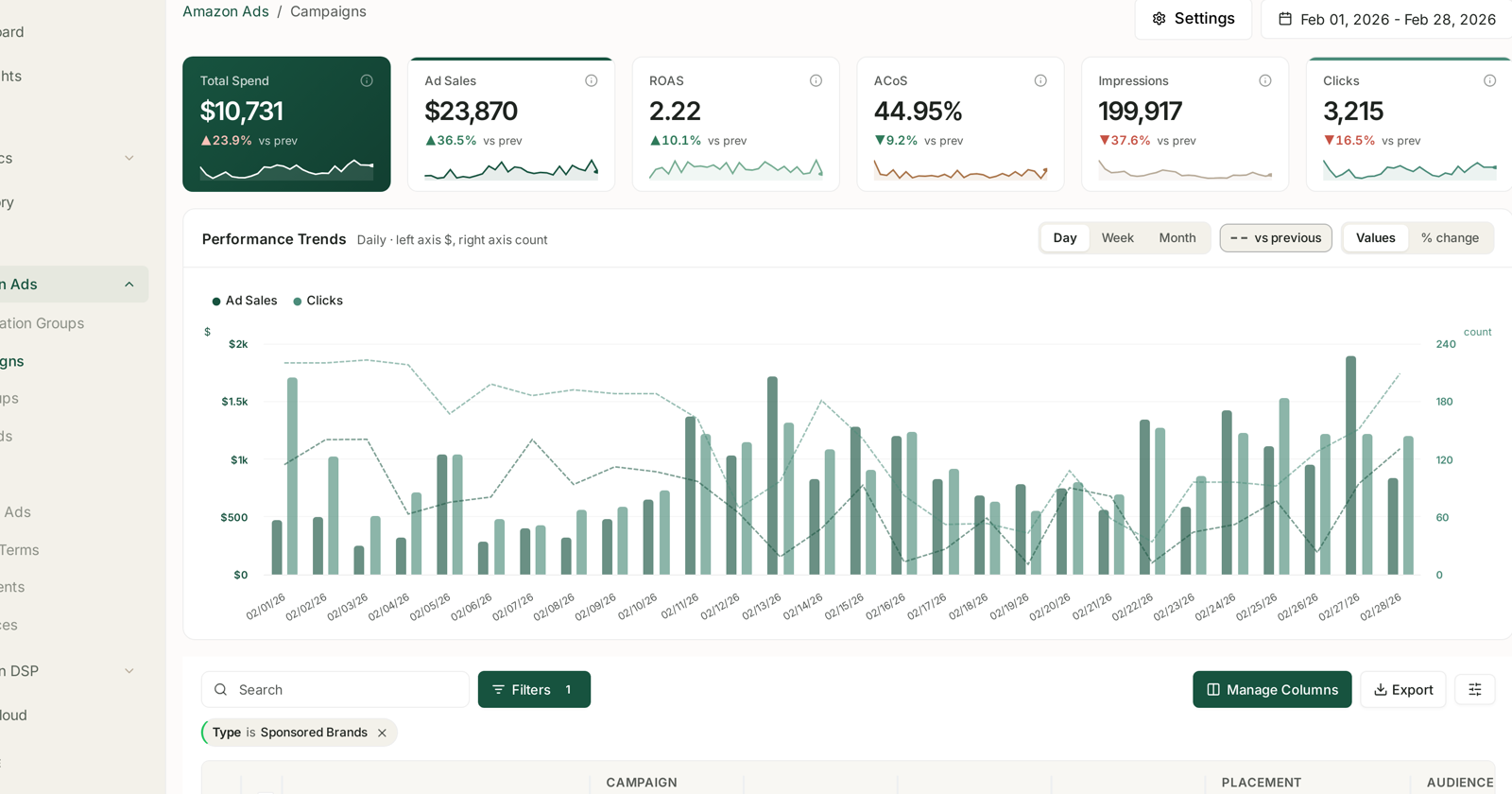
Ranking every campaign against its breakeven daily is what makes a five-campaign-per-product structure manageable — see Rule-Based Optimization: Automating Bids and Budgets. Twenty-five auto campaigns across five products, checked by hand every morning through Q4, is a full-time job.
Step 3: expand what is working
Once the first five show real performance, launch five more at different bids. Same optimisation rules.
Then launch a third set with dynamic bids up-and-down, to test whether letting Amazon raise bids improves things. In peak it often does — but test it rather than assuming it.
Then roll the whole tactic out to additional products in the portfolio.
The sequence matters. Expand only after the first set proves itself on this product, in this season. Peak behaves differently every year.
Step 4: keep reallocating
Profitable and hitting its budget cap → raise the budget.
High ACOS → cut the budget or pause.
Move the money from the second group to the first, continuously.
And if product TACOS is where you want it and budget is available, create more auto campaigns. There is no natural limit here other than TACOS and attention.
Watch TACOS daily, not ACOS alone. ACOS tells you whether a campaign is efficient; TACOS tells you whether the whole product is still profitable while you scale — see Setting Target TACOS per Product.
Why it works
Auto campaigns find search terms your manual campaigns do not have, and peak season brings shoppers using language your keyword research never saw.
Five bids per product means you are not betting on one guess about what a click is worth in an inflated market.
And killing losers on a 15-click rule means the failures are cheap while the winners get tripled.
It is deliberately a volume strategy. Most of the campaigns will be cut. That is the design, not a failure of it.
Common mistakes
Running it on average products instead of the ones with genuine peak uplift.
Checking weekly. The whole method depends on a daily cycle.
Defining good and bad ACOS by feel rather than against breakeven.
Scaling budgets without watching TACOS, and growing revenue into a loss.
Raising Product pages placement bids because they look good in week one.
Expanding to more products before the first set has proven itself.
Leaving it running after peak. These bids and budgets are built for inflated traffic; in January they are simply overspending.
Related
- Easy-Win Campaigns — the year-round version of buying cheap traffic.
- Prepare for Prime Day: Budget Rules and Inventory Cover — the same discipline at a shorter event.
- Setting Target TACOS per Product — the ceiling all this scaling runs against.