

Two questions about an advertising account can be answered without knowing anything about the products, the category or the margin:
What share of spend is going to Sponsored Products? and what share of that is going to Top of Search?
Both have benchmarks. Both are usually wrong in accounts that have grown without a plan, and both change what your existing budget buys without needing any more of it.
Prefer to watch? One hundred and twenty-six seconds on why Sponsored Products should dominate, why Top of Search should take the majority, and the multiplier check almost nobody runs.
Ad type mix: Sponsored Products should dominate
The benchmark: Sponsored Products should be 85–90% of sponsored spend. 80% is the floor.
The reason is rank. Of the sponsored ad types, SP is the one most directly tied to keyword-level organic position — it targets a search, appears in the results for that search, and its sales feed the velocity that decides where you rank organically for it.
Sponsored Brands and Sponsored Display do valuable work, but they do not move keyword rank the same way. SB sends traffic to a storefront or a multi-product page, so the keyword-to-product signal is diluted. SD is not keyword-targeted at all.
So an account spending 40% of its budget on SB and SD is buying sales without buying rank. It may look efficient. It is not compounding.
What "wrong" usually looks like: SB creeping up because the banners are satisfying to look at and their reported sales are flattered by a 14-day attribution window, while SP is capped by budgets nobody has revisited.
Reading it: in Amazon Ads → Campaigns, group by ad type and compare spend. One screen, one date range, no export.
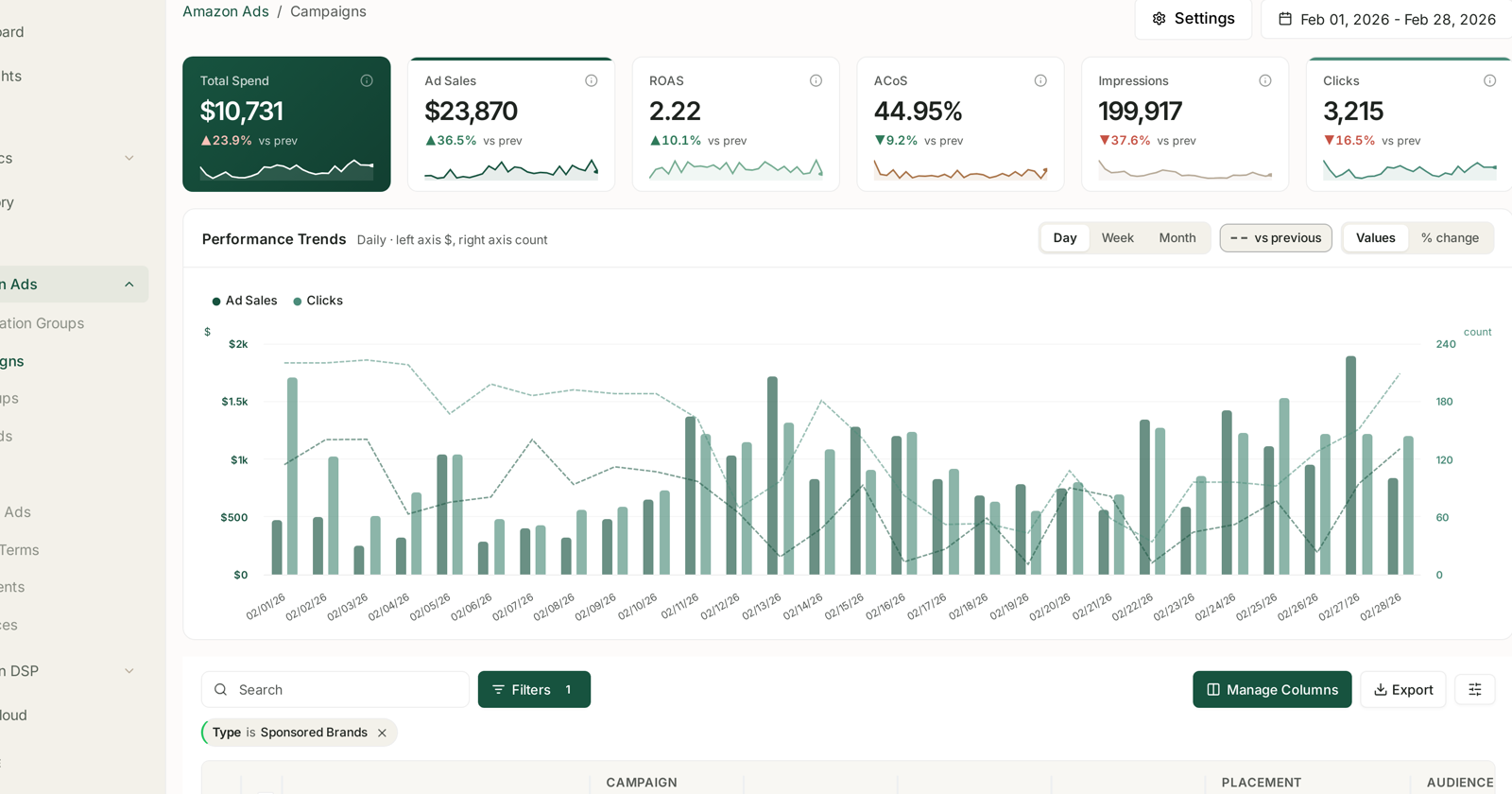
Before you rebalance, do not simply add the ad types together and treat the total as truth. They use different attribution windows and one shopper can touch several ads. See Why Sponsored Products, Brands and Display Numbers Do Not Simply Add Up.
Placement mix: Top of Search should take the majority
The benchmark: Top of Search should be 60% or more of Sponsored Products spend.
Sponsored Products appears in three places, and they behave like three different products:
| Placement | What it is | Typically |
|---|---|---|
| Top of Search | the first row of results | highest CVR, highest CPC, drives rank |
| Rest of Search | further down the results page | moderate everything |
| Product Pages | on competitors' detail pages | lowest CVR, cheapest clicks |
Top of Search converts best because intent is highest there, and it is where the sales velocity that moves organic rank actually happens. An account with most of its SP spend on Product Pages is buying the cheapest clicks rather than the most valuable ones.
Below 60% is a signal to investigate, not an automatic fault — some categories genuinely reward product-page conquesting. But it should be a decision, not an accident.
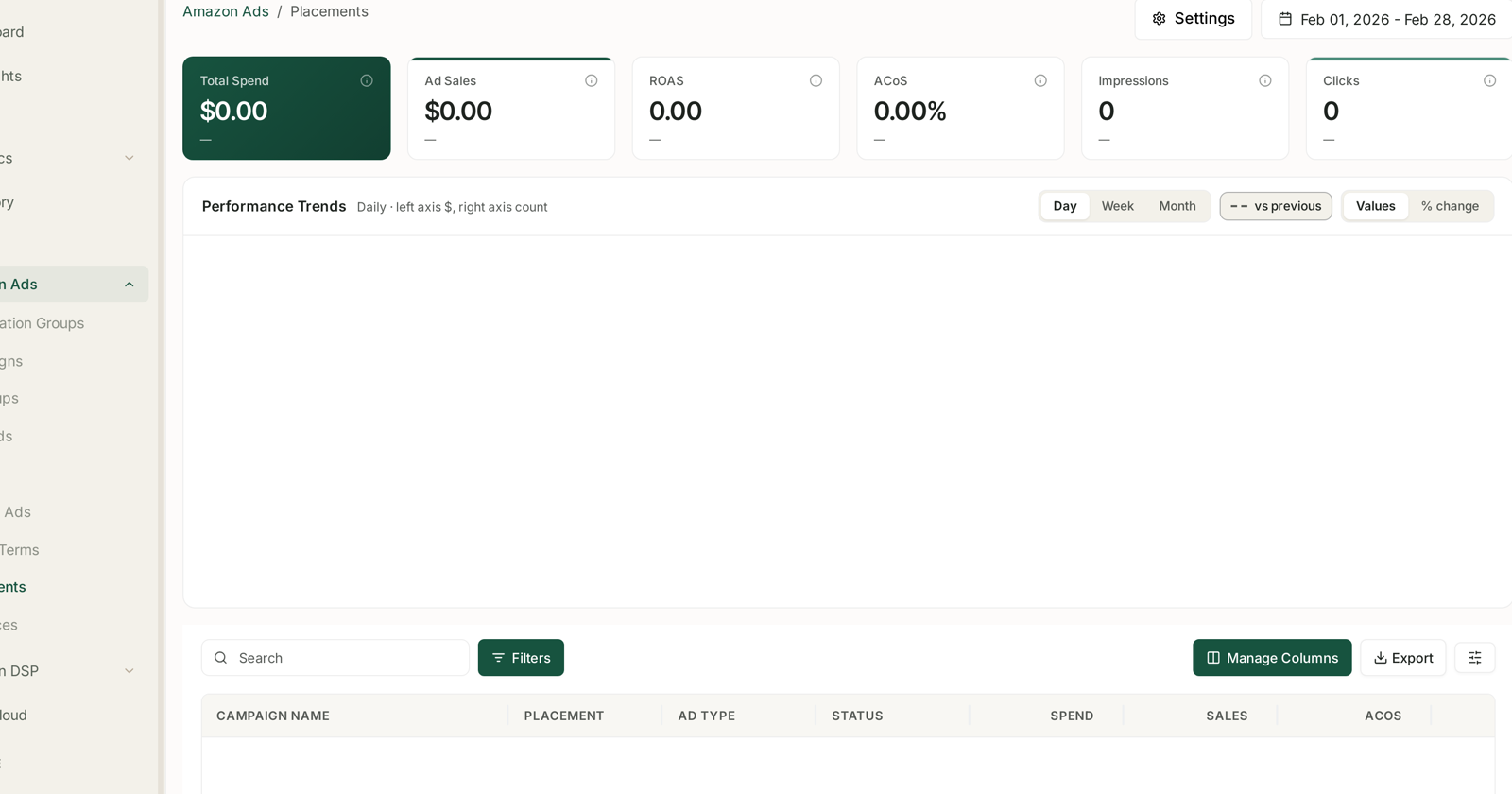
The related check: do the bids match the performance?
This is the third question, and it catches a specific, common error.
Placement multipliers raise your bid for a given placement. The check is simply: does the placement getting the biggest multiplier also have the best performance?
Surprisingly often it does not. A campaign carries a +50% Top of Search multiplier set during a launch eighteen months ago, while Top of Search has since become its worst-converting placement. Nobody looked, because nothing broke loudly.
Focus on the top-spending campaigns first. A mis-set multiplier on a campaign spending £40 a month is not worth the attention; the same error on your largest campaign is.
And the least-performing placement should be getting the least spend. If it is not, the multipliers are working against you.
The full routine is Audit Your Placement Multipliers.
Where the multipliers are set
Placement adjustments are set at campaign creation and editable afterwards. Amazon offers adjustments for top of search (first page), rest of search and product pages, and more recently by audience as well.
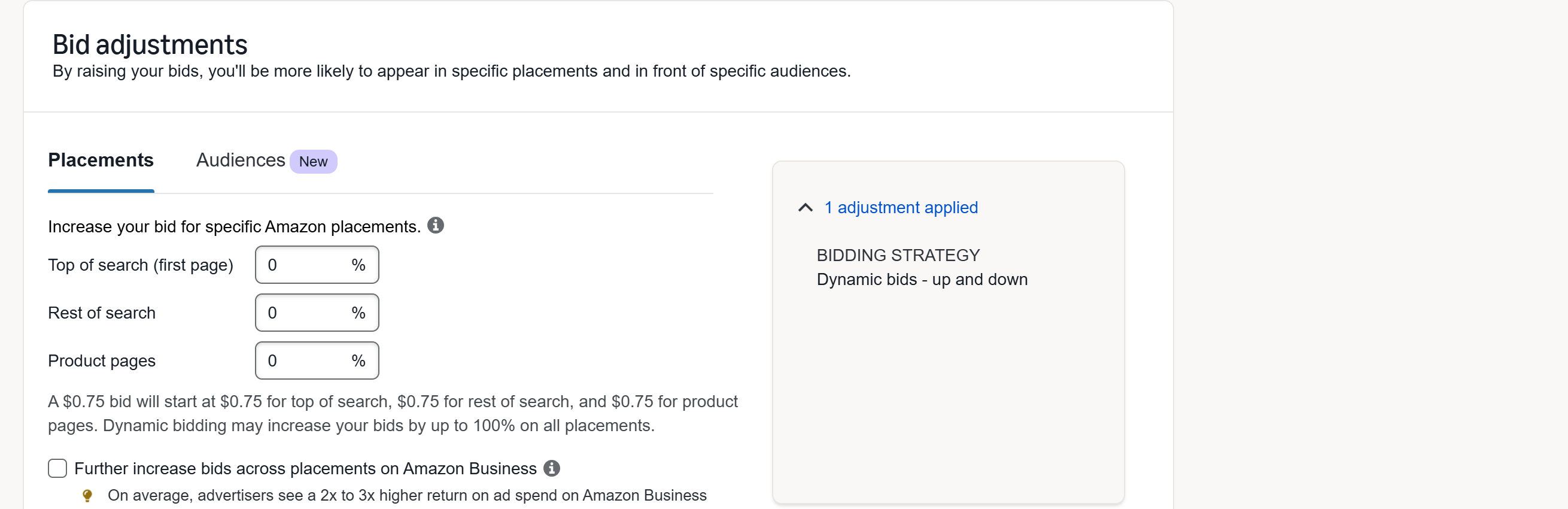
Leave them at zero on a new campaign. You cannot set a sensible multiplier before you have data, and you will have data in a fortnight. See Create a Sponsored Products Campaign.
Fixing the mix
Do not move budget in one step. These are large structural shifts and the account needs time to re-equilibrate.
Raise SP budgets before cutting SB and SD. If SP campaigns are budget-capped, the extra spend has somewhere useful to go immediately. Cutting first just reduces total spend.
Then trim the ad types that are over-weighted, starting with anything bought on an impression-share or reach basis, which is the least measurable spend in the account.
Move placement spend with multipliers, not budgets. Raising the Top of Search multiplier shifts the mix within a campaign; changing budgets shifts it between campaigns, which is a blunter instrument.
Re-measure after a fortnight. Attribution needs to land before the new mix means anything.
Common mistakes
Chasing the cheapest clicks. Product Pages will always look cheap per click and rarely wins on value per click.
Rebalancing on last-click ACoS alone. SB and SD reach people earlier, and last-click under-credits both. Cut them on mix, not on ACoS.
Setting multipliers from a hunch. They should follow measured placement performance on that campaign.
Fixing the mix while bleeders are still running. Rebalancing an account that is leaking just redistributes the leak. Run The Bleeder Reports first.
Related
- Score Your PPC Performance — where these benchmarks sit in the wider score.
- Placements: Top of Search, Rest of Search and Product Pages — the screen, in full.
- Audit Your Placement Multipliers — the bid-versus-performance check, step by step.
- Placement Bid Optimisation — the weekly bid-level version of the same question.
- The Nine-Report PPC Routine — the schedule these monthly reports belong to.
- Scaling Profit Campaigns — growing spend once the mix is right.